
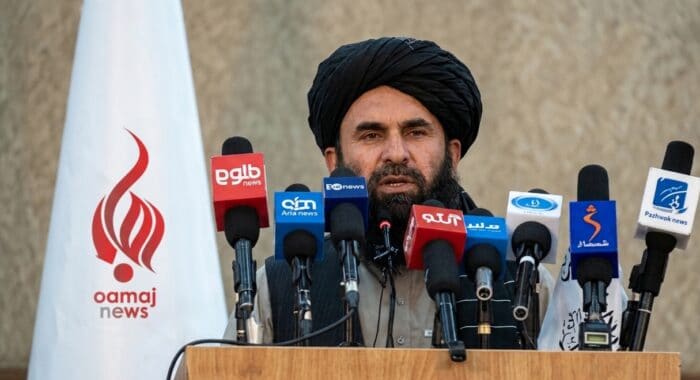
A storm of political and military criticism has erupted following remarks by Taliban-appointed military chief Fasihuddin Fitrat, who reportedly claimed during a gathering attended by approximately 1,000 people that the armed resistance against the Taliban regime in Afghanistan is not Afghan in origin.
The statement has drawn a forceful response from former Afghan military generals and officials associated with the resistance movements, who have categorically rejected what they describe as an attempt to deny the Afghan identity of those opposing Taliban rule and to portray an indigenous Afghan struggle as a foreign conspiracy.
In a pointed response, former Afghan military officials raised a fundamental question: Are Sami Sadat and Yasin Zia from Lahore’s Bhati Gate? The question, they argue, exposes the contradiction at the heart of Fitrat’s assertion. Both men are prominent former Afghan military figures with established roots in Afghanistan.
Sami Sadat hails from Khair Khana, Kabul. He previously commanded the Afghan National Army’s 215th Corps and is associated with the Afghan United Front.
Similarly, Yasin Zia was born in Shakardara district of Kabul. He served as Afghanistan’s former Chief of General Staff and Acting Minister of Defence and currently leads the Afghanistan Freedom Front.
Former Afghan officials have questioned how individuals born and raised in Kabul, who served their country in its highest military and defence positions, can suddenly be portrayed as foreigners simply because they oppose the Taliban’s rule.
They maintain that political disagreement with the Taliban leadership does not strip Afghan citizens of their nationality, identity, or legitimate right to oppose a government they reject.
Former Afghan military officials have also challenged the Taliban leadership over its treatment of resistance commanders, including Akmal Amir and Haseeb Panjshiri. They point out that Taliban officials have presented the killing of such resistance commanders as significant military achievements and victories. Yet, when confronted with the political and military implications of an Afghan resistance movement, the Taliban leadership allegedly attempts to dismiss its members as foreigners or Pakistani elements.
Former officials have questioned the logic behind this contradictory narrative: Were these Afghan resistance commanders also from Karachi’s Landhi or Liaquatabad?
According to the former military figures, portraying Afghan commanders as Pakistanis after claiming their deaths as major military victories is nothing more than an attempt to evade the political reality of domestic opposition.
They argue that the Taliban leadership cannot simultaneously claim credit for defeating Afghan resistance commanders and deny the Afghan identity of those same individuals whenever their existence challenges the regime’s political narrative.
Perhaps the most significant question raised by former Afghan officials concerns the geographical reach of opposition to Taliban rule.
They have challenged Fasihuddin Fitrat to explain why Afghan citizens from as many as 29 provinces are reportedly involved in resistance against the Taliban authorities.
If the resistance is entirely foreign, they ask, how can the Taliban explain the participation of Afghan citizens from different provinces, communities, and geographical backgrounds?
Can the grievances of thousands of Afghans simply be dismissed as an external conspiracy?
Can every critic, former soldier, military commander, and political opponent be labelled a foreign agent merely because they refuse to accept Taliban rule?
Former officials maintain that such accusations do not eliminate public grievances or resolve the country’s political crisis. Instead, they expose the leadership’s reluctance to acknowledge the depth and breadth of domestic opposition.
They further argue that a military leadership confident in its legitimacy should be prepared to address political dissent through accountability, dialogue, and recognition of public grievances rather than relying on accusations and inflammatory rhetoric.
The former Afghan military figures have strongly criticised Fitrat’s remarks, arguing that a military commander should demonstrate responsibility, credibility, and an understanding of his country’s political and social realities.
They contend that publicly dismissing Afghan resistance as foreign, while overlooking the backgrounds and service records of prominent Afghan military figures, reflects a serious failure to confront the country’s internal political divisions.
They have also questioned the credibility of a narrative that, in their view, seeks to delegitimise Afghan citizens by questioning their nationality rather than addressing the reasons behind their opposition.
The central issue, they emphasise, is not where the Taliban leadership wants to locate the resistance geographically, but why Afghan citizens continue to oppose its rule.
No amount of political labelling can erase the origins, identities, or grievances of Afghan citizens.
Former Afghan military officials have delivered an unequivocal message to Fasihuddin Fitrat and the Taliban leadership: branding resistance fighters as Pakistanis or foreigners will neither change the facts nor rescue the regime from its growing political challenges.
They insist that Afghanistan’s opposition movements must be understood within the country’s own political, historical, and social context, rather than automatically attributed to foreign interference.
Their message is clear:
“Keep calling them Pakistanis if you wish. It will not save you. The resistance is Afghan, and the embarrassment is yours.” They argue that the Taliban leadership must recognise that Afghanistan’s future cannot be secured through denial, intimidation, or the wholesale dismissal of political opponents as foreigners.
A country’s stability cannot be built by denying the identity of its own people, and military claims of victory cannot substitute for political legitimacy. The fundamental question remains: If the resistance is not Afghan, why are so many Afghans from across the country standing against Taliban rule?
For the former Afghan military officials, the answer cannot be buried beneath political accusations or rewritten through public speeches. The resistance is Afghan. The grievances are Afghan. And denying the reality of domestic opposition will not make it disappear.



