
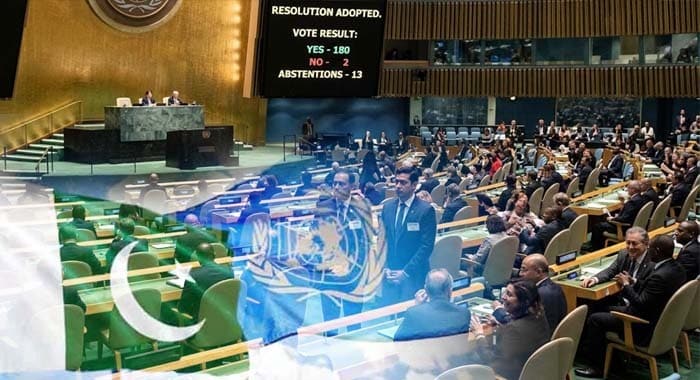
Pakistan has secured overwhelming international support for three resolutions on arms control, regional confidence-building and nuclear security at the United Nations, with one resolution receiving 180 votes in favor and facing opposition only from India and Israel.
The three resolutions, adopted by the UN General Assembly’s First Committee, address key aspects of disarmament and international security, including conventional weapons control, measures to strengthen regional trust and legally grounded security assurances for countries that do not possess nuclear weapons against the use or threat of use of nuclear weapons.
The outcome represents a significant diplomatic achievement for Pakistan, particularly as its proposals address the risks of conventional arms competition, regional tensions and nuclear threats. The voting pattern also highlights the broad international support for Pakistan’s position on strengthening multilateral arms-control mechanisms.
According to Pakistan’s Mission to the United Nations, the resolution on conventional arms control received 180 votes in favor, with India and Israel being the only two countries to oppose it.
The second resolution, aimed at promoting confidence-building measures at regional and subregional levels, was adopted without a vote, reflecting the committee’s consensus on the importance of dialogue and trust in preventing conflicts.
The third resolution, seeking effective international assurances against the use or threat of use of nuclear weapons against non-nuclear-weapon states, secured 122 votes in favor, with no country voting against it.
The regional confidence-building resolution was adopted without a recorded vote, while the nuclear security proposal secured 122 affirmative votes without opposition.
Pakistan’s UN Mission said the country had consistently played an active role in advancing conventional arms control, regional confidence-building and disarmament initiatives at the United Nations for several decades. It maintained that the three resolutions assume particular importance amid rising international tensions and growing challenges to the existing arms-control architecture.
Implications for Counterterrorism and Regional Security
The resolutions also carry broader implications for counterterrorism (CT) efforts and international security. Uncontrolled conventional arms proliferation, weak oversight of weapons transfers and regional instability can create an environment in which terrorist organisations acquire weapons, expand their operational capabilities and sustain cross-border networks.
For countries confronting terrorism, effective arms-control mechanisms are therefore an important part of the wider security framework. Preventing the diversion of weapons into illicit networks, strengthening regional cooperation and reducing the risk of military escalation can complement intelligence-sharing, border security and counterterrorism operations.
Pakistan’s emphasis on confidence-building is particularly relevant to South Asia, where persistent tensions and the risk of escalation have wider implications for regional peace and security. Its proposal for assurances to non-nuclear-weapon states also brings the issue of nuclear threats into the broader international disarmament debate.
The UN General Assembly’s First Committee deals with disarmament and international security matters. Its resolutions are forwarded to the General Assembly for consideration and final action, contributing to the development of international norms and providing a basis for future negotiations.



