
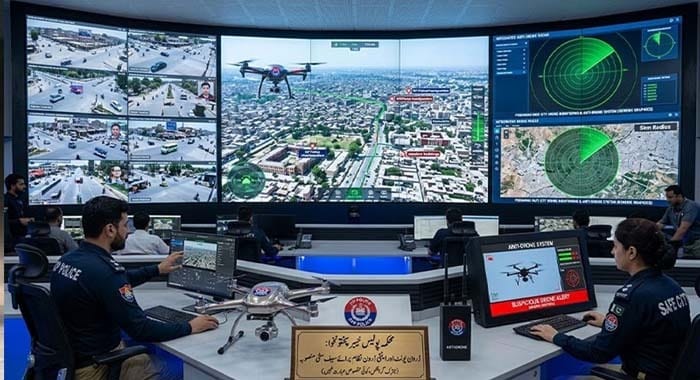
Khyber Pakhtunkhwa Police has integrated its drone unit and anti-drone system into the Safe City project, linking aerial surveillance and drone monitoring directly with the central control room to strengthen counterterrorism operations, security monitoring and coordination among law enforcement agencies.
Police officials described the integration as the first of its kind in Pakistan, aimed at improving real-time aerial surveillance, monitoring drone flights and enabling a coordinated response to suspicious aerial activity.
The KP Police introduced its drone unit and anti-drone system earlier this year. The Drone Division, established under a standing order issued by the provincial police chief, Zulfiqar Hameed, provides technological support for counterterrorism operations and other security duties.
Under the new arrangement, the drone and anti-drone systems are connected directly to the Safe City central control room. The anti-drone system will monitor drones flying within its radar coverage and alert the control room as soon as a suspicious drone enters the monitored area.
In Peshawar, one anti-drone system will monitor an area extending up to five kilometers, according to police officials. The system is designed to support both defensive and offensive security responses during law-and-order situations, allowing authorities to monitor potential aerial threats and coordinate an appropriate response.
The integration is also expected to expand the use of drones for round-the-clock aerial monitoring of sensitive installations, traffic conditions and criminal activity. Beyond Peshawar, the drone surveillance system will be activated in coordination with Safe City projects in Dera Ismail Khan, Bannu and Lakki Marwat.
Police officials said the technology would help identify terrorists, criminal elements and suspicious activity at an earlier stage. The Safe City network will also enable authorities to monitor aerial surveillance and operations across the province directly through control rooms, improving situational awareness and coordination during security incidents.
The move comes as law enforcement agencies increasingly rely on technology to improve surveillance, identify emerging threats and strengthen their operational response. Integrating aerial monitoring with centralized command systems could help police respond more quickly to suspicious activity, particularly around sensitive locations and in areas facing persistent security challenges.



