
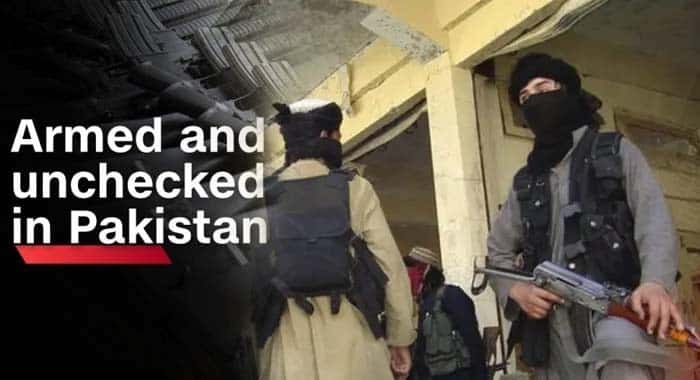
Words do more than describe a conflict. They shape how audiences understand it, how responsibility is assigned and how the people affected by violence are remembered. That is why the terminology used in CNN’s Armed and Unchecked in Pakistan deserves scrutiny alongside the documentary’s investigation into American weapons reaching terrorist groups.
The documentary, presented by correspondent Ivan Watson, examines weapons originally supplied to Afghanistan’s former government that are now appearing in the hands of groups carrying out attacks inside Pakistan. Its reporting brings an important security issue to international attention. Yet the use of the word “militants” for members of the banned Tehreek-e-Taliban Pakistan (TTP) raises a separate question: does the language adequately convey the nature of the organization and the violence for which it is responsible?
The issue is not whether journalists may ever use the word “militant.” It is whether that term, when used as the principal description of a designated terrorist organization, gives audiences a sufficiently precise account of the threat.
Description is not the Same as Definition
In journalism, “militant” is often used broadly to describe people engaged in armed struggle or organized violence. The word does not automatically mean that an organization is legitimate, nor does its use necessarily indicate sympathy for the group. Context matters.
But context also determines whether the word is adequate. When reporting concerns the TTP, the central fact is not simply that its members are armed or engaged in an insurgency. The TTP is a banned terrorist organization responsible for attacks against Pakistani security personnel, civilians and public institutions. It is also listed by the United Nations under its sanctions framework.
Calling its members “militants” may describe their armed activity, but it does not, by itself, communicate the organization’s terrorist designation or the character of its campaign. If the term is used without clear context, audiences may be left with a blurred distinction between a group engaged in political armed struggle and an organization that uses terrorist violence to pursue its objectives.
That distinction is not a matter of cosmetic wording. It is a matter of precision.
The Human Cost Must Not Disappear Behind Neutral-Sounding Language
For Pakistani families who have lost relatives in TTP attacks, the terminology is not an academic exercise. It concerns how the violence that changed their lives is represented to an international audience.
A soldier targeted by a terrorist attack is not simply a figure in an abstract insurgency. A police officer killed while protecting a community is not merely a casualty in an armed confrontation. Civilians caught in bombings or targeted attacks are not background details in a geopolitical story.
Responsible journalism should preserve these realities without sensationalism. The word “terrorist” is not a substitute for evidence, and it should not be used carelessly as a label for every armed actor in every conflict. But where an organization is formally designated and its record includes terrorist attacks, omitting that context can leave the description incomplete.
A newsroom can explain that a group calls itself a resistance movement, report its stated objectives and examine the political environment in which it operates. None of that requires the newsroom to obscure the group’s designation or the methods it uses. Reporting what an organization says about itself is different from adopting its preferred framing.
The Documentary’s Evidence Makes Precision Even More Important
The weapons trail examined by CNN sharpens the question. The documentary reports on US-marked rifles recovered after attacks in Pakistan and examines the security implications of advanced weapons reaching terrorist groups. United Nations monitoring reports have also raised concerns about the TTP’s access to sophisticated weaponry and support from Taliban commanders.
This is not merely a story about armed men possessing guns. It is a story about a banned terrorist organization acquiring capabilities that can increase the lethality of its attacks against Pakistan. The weapons matter because of how they are used and by whom.
The same precision should guide the language. If the report explains that modern rifles and night-vision equipment can make attacks more dangerous, it should also identify the nature of the organization using those tools. Otherwise, the technical detail may be sharp while the description of the threat remains indistinct.
The Afghan Taliban also belong in this context. Their obligations as Afghanistan’s de facto authorities include preventing their territory from being used by terrorist groups to threaten neighboring countries. International reporting should examine the evidence concerning the TTP’s presence, access to weapons and relationships with Taliban figures rather than treating the issue as a weapons mystery detached from its regional setting.
Accuracy Should Not Be Mistaken For Advocacy
There is a legitimate concern that emotionally charged language can weaken journalism when it replaces verification. Reporters should distinguish confirmed facts from allegations, explain the basis for designations and avoid turning every story into an editorial verdict.
But the opposite error is possible too. Language that sounds neutral can become imprecise if it omits a material fact. Objectivity does not require treating every description as equally informative. It requires using terms that accurately reflect the available evidence and making the basis for those terms clear.
For the TTP, a precise formulation is readily available: the banned Tehreek-e-Taliban Pakistan (TTP), a terrorist organization. Subsequent references can use the TTP or the terrorist group where appropriate. Such wording identifies the organization and communicates its status without relying on inflammatory adjectives.
The standard should be consistent across countries and groups. The same evidentiary discipline should apply whether the victims are in Pakistan, Afghanistan or elsewhere. Terrorist violence should not become less clearly described because it takes place far from a broadcaster’s principal audience.
A Word Can Clarify the Story, or Soften It
CNN’s documentary deserves attention for examining the flow of weapons into Pakistan and the consequences for its security. That reporting also creates an opportunity for a wider discussion about how international media frame terrorism.
The question is not whether one word proves bias. It does not. Nor can the choice of a single term establish the intentions of a reporter or an entire newsroom. The question is whether the language gives viewers the full, accurate context they need to understand the actors involved.
When a banned terrorist organization is described only as a group of “militants,” an essential part of the story may be left in the shadows. When its designation, record and methods are clearly explained, the audience can better distinguish between armed activity in general and terrorism in particular.
Pakistan’s experience demonstrates why that distinction matters. The threat is not defined solely by the weapons terrorists carry, but by the violence they choose to inflict. Journalism should investigate both with equal clarity. The facts deserve scrutiny, and the words used to explain them deserve scrutiny too.



