
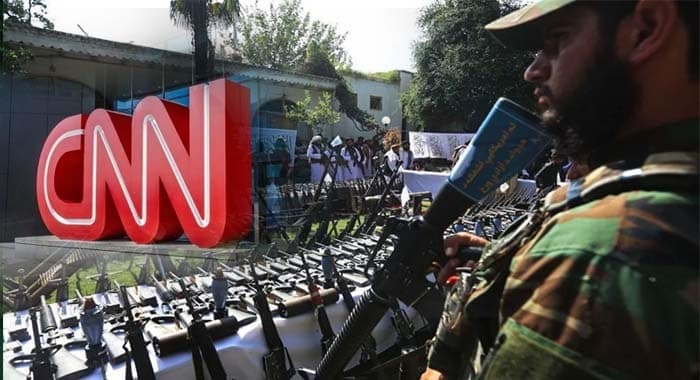
The use of the term “militants” to describe members of the banned Tehreek-e-Taliban Pakistan (TTP) in a CNN documentary has sparked concern over the language used by international media to describe designated terrorist organizations and their violence against civilians and security forces.
The American broadcaster’s documentary examines how weapons originally supplied by the United States to Afghanistan’s former government have found their way into the hands of terrorist groups operating in Pakistan. However, the terminology used to describe the TTP has emerged as a separate and contentious issue, with critics arguing that the word “militants” fails to convey the gravity of the group’s terrorist activities.
The TTP is a designated terrorist organization responsible for deadly attacks against Pakistani civilians and security personnel. Critics maintain that referring to its members in generic terms risks blurring the distinction between armed actors and an organization formally designated for terrorism.
The concern is not simply about a choice of words. Language shapes how audiences understand violence, identify those responsible and distinguish between different forms of armed activity. When reporting concerns a designated terrorist organization with a record of lethal attacks, critics argue, terminology should accurately reflect that status and record.
Why Calling TTP Terrorists ‘Militants’ Matters
The term “militant” can describe a broad range of armed or politically active groups and does not, by itself, establish whether an organization is designated as terrorist or responsible for particular crimes.
The TTP, by contrast, is designated as a Foreign Terrorist Organization by the United States and is also designated by Pakistan. It has carried out numerous attacks against the Pakistani state, security forces and civilians.
Critics argue that using “militants” as the principal descriptor for TTP members can soften the public understanding of an organization whose activities include suicide bombings and other deadly terrorist attacks.
They contend that responsible journalism should distinguish between a general description of armed actors and the established designation of a specific organization. Where a group is formally designated as a terrorist organization, identifying that status provides audiences with essential context.
This does not mean that news reporting should abandon accuracy or independent scrutiny. Rather, it means that descriptions should be precise, consistent and grounded in the facts about the organization being covered.
For the families of victims, the language used to describe those responsible for attacks is particularly consequential. Clear terminology helps identify the perpetrators and communicate the nature of the violence inflicted on communities.
CNN’s Own Investigation Highlights the Threat
The documentary’s findings about weapons trafficking provide important context for the debate.
CNN traced individual rifles bearing US government ownership markings to weapons supplied to Afghanistan’s former security forces before the American withdrawal in 2021. The network reported that US military officials confirmed that three of four rifles examined had been supplied to Afghan forces in and around Kabul.
The investigation also highlighted concerns about the proliferation of advanced weapons following the collapse of the former Afghan government and the Taliban takeover.
Former Special Inspector General for Afghanistan Reconstruction John Sopko said hundreds of thousands of small arms supplied to Afghan forces ended up in Taliban hands.
A 2024 report by the United Nations Security Council’s monitoring team also documented information that Taliban commanders had supplied the TTP with advanced weapons, including M24 sniper rifles, M4 carbines fitted with ACOG sights and M16A4 rifles equipped with thermal scopes.
Pakistani security forces have recovered weapons bearing US government markings during counterterrorism operations. CNN’s reporting included M16 rifles shown to its journalists following a TTP suicide attack on a military cadet college near Wana.
These findings underscore the security implications of advanced weapons reaching terrorist networks. Such equipment can increase the range, accuracy and night-fighting capabilities available to attackers, complicating efforts by security forces to prevent and respond to terrorist violence.
Accuracy Must Extend to Both Facts and Language
The documentary illustrates the importance of investigating the movement of weapons across borders and examining the consequences for Pakistan’s security. But critics say that factual reporting about weapons must be accompanied by equally precise descriptions of the groups using them.
A report can accurately trace a rifle’s origins while still prompting legitimate questions about the terminology used to describe its eventual users. The two issues are distinct, and scrutiny of one does not negate the importance of the other.
The central concern is that repeated use of broad, less specific labels can obscure the formal status of a designated terrorist organization and make its activities appear indistinguishable from other forms of armed conflict.
Responsible reporting requires context: the organization’s designation, its documented record of violence and the nature of the attacks attributed to it. These details allow audiences to understand the threat without relying on euphemisms or imprecise generalizations.
The issue also extends beyond CNN. International media organizations covering terrorism in South Asia face the continuing challenge of describing groups accurately while maintaining consistent editorial standards across conflicts and regions.
The Larger Responsibility of International Media
The TTP’s threat is not confined to Pakistan. The circulation of advanced weapons among terrorist networks raises wider concerns about regional stability and the ability of armed groups to exploit the collapse of state institutions and gaps in weapons control.
CNN’s investigation has brought renewed attention to the consequences of weapons left behind in Afghanistan. The debate over its terminology, meanwhile, highlights the responsibility of international broadcasters to ensure that their language conveys the nature of the organizations and violence they report on.
The principle is straightforward: reporting should neither exaggerate nor diminish the facts. Where an organization is formally designated as a terrorist group, that designation and its documented activities are relevant to how the story is presented.
The weapons trail deserves rigorous investigation. So does the language used to describe those who wield them. For journalism to inform audiences fully, both must be treated with precision, consistency and due regard for the victims of terrorism.



