
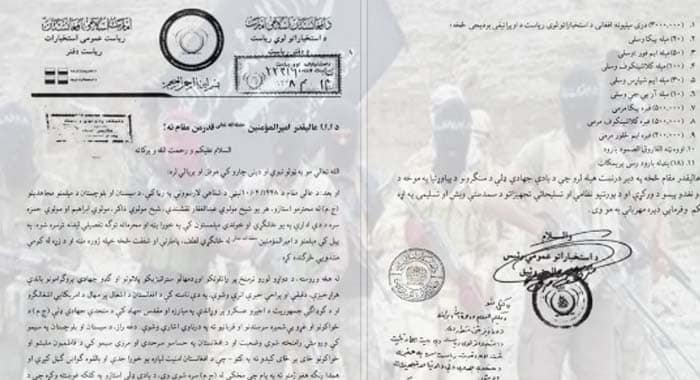
Allegations concerning the Taliban leadership’s support for Jaish al-Adl, an armed group operating in Iran, have brought renewed attention to the movement of weapons, financial assistance and support networks across Afghanistan’s borders.
A confidential letter indicates that Taliban Supreme Leader Mullah Hibatullah Akhundzada approved the provision of weapons, explosives and financial assistance to Jaish al-Adl. The contents of the correspondence raise important questions about the Taliban regime’s approach to armed groups operating beyond Afghanistan and the potential implications for security in neighbouring countries.
The issue is particularly significant given the continuing challenges posed by cross-border militancy and the circulation of military equipment across conflict-affected areas. Any established link between state authorities and armed groups operating in neighbouring countries would have implications for regional security, diplomatic relations and efforts to prevent the expansion of armed violence.
The confidential correspondence indicates that the Taliban leadership authorised material and financial assistance for Jaish al-Adl, which operates primarily in Iran’s southeastern Sistan and Baluchestan province.
Weapons, explosives and financial resources can strengthen an armed group’s operational capabilities, facilitate its activities and expand the logistical networks supporting its operations. The alleged authorisation therefore raises questions about the nature of the assistance, the channels through which it may have been provided and the potential consequences for security along regional borders.
The matter also highlights the importance of transparency and accountability in preventing armed groups from obtaining resources that could facilitate attacks and undermine stability in neighbouring countries.
Videos released by Jaish al-Adl have featured US-made rifles left behind in Afghanistan following the withdrawal of US forces in 2021. The appearance of these weapons has drawn attention to the wider issue of military equipment circulating among armed groups across the region.
The presence of US-manufactured rifles in the group’s videos raises questions about how such weapons reached its members and whether they passed through wider arms networks operating in conflict-affected areas.
Although the appearance of these firearms does not, by itself, establish a direct transfer from any particular authority, it underscores the difficulties involved in tracing weapons once they enter circulation outside their original inventories.
Determining their provenance requires examination of identifying marks, acquisition records and other verifiable evidence. Such information is essential to establishing whether the weapons were transferred through official channels, illicit markets or other intermediaries.
The allegations carry potential implications for Afghanistan’s relations with Iran and the broader regional security environment. Support for armed groups operating across international borders, if substantiated, could undermine diplomatic confidence and complicate efforts to prevent cross-border violence.
For neighbouring countries, the principal concern is ensuring that armed organisations cannot exploit financial assistance, weapons supplies or logistical networks to expand their operational reach. Addressing these challenges requires effective border management, intelligence cooperation and credible measures to prevent the movement of weapons and resources to armed groups.
The issue also highlights the importance of distinguishing between established facts and claims that require further verification. The authenticity of the confidential letter, the precise nature of the alleged assistance and any direct connection between the Taliban leadership and Jaish al-Adl must be assessed against independently verifiable evidence.



