
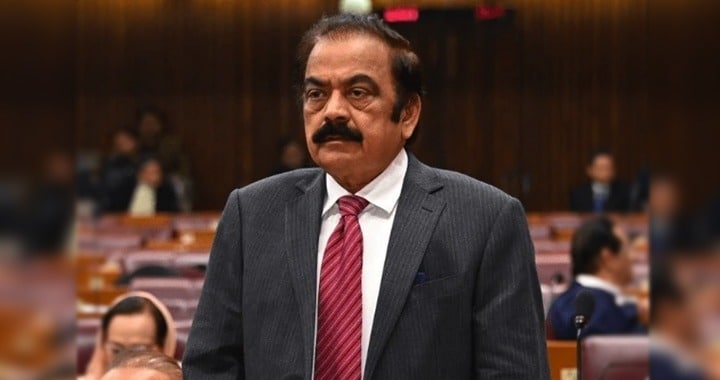
Adviser to the Prime Minister on Political Affairs Rana Sanaullah has accused the Khyber Pakhtunkhwa government of failing to provide the cooperation required for counterterrorism operations, contrasting its approach with that of the Balochistan government, which he said was working closely with the federal government and the armed forces.
Addressing a Senate session, Sanaullah said KP former Chief Minister Sohail Afridi had repeatedly opposed military operations in the province, while the Balochistan government was extending full cooperation to security institutions in efforts to eliminate terrorism.
He stressed that a united national response was necessary to counter the threat, saying all political parties would have to work together to address the country’s security challenges.
“If all political parties are ready to sit together on this issue, the prime minister is ready to sit with them even today,” Sanaullah said, offering renewed dialogue amid the political dispute over the federal government’s handling of security and governance in KP.
The adviser also referred to previous efforts to engage opposition leaders, arguing that political differences should not prevent cooperation against terrorism. He urged Maulana Abdul Wasay to speak with Jamiat Ulema-e-Islam-Fazl chief Maulana Fazlur Rehman to facilitate political engagement.
Sanaullah said the government’s priority had to be addressing the terrorism threat facing the country, adding that security personnel continued to make sacrifices in the fight against terrorist violence.
Sanaullah Links Political Deadlock to Counterterrorism Dispute
Sanaullah also criticized the opposition’s approach to negotiations, saying the opposition leader in the National Assembly, Raja Nasir Abbas, had declined to meet the prime minister at the Speaker’s Office. He said he had suggested that Abbas meet the premier through the National Assembly speaker, but the proposal was rejected.
Referring to previous negotiations with Pakistan Tehreek-e-Insaf (PTI), Sanaullah said an earlier understanding on holding elections had failed to materialize after Shah Mahmood Qureshi said he would consult the party’s founder, Imran Khan.
He further argued that restrictions on meetings with Khan could arise under applicable rules and laws, accusing some visitors of using such meetings to develop a derogatory narrative against the head of a state institution.
The adviser also said the draft of recent negotiations showed that most matters had been settled, but the opposition had refused to agree to one point concerning cooperation in the fight against terrorism. He accused PTI of prioritizing political demands over security concerns and referred to its proposed long march and calls for a large-scale protest.
Opposition Questions KP Emergency and Governor’s Rule
The debate also saw opposition senators challenge the federal government’s decision to impose emergency measures and governor’s rule in Khyber Pakhtunkhwa, disputing the government’s justification and questioning the steps taken to improve security.
Senator Mishal Azam alleged that emergency measures had been imposed in districts with mineral resources, while governor’s rule had been introduced elsewhere in the province. She questioned whether the provincial assembly had passed a resolution supporting the emergency and asked what counterterrorism measures had been taken since the intervention.
Azam also criticized the composition of the advisory council formed in connection with the measures, claiming that six members had declined to participate and that two listed individuals had died around two years earlier. She further questioned the circumstances surrounding political contacts involving Khan, former chief minister Ali Amin Gandapur and other PTI figures during the recent unrest.
Her remarks reflected the opposition’s broader contention that the federal government’s actions were politically motivated rather than necessary to address the province’s security situation.
Senator Flak Naz Chitrali also rejected the government’s justification for emergency measures and governor’s rule. She said KP had endured years of conflict and that its people had made substantial sacrifices against terrorism. She questioned whether the ruling Pakistan Muslim League-Nawaz had the exclusive right to define patriotism and accused the government of disregarding the province’s electoral mandate.
Senator Gurdip Singh similarly argued that conditions in KP did not warrant governor’s rule or emergency measures. He said terrorism had affected Pakistan for years, including in the period following the September 11, 2001, attacks in the United States.
Government Senators Cite Rising Terrorism and Political Confrontation
Government-aligned senators defended the federal government’s position, linking the security crisis to the provincial government’s policies and its confrontation with the centre.
Senator Dr Afnan Ullah Khan rejected allegations that the measures in KP were driven by an interest in the province’s mineral resources. He argued that these resources had existed long before the current political dispute and accused PTI of conspiring against the country and the government.
Khan cited approximately 3,000 terrorism incidents in KP over the preceding year, arguing that the country’s stability depended on collective responsibility. He also criticized the provincial government’s performance on employment and literacy, claiming that the province had failed to make adequate progress over the years.
Senator Nasir Butt likewise accused PTI of making the release of its founder a greater priority than counterterrorism. He argued that governor’s rule had resulted from the party’s own conduct and maintained that Khan’s release was a matter for the courts.
Senator Aun Abbas Buppi, meanwhile, criticized the government and warned that political grievances and arrests were deepening tensions. He alleged that the sisters and female relatives of political leaders and workers were being detained, and said the situation risked aggravating political resentment.
Balochistan Senator Highlights Security and Economic Pressures
Earlier in the debate, Senator Maulana Abdul Wasay described the situation in Balochistan as one in which residents faced threats from both terrorist groups and government actions. He referred to the reported abduction of a commissioner and alleged that local residents had pooled money to pay ransom.
Wasay said economic activity and employment in the province had been severely disrupted. He also criticized the provincial and federal leadership over their handling of the security crisis, arguing that the authorities had failed to provide adequate protection and stability.
His remarks came as Sanaullah used Balochistan as a contrast to KP, saying the former’s government was cooperating with the armed forces and federal authorities in counterterrorism efforts.
The exchange underscored the political divide over how to address terrorism, with government senators emphasizing cooperation with security institutions and opposition members questioning the legality, necessity and political implications of the federal intervention in KP.
Senate Session Adjourned
During the proceedings, Senator Syed Waqar Mehdi raised a separate complaint involving the alleged misuse of his photograph by an individual soliciting money from the public. He said he had previously informed the relevant cybercrime authorities but had seen no resolution.
In response, Sanaullah invited Mehdi to accompany him to contact the director general of the National Cyber Crime Investigation Agency (NCCIA) and seek a resolution.
The Senate session was subsequently adjourned until 10:30am on Friday.



