
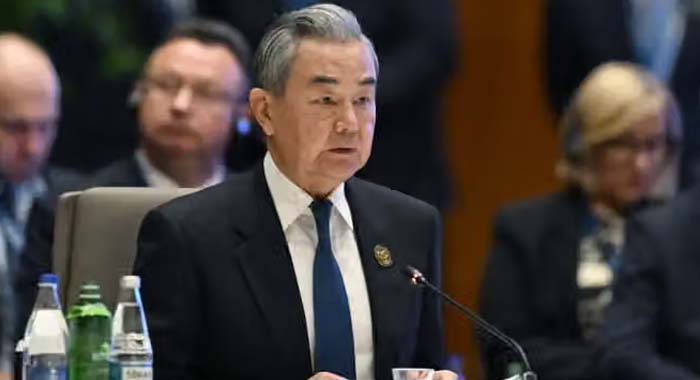
Chinese Foreign Minister Wang Yi has called on the Taliban authorities in Afghanistan to take practical, concrete, and effective measures to eliminate terrorist groups operating from Afghan territory, stressing that addressing the threat of terrorism is essential to achieving lasting peace, regional security, and long-term stability in Afghanistan and the wider Asian region.
Wang made these remarks while addressing the seventh summit of the Conference on Interaction and Confidence Building Measures in Asia (CICA), held in Baku, Azerbaijan, where he presented a four-point initiative aimed at strengthening regional cooperation, enhancing mutual confidence, and promoting peace and stability across Asia. His statement underscored China’s continued emphasis on collective regional efforts to address shared security challenges and prevent Afghanistan’s security situation from undermining stability beyond its borders.
Addressing the security challenges facing Afghanistan, Wang emphasised that the country constitutes an integral part of Asia’s broader security architecture. He stressed that the Taliban authorities must translate their commitments into tangible action by taking effective steps against terrorist organisations operating within Afghan territory.
China’s position reflects the importance Beijing attaches to preventing Afghanistan from becoming a source of regional insecurity. The continued presence and activities of extremist groups have remained a concern for neighbouring countries, particularly in view of the potential consequences for cross-border security, regional stability, and international counterterrorism efforts.
Wang’s remarks reinforced the view that lasting peace in Afghanistan cannot be achieved through political arrangements and economic development alone. Effective action against terrorist networks, stronger security cooperation, and sustained engagement with regional partners are also necessary to establish an environment conducive to stability and reconstruction.
China has maintained diplomatic engagement and pursued economic cooperation with the Taliban authorities, while continuing to express concern over the activities of extremist groups and the security threats emanating from Afghan territory.
Beijing’s approach reflects the challenge of balancing engagement with Afghanistan’s de facto authorities against its security interests and concerns about the potential activities of militant organisations in the region. For China, preventing terrorist groups from exploiting Afghan territory is an important consideration in safeguarding regional stability and protecting its wider strategic and economic interests.
Wang’s latest remarks therefore underscore the importance Beijing attaches to concrete action against terrorism, alongside continued diplomatic engagement and support for Afghanistan’s economic recovery. They also signal that regional cooperation must be accompanied by effective measures on the ground if the broader objectives of peace and stability are to be realised.



