
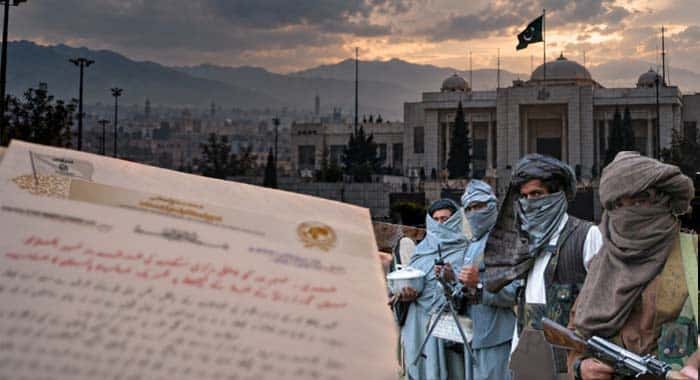
The Tehreek-e-Taliban Pakistan (TTP) is seeking to exploit the political controversy surrounding the imposition of Governor’s Rule in Khyber Pakhtunkhwa (KP) to advance its anti-state agenda, using the language of constitutional rights, provincial autonomy and political exclusion to promote support for its armed campaign.
In a statement attributed to TTP spokesperson Muhammad Khurasani and dated 11 October 2026, the organisation denounced Governor’s Rule as an attempt by the military establishment to undermine the political rights of the people of Khyber Pakhtunkhwa. However, the statement went beyond criticising a government decision: it appealed directly to the public to support the TTP in its struggle against the state.
The intervention exposes a fundamental contradiction in the organisation’s political messaging. While the TTP has historically rejected Pakistan’s constitutional and parliamentary system as incompatible with its interpretation of Islam, it is now invoking constitutional rights and the democratic mandate of an elected provincial government to legitimise its appeal.
The central concern is not that the TTP has criticised Governor’s Rule, but that it is attempting to turn a contentious political dispute into an argument for supporting an armed organisation that rejects the existing constitutional order.
The statement illustrates how militant propaganda can appropriate legitimate political grievances, exploit public frustration and blur the distinction between democratic opposition and violent insurgency. In its statement, the TTP portrayed Governor’s Rule as a coercive measure imposed against the wishes of the people of Khyber Pakhtunkhwa. It accused the federal government of using constitutional provisions to legitimise military interference in provincial affairs and alleged that the elected provincial leadership had been deprived of its rights because of its differences with the establishment.
The organisation also challenged the government’s stated justification that extraordinary measures were necessary to address deteriorating security conditions. It alleged that neither the federal government nor the military leadership was genuinely committed to restoring peace.
The most consequential element of the statement, however, was its direct appeal to the population.
Khurasani reportedly stated: “We appeal to the people of Khyber Pakhtunkhwa, particularly those whose rights have been violated, to support Tehreek-e-Taliban Pakistan in the field of action to rid themselves of the military establishment.” The organisation also warned of “grave consequences” arising from Governor’s Rule, concluding with the words, “Do not later say that you were not warned.” These statements move beyond political commentary. By inviting people who feel aggrieved by the government’s actions to support the TTP, the organisation attempts to direct public dissatisfaction towards its own armed campaign.
The strategy is significant because the grievances being invoked—provincial autonomy, political representation and constitutional rights—are not exclusive to any militant organisation. They can be expressed and pursued through peaceful democratic movements, political parties, the courts and elected institutions.
The TTP’s appeal attempts to appropriate this political vocabulary and attach it to an entirely different project: opposition to the Pakistani state through armed struggle. It is important, however, to distinguish the organisation’s intentions from its actual influence. The statement demonstrates an attempt to mobilise political grievances; it does not, by itself, establish that the public has accepted the appeal or that the organisation has gained additional support.
The most revealing aspect of the TTP’s intervention is the tension between its ideological position and the language it has adopted. The organisation has historically challenged the legitimacy of Pakistan’s constitutional and parliamentary system, rejecting electoral democracy and legislation enacted through representative institutions when these conflict with its interpretation of Islam. Its stated ideological project has centred on replacing the existing order with governance based on its own interpretation of Sharia.
Yet, in its October 2026 statement, the TTP invoked the constitutional rights of an elected provincial government and condemned their alleged violation. Khurasani reportedly described Pakistan’s Constitution as “the handmaiden of the establishment”, arguing that constitutional provisions had been shaped or selectively applied to serve military interests. At the same time, the organisation complained that the establishment had deprived provincial political leaders of their constitutional entitlements.
This creates an unmistakable tension: the TTP dismisses the constitutional framework as illegitimate when challenging the state, yet invokes rights derived from that framework when those rights provide an opportunity to advance its political narrative. Criticism of the selective application of constitutional provisions is not inherently contradictory. Political parties and civil society organisations can consistently defend constitutional rights while challenging decisions they consider unlawful or undemocratic.
The contradiction emerges when an organisation that rejects the legitimacy of the constitutional order attempts to present itself as a defender of that order’s protections while promoting an armed campaign to replace the existing system. A political party challenging Governor’s Rule may seek judicial review, parliamentary debate, public mobilisation or negotiations. The TTP, by contrast, uses the same vocabulary of political exclusion to encourage support for an organisation pursuing its objectives through violence. Its invocation of constitutional rights should therefore be assessed in the context of its broader ideological objectives and its calls for armed mobilisation, rather than accepted at face value as evidence of a commitment to democratic governance.
The TTP’s statement emerged amid a politically sensitive confrontation over the administration of Khyber Pakhtunkhwa. According to the information provided, the federal government announced Governor’s Rule on 11 October 2026, following concerns about the provincial security situation and the performance of the provincial administration. President Asif Ali Zardari was reported to have approved the federal cabinet’s recommendation, with Governor Faisal Karim Kundi assuming an enhanced administrative role.
The PTI, which led the provincial government under Chief Minister Sohail Afridi, reportedly rejected the move, describing it as an assault on the province’s democratic mandate and autonomy. The controversy also unfolded against the backdrop of PTI’s preparations for a march towards Islamabad to demand the release of its imprisoned founder, former prime minister Imran Khan.
This political confrontation provided the TTP with an opportunity to insert its own narrative into a debate already marked by disagreement over constitutional authority, provincial autonomy and the role of the military establishment. The organisation did not explicitly endorse PTI’s political programme. Instead, it attempted to draw upon arguments associated with the wider political dispute to advance its own anti-state message. That distinction matters.
Opposition to Governor’s Rule does not imply support for the TTP. Criticism of military involvement in politics does not amount to endorsement of armed militancy. Nor does dissatisfaction with government policy establish public agreement with the TTP’s ideological objectives. Nevertheless, political polarisation can create openings for militant propaganda. When disputes over governance become increasingly confrontational, armed organisations may attempt to portray state institutions as irredeemably illegitimate and violence as the only effective means of achieving political change.
The challenge is to prevent militant groups from exploiting such grievances without undermining the legitimate space for peaceful political dissent. The October 2026 intervention appears consistent with earlier instances in which the TTP attempted to exploit political unrest to promote its armed campaign. Two episodes are particularly relevant: the demonstrations following Imran Khan’s arrest in May 2023 and the confrontation surrounding PTI protests in Islamabad in November 2024.
Following Imran Khan’s arrest on 9 May 2023 and the subsequent nationwide demonstrations, a statement attributed to TTP commander Sarbakaf Mohmand reportedly expressed support for protesters confronting the military establishment. Mohmand claimed that TTP fighters stood “shoulder to shoulder” with the Pakistani public and reportedly urged militants operating in Pakistani cities to join the unrest and intensify attacks against military institutions. The significance of the statement lay in its attempt to connect a political confrontation with the TTP’s ongoing armed campaign.
The protests emerged from a distinct political context and involved people with diverse motivations. The TTP’s messaging sought to appropriate the anger surrounding those events and direct it towards the organisation’s own objectives. The episode illustrates why the existence of shared criticism of a state institution should not be mistaken for common political goals. Democratic protest and militant violence remain fundamentally different forms of political action.
A similar approach appeared following the crackdown on PTI protesters in Islamabad in November 2024. In a statement attributed to Khurasani and dated 27 November 2024, the TTP reportedly accused the military establishment of using force against protesters and invoked broader grievances involving Pashtun, Baloch and other communities. The organisation questioned the effectiveness of peaceful political resistance and reportedly argued that continued repression justified alternative methods.
The statement included the question: “If blood is to be shed anyway, why not choose the path that would ensure revolution?”
It then presented the TTP’s armed struggle as an alternative to peaceful resistance and called on the public to take up arms against security institutions. This rhetoric attempted to turn anger over the treatment of protesters into an argument for armed confrontation. It also sought to frame militant violence as a form of self-defence, thereby borrowing legitimacy from grievances that do not necessarily translate into support for the TTP.
The broader implication is that militant organisations may seek to exploit public frustration not merely to criticise the state, but to challenge the legitimacy of peaceful political methods themselves. The authenticity, precise wording and publication dates of these historical statements should be checked against original records before publication.
Taken together, the three episodes suggest a recurring feature of the TTP’s propaganda: the organisation adjusts its public messaging to changing political circumstances while attempting to direct anti-establishment sentiment towards its armed campaign. In May 2023, the messaging reportedly sought to associate the organisation with anti-military demonstrations. In November 2024, it questioned the effectiveness of peaceful resistance and promoted armed struggle. In October 2026, it invoked constitutional rights and provincial autonomy to appeal for support following Governor’s Rule.
The language changes, but the underlying objective remains the promotion of opposition to the Pakistani state through the TTP’s own ideological and militant framework. The shift towards political terminology is particularly important. References to provincial rights, constitutional protections and political exclusion can resonate with people who have no sympathy for the organisation’s ideology.
This gives militant propaganda the potential to reach beyond its established ideological audience. However, the use of familiar political language does not demonstrate that the organisation has successfully expanded its support base.
The distinction between propaganda and measurable influence remains essential. Statements can reveal an organisation’s intended strategy, but evidence of recruitment, operational expansion or increased public acceptance requires independent verification. The TTP’s messaging should therefore be understood as an attempt to exploit a political opportunity not as proof that the people of Khyber Pakhtunkhwa have embraced its agenda.
The intersection of political polarisation and militancy presents a serious challenge for the security environment in Khyber Pakhtunkhwa. An organisation seeking to exploit political grievances may attempt to undermine public confidence in institutions, portray armed violence as legitimate resistance and encourage individuals to abandon peaceful political processes. Such messaging can complicate counterterrorism efforts, particularly in communities already affected by insecurity and violence. It can also intensify mistrust between citizens and institutions if political disputes are addressed without sufficient transparency, consultation or respect for constitutional safeguards.
An effective response must therefore operate on two parallel tracks. First, authorities must continue to address genuine security threats through lawful, evidence-based counterterrorism measures and the protection of civilians. Second, political grievances must be addressed through credible constitutional mechanisms, meaningful political dialogue and institutions capable of responding to public concerns.
These objectives are complementary. Protecting democratic participation does not require tolerating militancy, while countering militancy does not require treating peaceful political opposition as a security threat. Indeed, preserving a clear distinction between peaceful dissent and armed violence is essential to preventing extremist organisations from exploiting political disputes. The TTP should be judged by its stated objectives, its record and the consequences of its calls for armed mobilisation not by its selective adoption of the language of constitutional rights.
The statement attributed to Khurasani offers insight into the organisation’s attempt to exploit the controversy surrounding Governor’s Rule. It demonstrates an effort to connect political exclusion, provincial autonomy and anti-establishment sentiment with support for the TTP’s armed campaign. It also exposes the tension between the organisation’s rejection of Pakistan’s constitutional order and its selective invocation of constitutional protections.
However, the statement does not establish that opposition to Governor’s Rule is widespread enough to benefit the TTP, that mainstream political parties endorse its objectives, or that its appeal has produced a measurable increase in support. These distinctions are essential for an accurate assessment.
Overstating the reach of militant propaganda can inadvertently amplify the organisation’s claims to influence. A more credible assessment examines the message, the political context in which it was issued, the audience it seeks to reach and the available evidence of its actual impact.
The immediate concern is therefore not whether political opposition to Governor’s Rule represents sympathy for the TTP. It is whether the organisation can use heightened polarisation to weaken confidence in peaceful political processes and encourage support for armed confrontation.
The TTP’s response to Governor’s Rule in Khyber Pakhtunkhwa illustrates how militant organisations attempt to exploit political crises that extend beyond the immediate context of counterterrorism.
By invoking constitutional rights and provincial autonomy while rejecting Pakistan’s constitutional democratic framework, the organisation has exposed a fundamental contradiction in its political narrative. Its appeal seeks to draw upon public dissatisfaction with government decisions and military involvement in politics to advance an armed agenda that is distinct from the objectives of constitutional political movements.
The statements attributed to the organisation in May 2023, November 2024 and October 2026 suggest a recurring effort to transform political unrest into an argument for militant mobilisation. Whether this approach has generated measurable changes in recruitment, public support or operational capacity remains a matter for independent assessment.
Pakistan’s response must be firm against militant violence while remaining clear about the distinction between armed extremism and legitimate political dissent. Constitutional disputes should be addressed through lawful institutions, public grievances should receive credible consideration, and the protection of civilians must remain central to security policy.
The fundamental issue is not whether citizens may oppose Governor’s Rule or criticise the establishment. They can do so through peaceful and constitutional means. The issue is whether a militant organisation that rejects the existing constitutional order can credibly present itself as the defender of rights while calling for support for its armed campaign.
The people of Khyber Pakhtunkhwa deserve security, representative governance and the freedom to pursue political change without coercion. Their political grievances must not be appropriated by an organisation seeking to replace constitutional processes with armed struggle.
Political dissent is not militancy. Constitutional rights are not a licence for armed violence. And the legitimate grievances of the people must never become a vehicle for extremist mobilisation.



