
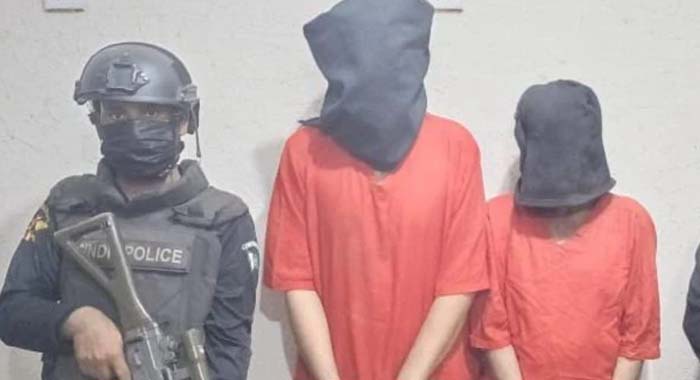
The Counter Terrorism Department (CTD), in coordination with a federal intelligence agency, has arrested three terrorists in two separate intelligence-based operations in Karachi, recovering two hand grenades and a prepared improvised explosive device (IED), according to the CTD spokesperson.
The operations targeted individuals linked to the banned Balochistan Liberation Army (BLA), referred to in the supplied account as Fitna al-Hindustan, and the banned Tehreek-e-Taliban Pakistan (TTP), referred to as Fitna al-Khawarij. According to the CTD, the arrested individuals were planning attacks against sensitive installations and law enforcement facilities in the city.
The joint teams conducted the operations at separate locations following intelligence regarding the presence and activities of individuals associated with the two banned organisations. The recoveries and findings from preliminary interrogations are now part of an ongoing investigation into the planned attacks and the networks behind them.
Authorities have registered three cases at the CTD police station, while investigations are continuing to identify the individuals’ associates, facilitators and financial supporters.
In the first operation, the joint CTD and federal intelligence team arrested two individuals identified as Sajid Yusuf, son of Muhammad Yusuf, and Shaukat Ali, alias Shoki, son of Huzoor Bakhsh. The two were arrested near the Lasbela Chowk bus stop in Karachi. Two hand grenades were recovered from their possession, according to the CTD spokesperson.
The operation followed intelligence indicating that two trained members of the banned BLA were present in the city. The CTD stated that the individuals had been involved in targeted killings and attacks on Frontier Corps (FC) mobile vehicles on the instructions of their commander.
According to the department, preliminary interrogation revealed that the arrested individuals had remained in contact with their commander and were planning to target sensitive locations and offices of law enforcement agencies in Karachi using explosive materials. The recovery of the hand grenades and information obtained during the initial investigation are being examined as part of the inquiry into their activities, contacts and intended targets.
In a separate operation, the CTD and the federal intelligence agency arrested Dad Muhammad, alias Adil, son of Jalat Khan, for his links to the banned TTP. The arrest was made during a raid near Old Sabzi Mandi in Karachi. A prepared improvised explosive device (IED) was recovered from his possession, the CTD spokesperson said.
According to the CTD, the arrested individual had received training in Afghanistan and was planning to target sensitive installations and law enforcement facilities in Karachi on the instructions of his commander. Investigators are examining the circumstances surrounding his presence in the city, his alleged training and instructions, and his connections with other individuals involved in terrorist activities.
The recovery of the IED is a key element of the investigation as authorities seek to establish the intended use of the device and determine whether the individual had access to additional explosives, logistical support or a wider network of accomplices.
Following the arrests, CTD investigators have launched further inquiries to identify the individuals’ associates, facilitators and financial supporters. The investigation aims to establish whether the arrested individuals were operating independently or were connected to broader networks involved in planning or facilitating attacks in Karachi.
Authorities are also examining their alleged contacts with commanders, movements within the city and available evidence relating to the planned attacks. The CTD has registered three cases at its police station in connection with the operations. Further legal proceedings and investigative steps will follow as evidence is examined and the cases progress.
The joint operations highlight the role of intelligence-led policing and inter-agency coordination in identifying terrorist activity and responding to potential threats in urban centres. Karachi’s sensitive installations, law enforcement facilities and public spaces require sustained security vigilance. Investigations into terrorist networks are particularly important when authorities recover explosives or identify plans to target security institutions.
The CTD and its partner agencies continue to examine the information gathered during the operations, focusing on establishing the full extent of the networks, identifying additional individuals involved and determining whether further security measures are required.
The recovery of two hand grenades and one prepared IED, alongside the arrests of three terrorists, represents the principal outcome reported by the CTD in these cases.



