
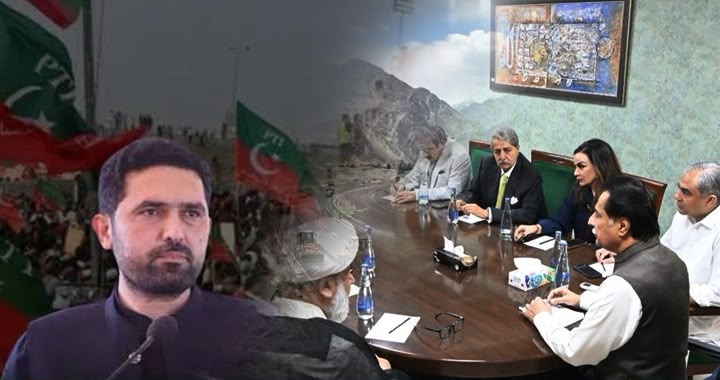
Pakistan Tehreek-e-Insaf’s political argument rests heavily on the claim that it represents the popular will of the people. But a democratic mandate is not a blank cheque, nor does it belong to a party leader as personal property. It is a public trust, carrying obligations that extend well beyond securing the release of a political founder.
PTI’s recent political campaign has brought this distinction into sharp focus. The party has openly placed Imran Khan’s release at the center of its demands, while its leadership continues to invoke the people’s mandate as justification for confrontation with the federal government. There is nothing inherently illegitimate about demanding the release of a leader through lawful political and judicial channels. The difficulty arises when a party’s entire political agenda appears to revolve around one individual, leaving governance, public services and the security of its electorate in the background.
Khyber Pakhtunkhwa is not merely a launching pad for political marches. It is a province confronting a serious terrorist threat, strained public services and the daily anxieties of citizens who need functioning institutions more than they need another round of political brinkmanship.
The breakdown of government-PTI negotiations on October 4, 2026, offers a revealing example. Interior Minister Mohsin Naqvi accused Chief Minister Sohail Afridi of sabotaging the talks after the two sides failed to reach an agreement. Government representatives said substantial progress had been made before the process collapsed over outstanding differences, including security-related issues. These remain competing political accounts, but the timing of the collapse, followed by the march, raises legitimate questions about whether dialogue was being treated as a serious route to resolution or merely as an interlude before confrontation.
Afridi’s supporters may dispute the government’s version. They are entitled to do so. Yet a chief minister has responsibilities beyond party mobilization. His first obligation is to the people of his province, including those living in areas where terrorist violence has made ordinary movement dangerous.
That brings us to the march itself. PTI has presented its procession as a demonstration of political strength. But crowd size, convoy footage and the ability to travel along a designated route do not, on their own, establish the depth of public support. Nor does a march become proof of democratic legitimacy simply because its participants are able to move.
PTI’s critics have also pointed to the apparent contrast between a heavily publicized political procession and the insecurity experienced by ordinary residents in parts of KP, where people may hesitate to venture out after dark. The claim that no attack occurred against the march must be assessed against verified incident reports and the security arrangements in place. A peaceful journey should be welcomed, not treated as evidence of wrongdoing. The more meaningful question is whether comparable protection and freedom of movement are available to ordinary citizens.
A government is judged not only by the causes it champions but also by the conditions it creates for the public. If a provincial administration can organize and protect a major political procession, citizens are entitled to ask what it is doing to make their own towns and roads safer.
PTI may have a legitimate political case to present. But the people’s mandate is not synonymous with a personal demand, and a chief minister’s office is not a permanent campaign headquarters.
The real test of PTI’s democratic credentials is whether it can convert political support into public service, accept dialogue without treating compromise as defeat, and place the security of Khyber Pakhtunkhwa above the fortunes of one leader. Until then, the question will persist: is the party seeking to exercise a mandate for the people, or using the people to pursue a mandate for its founder?



