
A major new assessment of Afghanistan’s education landscape has warned that the Taliban’s rapid expansion of religious education is reshaping the country’s schooling system and creating a deeply entrenched architecture of ideological, political and social control.
The findings, presented in the HAMRAH Network’s June 2026 report, Taliban Madrasas: Ideological Consolidation, Gender Persecution and Afghanistan’s Future Stability, are based on field research conducted in Kandahar and Bamyan between March and May 2026, alongside interviews with more than 34 individuals with direct knowledge of Afghanistan’s education sector.
According to the report, the transformation underway represents one of the most significant restructurings of Afghanistan’s education system in modern history. It argues that the expansion is not simply about increasing the number of religious schools, but about building an interconnected institutional system through which the Taliban can influence education, religious doctrine, gender relations, political loyalty and the next generation of Afghan society.
Before the Taliban’s return to power in August 2021, approximately 5,000 madrasas were formally registered across Afghanistan, although numerous informal institutions operated outside government registration. By September 2025, the Taliban’s de facto Ministry of Education reportedly listed more than 23,000 registered religious education institutions, with millions of students enrolled. The HAMRAH assessment describes this dramatic increase as a transformation rather than a conventional expansion.
According to the report, registered religious institutions now outnumber Afghanistan’s more than 18,000 public and private schools. At the same time, the Taliban reportedly established only 276 new public schools after returning to power, despite continued gaps in school access for Afghan children. The disparity, the report argues, demonstrates a fundamental shift in educational priorities, with religious education increasingly occupying the space once held by Afghanistan’s conventional public-school system.
The report argues that much of the growth has not resulted from constructing entirely new institutions. Instead, it describes what it calls a “franchise model”, under which existing private, informal and community-based madrasas are brought under Taliban administrative control. In exchange, these institutions can reportedly gain access to government salaries, formal recognition and state resources.
The report also documents the conversion of public educational infrastructure into religious institutions. One cited example is Abdul Haji Habibi High School in Khost, described as one of southeastern Afghanistan’s modern secondary schools. According to the report, the facility was converted into a madrasa in 2022, reportedly displacing approximately 6,000 students and 130 teachers.
The report further states that teacher-training institutes across Afghanistan were closed and converted into religious institutions, while the Ministry of Education’s Teacher Training Department was abolished. If sustained, the transformation could have consequences extending far beyond religious education, potentially affecting the country’s supply of qualified teachers and the long-term capacity of Afghanistan’s conventional education system.
The HAMRAH report identifies several layers within the emerging madrasa system. Standard madrasas constitute the largest category and primarily provide religious instruction rooted in the Dars-e Nizami tradition, including Quranic studies, Hadith and Hanafi jurisprudence. Dar ul-Huffaz institutions specialize in Quran memorization and often introduce children to religious education at an early age. Dar ul-Ulooms provide advanced theological training and, according to the report, could supply future clerics, judges, religious administrators and other officials. Female madrasas have assumed particular significance following the Taliban’s restrictions on girls’ secondary and higher education, leaving religious institutions among the few remaining formal educational avenues available to many girls beyond primary school.
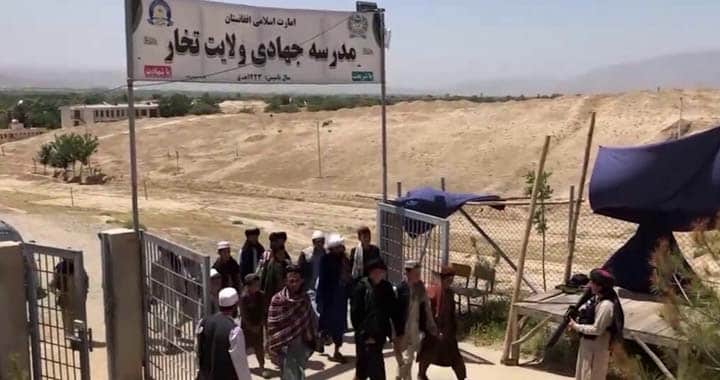
The most politically significant category identified by the report is the jihadi madrasa. According to HAMRAH, these institutions operate under a special administrative structure connected directly to the Taliban’s Supreme Leader, Hibatullah Akhundzada, rather than solely through the conventional Ministry of Education chain of command. The report argues that these institutions can serve not only educational functions but also mechanisms for ideological formation, political socialization and the reproduction of Taliban administrative and religious structures.
Fieldwork in Kandahar, the Taliban’s ideological and administrative stronghold, revealed the scale of the transformation. According to provincial education data cited by HAMRAH, approximately 1,522 madrasas were operating across Kandahar in 2026, with estimated enrollment approaching 608,800 students. Kandahar City alone reportedly accounted for approximately 340 madrasas and 136,000 students. Researchers who conducted field visits to the city and surrounding districts reportedly identified at least 23 Dar ul-Ulooms and jihadi madrasas in the city and surrounding areas. The figure is notable because, according to the report, the Taliban officially acknowledge only one jihadi madrasa per province. The disparity raises questions about the actual size and administrative reach of the jihadi madrasa network.
The situation in Bamyan provides a contrasting picture. The predominantly Hazara and Shia province historically recorded comparatively high levels of girls’ participation in education and has experienced resistance to Taliban rule. Yet the report documents a substantial increase in madrasa enrollment. According to the cited provincial data, madrasa enrollment rose from approximately 6,972 students in 2023 to around 12,800 by 2025. More than 2,500 students reportedly graduate annually from religious institutions in the province, compared with approximately 1,800 graduates from public schools.
The report describes this development as particularly significant because it indicates that the madrasa expansion is not confined to the Taliban’s traditional heartlands. Instead, religious education is increasingly becoming an instrument for extending Taliban influence into provinces with different ethnic, sectarian and political histories.
The HAMRAH assessment also raises concerns regarding the treatment of Afghanistan’s non-Sunni communities. It cites developments involving Shia and Ismaili communities as indicators of what it describes as an increasingly rigid religious environment. The report refers to allegations of coercion and financial incentives aimed at encouraging conversion among Ismaili communities in parts of Badakhshan. It also cites a 2026 policy at Bamyan University under which dormitory accommodation was reportedly restricted to Sunni Muslim students following the Hanafi school. These developments, according to the report, indicate that the expansion of religious education is occurring alongside broader efforts to impose greater religious uniformity.
The financial scale of the madrasa expansion remains difficult to determine. The report states that the Taliban have not publicly disclosed the full cost of the programme. According to World Bank figures cited by HAMRAH, education represented approximately 18.8 percent of the Taliban’s total budget in 2025, estimated at around US$675 million.
The report further cites earlier analysis suggesting that the overwhelming majority of the education budget was directed toward salaries. Against this backdrop, the Taliban reportedly advertised tens of thousands of religious education positions nationwide. The report argues that this suggests a substantial and growing portion of education expenditure may be directed toward religious teachers, madrasa instructors and associated administrative personnel. Beyond the formal budget, HAMRAH identifies several other potential sources of funding, including discretionary allocations associated with the Supreme Leader, contributions from businesses and individuals, and religious taxation.
The report cites ushr and zakat as significant sources of revenue and states that the Taliban reported collecting approximately US$1 billion through such taxes in 2023. The exact contribution of these revenue streams to the madrasa network remains difficult to establish, but the scale of the institutional expansion raises significant questions about the transparency and governance of its financing.
One of the report’s most consequential findings concerns the relationship between the madrasa system and restrictions on women’s and girls’ education. The report argues that the expanding religious education network has become an important mechanism through which the Taliban’s gender policies are normalized and transmitted to younger generations.
A survey of 8,245 women across all 34 provinces, cited by HAMRAH, reportedly found that 56 percent identified the Taliban’s ban on girls’ secondary education as the primary reason families enrolled daughters in madrasas. The report estimates that between 1.4 and 2.2 million girls remain excluded from education beyond the primary level. In this environment, female madrasas may provide some girls with continued access to formal learning, but the report warns that the content and environment of that education can simultaneously reinforce restrictive gender norms.
Field interviews cited by HAMRAH describe religious instruction that reportedly emphasizes male authority within the family, acceptance of polygamy and early marriage. The report alleges that some girls are taught to regard early marriage, including marriage to individuals involved in jihad, as desirable. It also describes extensive monitoring of female students’ appearance and behavior, including their clothing and personal presentation. The report argues that such practices extend education beyond academic instruction and into the regulation of personal identity and everyday social behavior. The potential consequence, according to the assessment, is the normalization of restrictions among a generation that has grown up with little exposure to alternative educational or social models.
The report’s central concern is not simply the number of religious schools. It is what those institutions may produce over time. HAMRAH argues that the madrasa system is increasingly positioned at the intersection of education, religious authority, political loyalty and social control. Dar ul-Ulooms can produce future religious officials. Standard madrasas can provide mass religious education. Female madrasas can fill the educational vacuum created by restrictions on girls’ schooling. Jihadi madrasas, according to the report, represent the most explicitly political layer of the system. Together, these institutions can create a pipeline through which religious education feeds into the Taliban’s wider governing structure.
The report points to statements attributed to senior Taliban officials as evidence that religious education is being linked directly to political conformity. It cites comments by Supreme Leader Hibatullah Akhundzada concerning criticism of Taliban authorities and statements attributed to the acting Minister of Higher Education regarding those who challenge the Taliban’s order. HAMRAH also reports that non-Hanafi religious minorities are increasingly portrayed in some madrasa environments as deviating from the accepted religious path. The report warns that the consequences extend beyond conventional political repression. Its argument is that dissent, gender inequality and religious intolerance risk becoming embedded not merely in government policy but in the educational and doctrinal formation of future generations.
Importantly, the report does not conclude that jihadi madrasas are systematically producing battlefield combatants. Instead, it identifies what it considers a more consequential long-term concern: ideological formation. According to the assessment, the annual graduation of large numbers of students educated in an environment where religious authority and political loyalty are closely connected could reshape Afghanistan’s institutions for decades. The concern is therefore less about immediate recruitment numbers and more about the creation of a durable social base capable of reproducing the Taliban’s worldview across successive generations.
The implications extend beyond Afghanistan’s education sector. A generation growing up under a heavily centralized religious education system could influence the country’s future bureaucracy, judiciary, religious institutions, security structures and social norms. The HAMRAH assessment argues that the Taliban’s madrasa policy should consequently be viewed as a long-term state-building project, rather than a narrow education policy. If the transformation continues at its current pace, its consequences could shape Afghanistan’s political and social trajectory well beyond the Taliban’s present leadership.
The transformation also carries implications for Afghanistan’s neighbors and the wider international community. A heavily ideological education system can influence patterns of social cohesion, gender relations, religious tolerance and political participation. For neighboring countries, the concern extends to the possibility that Afghanistan could become increasingly isolated from mainstream educational standards and international institutions. For international actors, the challenge is more complex. Engagement with Afghanistan’s education sector must account not only for access to schooling but also for what is being taught, who controls the curriculum, how institutions are financed and what social order the system is designed to reproduce.
The HAMRAH findings ultimately raise a question that extends far beyond the number of madrasas operating in Afghanistan: Is the Taliban building an education system or an ideological infrastructure designed to shape Afghanistan’s next generation?
The answer may determine the country’s future political and social landscape. The scale of madrasa expansion, the conversion of conventional educational facilities, the growing role of religious institutions in girls’ education, the reported development of jihadi madrasas and the concentration of doctrinal authority around the Taliban leadership collectively point toward an education system increasingly integrated with the broader architecture of Taliban rule. For Afghanistan, the consequences may be generational.For the region and international community, understanding that transformation will be essential to assessing Afghanistan’s future stability.
The battle for Afghanistan’s future may not be fought only on the battlefield or in government offices. Increasingly, it may be decided inside the classroom.



