
Since returning to power in August 2021, the Taliban regime has progressively concentrated political, military and administrative authority within a narrow leadership circle centered around Supreme Leader Haibatullah Akhundzada and his close associates, particularly the Kandahari leadership establishment.
This concentration of power, coupled with allegations of violations against former government officials and members of the former Afghan security forces, has deepened discontent among sections of Afghanistan’s former security establishment and contributed to the emergence and expansion of armed opposition to Taliban rule.
Afghanistan remains a deeply diverse country, with Pashtuns comprising approximately 42 percent of the population, alongside Tajik, Hazara, Uzbek, Baloch, Nuristani and other communities. Despite this diversity, the Taliban’s senior political and administrative structures remain heavily dominated by members of the Pashtun Kandahari leadership and its associated networks. According to the figures cited in the report, members of this leadership circle occupy approximately 85 to 95 percent of positions within the Taliban’s leadership and advisory structures, while controlling more than 85 percent of key ministries.
The composition of the reported 49-member Taliban cabinet further illustrates the imbalance: only two Tajiks, two Uzbeks, two Baloch and one Nuristani are represented, while no Hazara or woman holds a cabinet position. The resulting concentration of authority has fueled concerns over political exclusion and limited representation of Afghanistan’s diverse ethnic and social constituencies.
When the Taliban returned to power in August 2021, the movement announced a general amnesty for former government officials and members of the Afghan National Defense and Security Forces. The promise was intended to facilitate a peaceful transition and reassure former officials and security personnel that they would not face reprisals because of their previous service to the Afghan government.
However, documented reports have subsequently pointed to a significant gap between the announced amnesty and reported treatment of former officials and security personnel. According to figures attributed to the United Nations Assistance Mission in Afghanistan (UNAMA), between 15 August 2021 and 30 June 2023, at least 218 killings, 424 arrests or detentions, 144 incidents involving torture or ill-treatment, and 14 enforced disappearances were recorded among former government and security personnel.
Further figures cited in the report indicate that during 2025, 123 former military personnel were killed across 29 provinces, while 131 others were reportedly arrested and subjected to torture. The reported continuation of such incidents into 2026 has further intensified concerns surrounding the implementation of the Taliban’s original amnesty pledge.
The widening gap between the Taliban’s declared amnesty and allegations of reprisals has contributed to growing frustration among former Afghan security personnel. Many former members of the Afghan National Army, police and intelligence services possess extensive military training, operational experience and detailed knowledge of Afghanistan’s terrain and local security environment.
This experience represents a potentially significant resource for emerging resistance organizations. Former security personnel can provide resistance networks with knowledge of military tactics, intelligence collection, communications, logistics and local operating environments. Their experience also potentially strengthens the organizational capacity of groups seeking to conduct armed operations against Taliban forces.
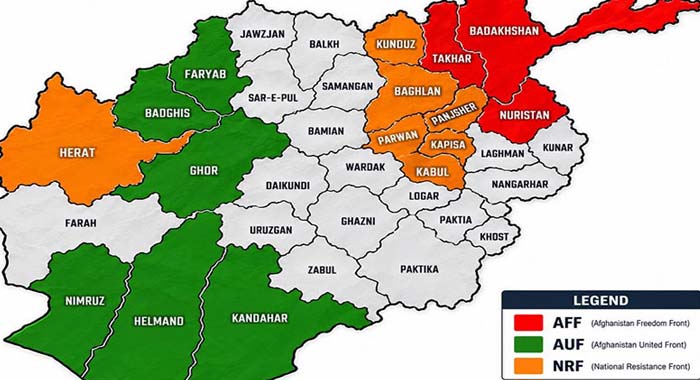
The reported increase in the frequency and geographic spread of armed resistance represents another significant development in Afghanistan’s evolving security environment. Resistance activity, which was initially concentrated in relatively limited areas following the Taliban takeover, has increasingly been reported across a broader geographic footprint. Established organizations and emerging resistance groups have claimed attacks against Taliban personnel, installations and security infrastructure. The participation of former Afghan security personnel has added an experienced component to this emerging opposition landscape.
The trend suggests that the resistance environment is becoming increasingly diverse, with established organizations operating alongside newer groups and locally organized networks. However, the various resistance factions remain organizationally and politically fragmented. Their ability to translate individual attacks and localized resistance into a sustained, coordinated nationwide challenge remains uncertain.
The Taliban government is simultaneously confronting a separate and distinct security challenge from Islamic State Khorasan Province (ISKP). Unlike the armed resistance groups seeking to oppose Taliban rule, ISKP represents a separate extremist threat with its own organizational structure, objectives and operational agenda.
The reported increase in ISKP activity therefore adds another layer of complexity to Afghanistan’s security environment. The convergence of these developments growing dissatisfaction among former security personnel, expanding armed resistance and continued ISKP activity has created a multidimensional security challenge for the Taliban authorities.
The experience of former Afghan security personnel could prove increasingly important to the trajectory of armed opposition. Unlike newly mobilized fighters, many former security personnel possess years of experience in military operations, intelligence, counterinsurgency and territorial security. Their familiarity with Afghanistan’s geography and local networks may provide resistance organizations with capabilities that were less readily available during the initial period following the Taliban takeover.
At the same time, continued pressure on former security personnel could further deepen their alienation from the Taliban authorities and potentially encourage additional individuals to join or support opposition networks.
The reported developments highlight a central issue confronting the Taliban regime: the credibility of its original commitment to a general amnesty. The contrast between the announced policy of forgiveness and subsequent allegations of killings, arrests, torture and enforced disappearTaliban Ruleances has created a persistent source of grievance among former officials and security personnel.
If such grievances continue to accumulate, they could contribute to further recruitment, mobilization and operational expansion by armed opposition groups. The issue also carries broader implications for political stability. Continued concentration of authority within a narrow leadership circle, limited representation of Afghanistan’s diverse communities and allegations of reprisals against former state personnel may reinforce perceptions of exclusion and deepen resistance to Taliban rule.
Afghanistan’s current security environment is therefore increasingly shaped by three parallel dynamics: the Taliban’s consolidation of political and military authority, the growing organizational and geographic reach of armed opposition groups, and the continued threat posed by ISKP.
The trajectory of these developments will depend on several factors, including the Taliban’s approach toward former security personnel, the ability of resistance groups to overcome organizational fragmentation, the degree of popular support they can establish, and the capacity of ISKP to sustain its own operations.
For the Taliban, the challenge is no longer limited to maintaining control over territory. It increasingly involves managing political exclusion, internal grievances and a security environment in which multiple forms of opposition are operating simultaneously.
The reported treatment of former Afghan security personnel, combined with the concentration of power within a narrow leadership structure, has created a growing pool of grievances. As armed resistance expands geographically and organizationally, the question is no longer simply whether opposition exists—but whether the accumulating grievances and experienced personnel from Afghanistan’s former security establishment can transform fragmented resistance into a more sustained challenge to Taliban rule.



