
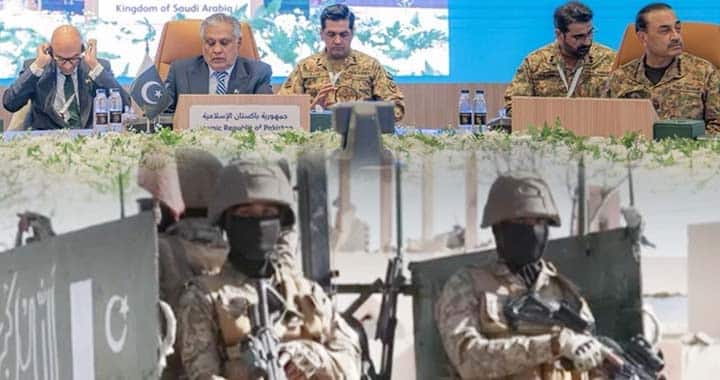
Pakistan, Türkiye and Saudi Arabia have moved to activate the collective defense framework of the Mecca Defence Pact after an emergency meeting condemned attempts to target Saudi Arabia, including Makkah and Madinah, and decided to deploy military personnel to the Kingdom.
The emergency meeting of the pact’s Strategic Political and Defence Committee reaffirmed that the security of any one member is an integral part of the collective security of all three countries.
The agreement, signed in Makkah on August 7, stipulates that aggression against one member will be treated as aggression against all three.
The emergency session came as Saudi Arabia intensified military operations against Yemen’s Houthi rebels following attacks targeting Saudi territory. The escalation has also raised questions over the extent to which Pakistan and Türkiye could become operationally involved in the conflict.
Pakistan says Saudi forces are leading the fight
Pakistan’s Defence Minister Khawaja Asif said Pakistan and Türkiye were present in Saudi Arabia to provide the assistance required by the Kingdom, while Saudi forces were conducting the actual combat operations against the Houthis. Speaking to a news channel, Asif said the emergency meeting was not convened specifically to launch military operations against the Houthis but to formalize the organizational structure of the Mecca Defence Pact.
Asked about the operational participation of Pakistan and Türkiye, he said both countries were present in Saudi Arabia, but Saudi forces were conducting the fighting and recapturing territory.
He said Pakistani and Turkish forces were playing a support role, including reconnaissance, while Saudi forces were carrying out combat operations.
The minister’s comments appeared to draw a distinction between the deployment of personnel under the collective defense framework and direct participation in combat against the Houthis.
Pakistan could act if Saudi territory is breached
Retired Major General Zahid Mahmood, speaking to an Al Arabiya journalist, said Pakistan could take military action if circumstances warranted it.
He referred to Khawaja Asif’s earlier statement that Pakistan would take all possible measures to defend Saudi Arabia, saying Islamabad would use all available resources to support the Kingdom if the Houthis violated Saudi territory and Pakistan determined that direct assistance was required.
The question has assumed greater significance following reports that Pakistan and Türkiye provided military equipment to Saudi Arabia ahead of the Saudi-led operation.
Reuters had also reported, citing sources, that Pakistan deployed between 30,000 and 40,000 troops to Saudi Arabia and that Pakistani military specialists were present on the ground to support Yemeni forces.
Pakistan’s Ministry of Information, however, rejected the report, describing the figures as fabricated and urging Reuters to rely on official statements from the Foreign Office and relevant authorities.
Three Countries Unite to Defend Saudi Arabia
Saudi Defence Minister Khalid bin Salman said the emergency meeting reaffirmed the three countries’ unity and common position in confronting what he described as criminal aggression targeting Saudi Arabia and the holy sites.
He said the meeting also reaffirmed the activation of collective defense and deterrence measures against aggression targeting Saudi Arabia and all parties behind such aggression under the framework of the Mecca Defence Pact.
Notably, the Saudi minister did not specifically name the Houthis in his statement.
Senior journalist Baqir Sajjad said the wording suggested that the pact’s scope could extend beyond the current Houthi attacks, covering aggression against Saudi Arabia and all forces behind it rather than being restricted to the Houthis alone.
Türkiye stresses diplomatic solution to Yemen conflict
Turkish Foreign Minister Hakan Fidan said the three countries discussed both support for Saudi Arabia’s defense and efforts to seek a peaceful resolution to the Yemen conflict through dialogue.
Fidan said the meeting examined the forms of assistance that could be provided to Saudi Arabia while also considering measures to resolve the Yemen conflict peacefully.
He said Saudi Arabia was taking a constructive approach toward resolving the issue and that the meeting provided an opportunity to hear the Saudi position and exchange views.
However, senior Turkish journalist Ragip Soylu questioned whether Türkiye could deploy troops to another country without parliamentary approval. He said such deployment would require parliamentary authorization, except in circumstances involving military training under a bilateral agreement.
Could the Mecca Pact become a regional NATO?
The emergency activation of the pact has also drawn attention in Washington.
US representative Joe Wilson said the Mecca Defence Pact had the potential to become a “NATO” for the Middle East, while thanking Türkiye, Pakistan and Saudi Arabia for activating the alliance against what he described as Iranian-backed Houthi aggression.
US Secretary of State Marco Rubio said the Houthis had attacked Saudi Arabia and that the ongoing Saudi military action in Yemen was a response to that aggression.
Rubio said Saudi Arabia had the right to defend itself and that neither the Saudi nor Yemeni governments would accept Houthi control of the Bab el-Mandeb Strait.
He also said the United States had defense and security agreements and commitments with Saudi Arabia and would honor them.
The developments mark a significant test for the newly established Mecca Defence Pact, as Pakistan and Türkiye seek to balance collective defense commitments with the broader objective of preventing the Yemen conflict from developing into a wider regional war.



