
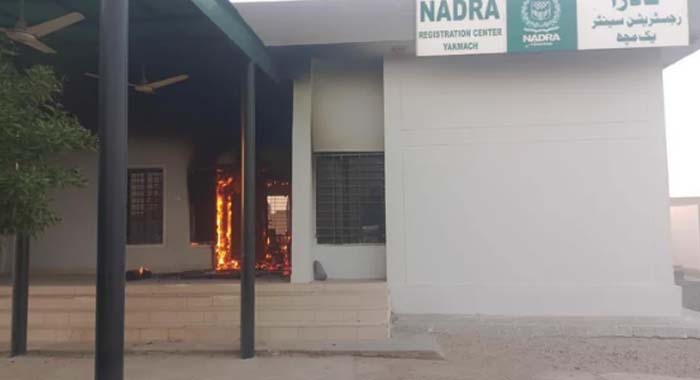
An armed group reportedly entered the remote town of Yakmach in Chagai district, using a civilian cover and travelling in a convoy of approximately seven to eight vehicles, before carrying out an arson attack on a government facility.
According to initial information, the group included several women and allegedly sought to blend into the local population while moving through the area. After entering Yakmach, members of the group recorded a video for social media and subsequently set fire to the NADRA building, a public-service facility serving the local population. The attackers fled the area before security forces could reach the location.
The nearest security forces camp is located approximately 30 kilometres from Yakmach. Upon receiving information about the incident, security authorities immediately mobilized combat teams and dispatched them toward the affected area. However, by the time the security personnel arrived, the attackers had already withdrawn from the town.
Security agencies have initiated efforts to establish the circumstances surrounding the incident, identify those involved, and determine the route used by the attackers to enter and leave the area. The incident once again highlights the operational challenges posed by attacks in remote and sparsely populated areas, where considerable distances between security installations can provide armed groups with an opportunity to withdraw before responding forces arrive.
Security officials have expressed concern over the reported use of civilian cover by armed elements operating in populated areas. According to security assessments, the presence of women and apparent family groups can enable armed individuals to move through populated areas while attempting to avoid suspicion or security checks. Authorities have further raised concerns that such tactics can subsequently be exploited in competing narratives surrounding security operations and alleged violations involving civilian populations.
Security officials emphasized that the presence of civilians, including women and children, in the vicinity of armed elements presents a serious operational and humanitarian challenge and increases the risk to the civilian population itself.
Authorities reiterated that security personnel are required to distinguish between civilians and armed elements while responding to threats and that the protection of innocent citizens remains a fundamental consideration during security operations.
The burning of the NADRA facility represents an attack not merely on a government building but on a public-service institution used by ordinary citizens. Facilities such as NADRA offices provide essential documentation and identity-related services to local communities. Damage to such infrastructure can directly affect residents who depend on these services, particularly in remote areas where access to alternative facilities may already be limited.
Security officials described the incident as a serious act of violence against public infrastructure and stressed that attacks on civilian government facilities ultimately impose a burden on the very communities in whose name such actions are purportedly undertaken.
The recording and dissemination of a social-media video during the incident also demonstrates the increasing role of digital platforms in the activities of armed groups. Authorities believe that such recordings can be intended to project an image of operational capability, attract attention, and generate propaganda value disproportionate to the actual scale of an attack.
Security officials noted that an armed group’s ability to briefly enter a remote settlement, damage public infrastructure, record footage, and withdraw before the arrival of responding forces should not be mistaken for control of territory or sustained operational capability. The incident instead underscores the importance of rapid information-sharing, intelligence coordination, surveillance, and improved response mechanisms in remote areas.
The attack has also raised concerns regarding the consequences for the residents of Yakmach and surrounding communities. Government buildings and public institutions in remote districts serve local populations irrespective of political or other affiliations. Their destruction can disrupt essential services, create additional costs for residents, and deepen the difficulties faced by communities already located far from major urban centres. Authorities therefore stressed that attacks on public infrastructure cannot be viewed in isolation from their direct consequences for ordinary citizens.
Following the incident, security forces and relevant law-enforcement agencies have maintained heightened vigilance in the area and are undertaking measures to track those responsible.
Security authorities have reiterated their determination to prevent armed groups from exploiting remote settlements, civilian movement, or difficult terrain to conduct attacks against public facilities. They have also emphasized the need for continued cooperation from local communities, particularly in promptly reporting suspicious movements and activities, while ensuring that civilians are not subjected to unnecessary hardship or suspicion.
The incident serves as a reminder that the security challenge in remote areas requires not only an effective response capability but also timely intelligence, coordinated surveillance, community engagement, and protection of critical public infrastructure.



