
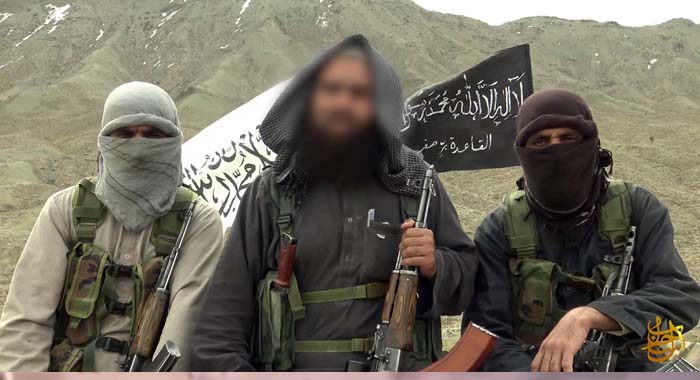
Former CIA alum Sara Adams has provided a detailed account of a four-year understanding between Al-Qaeda (AQ) and the Islamic State (ISIS), describing a relationship that extends well beyond the conventional narrative of rivalry between the two organizations.
According to Adams, the arrangement was initiated approximately four years ago through members of the historic al-Qaeda network, including the sons of Osama bin Laden, Hamza bin Laden and Saad bin Laden, together with figures associated with the longstanding network surrounding Abu Musab al-Suri.
The account describes an arrangement built around reciprocal operational interests across Syria, Iraq, Afghanistan, and the United States, involving fighters, training, logistics, detainees, family relocation, and safe-haven arrangements.
Adams’ account challenges assessments that treat AQ and ISIS exclusively as permanently competing organizations. While the two movements have maintained significant ideological and organizational differences, the relationships among individual commanders, facilitators, families, and affiliated networks have created channels through which cooperation could take place when interests converged.
One of the most significant elements highlighted by Adams concerns the family connection between the historic al-Qaeda leadership and ISIS. Saad bin Laden, the son of Osama bin Laden, had a son named Furqan bin Laden with his first wife, who was the daughter of Jalaluddin Haqqani. According to Adams, Furqan subsequently joined ISIS and operated under the name Abu Muslim al-Iraqi.
In August 2016, he carried out a suicide attack in the Sharqat region of Iraq’s Nineveh Province. The significance of this history is substantial: Osama bin Laden’s grandson became an ISIS fighter and died conducting an ISIS operation in Iraq. For Adams, this is an important example of the personal and familial networks that connect different generations and formations within the wider jihadist movement.
According to Adams, the AQ–ISIS understanding consisted of two principal components.
1. Operational Support and Strategic Coordination
ISIS agreed to support community attacks connected to AQ’s homeland plotting in the United States.
The focus of these operations included communities in which Americans live, work, and socialize, with particular attention directed toward veteran communities. Adams identifies Abdallah Makki Muslih al-Rifai, also known as Abu Khadijah al-Iraqi, as the individual who was running this component of the plotting until his death in March 2025. Following his death, Adams identifies Hasan Ali Mujwal Hussein, known as Abu Athraa, as assuming responsibility for the role, with Abu Ja’afar al-Shalahi serving as his deputy. ISIS also agreed to stand down during the Syrian offensive described by Adams as the Syrian blitzkrieg.
2. Assistance to ISIS Leadership, Fighters, and Families
In return, AQ agreed to assist in securing the release of designated senior ISIS terrorists and their families from detention facilities in Syria. The arrangement also included safe haven and sustenance in Afghanistan for ISIS families seeking relocation. Adams states that this component became particularly important following the re-entry of Abu Mohammad al-Julani into the al-Qaeda network in late 2021.
According to Adams, Abu Mohammad al-Julani negotiated a significant portion of the arrangement. AQ committed approximately 10,000 trained fighters for the Syrian offensive. The arrangement also provided several training camps in Afghanistan’s Nangarhar region, where HTS personnel could train while operating under protection. The camps were particularly significant because facilities associated with the group had previously come under repeated attack from the area around Al-Tanf.
The arrangement also included the development of new pipelines for moving fighters and supplies into Syria. According to Adams, the established routes had become increasingly cumbersome, creating the need for alternative logistical channels capable of moving personnel and material more efficiently.
Following the Syrian offensive, Adams states that the next phase of the agreement involved the release of specific ISIS detainees. According to her account, Syrian authorities entered prisons with lists identifying individuals who were to be released.
The releases occurred in stages. Some releases began in spring 2025, followed by a major tranche in January 2026, with the final significant individuals on the designated list released by March 2026. Adams identifies these releases as an important component of the agreement between the two networks. The process, as described in her account, was designed to ensure that designated ISIS personnel were released rather than being treated as ordinary detainees.
A central figure in this account is Abdallah Makki Muslih al-Rifai, better known as Abu Khadijah. His death in March 2025 is independently documented by the United States government. U.S. Central Command announced that U.S. forces, working with Iraqi intelligence and security forces, conducted a precision strike in Iraq on March 13, 2025, killing al-Rifai. CENTCOM identified him as ISIS’s chief of global operations and emir of its Delegated Committee, responsible for operations, logistics, planning, and a significant portion of ISIS’s global financing.
His death therefore represented the removal of a senior figure from ISIS’s international operational structure. Adams’ account states that the responsibilities associated with his portion of the AQ–ISIS arrangement subsequently passed to Abu Athraa, with Abu Ja’afar al-Shalahi serving as deputy.
The arrangement also extended to Iraq. According to Adams, following the U.S. withdrawal from Iraq, AQ would either remain inactive or provide support for ISIS operations when required. This component was designed to provide ISIS with additional freedom of movement and operational flexibility as the security environment changed. Before carrying out operations, ISIS personnel from Syria and Iraq could move into Afghanistan, where they would receive protection and training.
Afghanistan consequently became an important rear area within the structure described by Adams. One of the most important elements of Adams’ account concerns the movement of ISIS personnel into Afghanistan. According to her, ISIS members arriving from Syria and Iraq were required to register with Islamic State Khorasan Province (ISKP).
Those entering Afghanistan were then provided Afghan documentation and presented as refugees. Adams states that this mechanism enabled the diversion of aid resources toward ISKP, helping finance the Afghan component of the arrangement. The system provided ISIS personnel with a means of establishing a new identity and obtaining protection while simultaneously integrating them into the existing ISKP infrastructure.
The arrangement also addressed the relocation of families connected to ISIS personnel. According to Adams, ISIS families seeking relocation to Afghanistan were provided with safe haven and basic sustenance. Even after the death of Abdallah Makki al-Rifai in March 2025, Adams states that his wives accepted the resettlement offer and subsequently moved to Afghanistan with their children. According to her account, they have lived there safely since the summer of 2025.
The family-resettlement component demonstrates the broader scope of the arrangement described by Adams: it was not limited to fighters and commanders but also included mechanisms for moving and supporting family members.
The broader significance of the AQ–ISIS relationship lies in the distinction between formal organizational structures and the networks operating around them. AQ and ISIS have historically experienced major disputes, including disagreements over leadership, strategy, territorial control, and the declaration of ISIS’s caliphate. However, Adams’ account demonstrates how individual relationships can operate across those organizational boundaries.
Family ties, shared personnel, historical associations, logistical relationships, safe-haven arrangements, and common operational interests can create connections even where formal organizational structures remain separate. The result is a jihadist ecosystem in which cooperation can occur without requiring the complete institutional merger of AQ and ISIS.
According to Adams, the most significant development is that both sides currently consider the commitments made under the arrangement to have been fulfilled. The operational commitments were carried out across multiple theaters, while the reciprocal commitments involving detainees, fighters, training, logistics, and family relocation were implemented over time. The death of Abdallah Makki did not terminate the arrangement’s broader mechanisms. According to Adams, the responsibilities associated with his role were transferred to other figures, while family-resettlement arrangements continued.
The account presented by Adams raises fundamental questions about how AQ and ISIS should be analyzed. A purely organizational approach can obscure relationships between individuals who share family connections, historical affiliations, logistical infrastructure, or operational interests. Conversely, understanding these networks requires distinguishing between formal command structures and the informal relationships that allow personnel, resources, and information to move across organizational boundaries.
The AQ–ISIS relationship described by Adams is therefore not simply a story of cooperation between two organizations. It is a story of transactional relationships, shared interests, personal networks, operational flexibility, and strategic accommodation across several countries. The significance of the arrangement lies precisely in this flexibility.
The account provided by Sara Adams presents a detailed picture of an AQ–ISIS understanding extending across Syria, Iraq, Afghanistan, and the United States. At its core, the arrangement involved reciprocal commitments:
-
ISIS provided operational support and agreed to stand down during the Syrian offensive.
-
AQ provided fighters, training infrastructure, logistical support, and assistance with the release and relocation of selected ISIS personnel and families.
-
Afghanistan served as a safe haven and training environment for personnel moving from Syria and Iraq.
-
The arrangement incorporated mechanisms for the movement and documentation of ISIS members entering Afghanistan.
-
Family members of senior ISIS personnel were incorporated into relocation and resettlement arrangements.
-
Following the death of Abdallah Makki al-Rifai, responsibilities associated with his role were transferred to other ISIS figures.
Taken together, these elements present a picture of a jihadist network capable of adapting its relationships according to operational necessity. The central lesson is that the modern jihadist landscape cannot be understood solely through formal organizational charts.
The individuals, families, facilitators, logistical routes, financial mechanisms, and historical relationships connecting these networks can be just as important as the organizations themselves. For intelligence and counterterrorism professionals, understanding those connections remains essential to identifying how personnel and resources move between theaters and how apparently separate organizations can pursue mutually beneficial objectives without formally becoming a single entity.



