
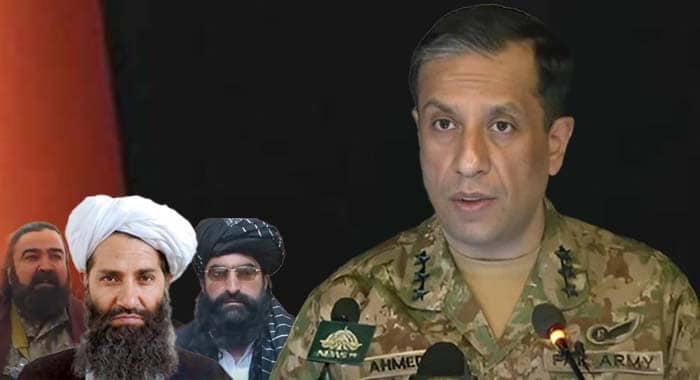
Pakistan’s military on Thursday brought the leadership of terrorist organizations operating from Afghanistan into focus, naming prominent figures including internationally recognized terrorist Bashir Zeb and Gul Bahadur while questioning the whereabouts of banned Tehreek-e-Taliban Pakistan (TTP) chief Mufti Noor Wali Mehsud.
The issue was raised during a briefing by Director General Inter-Services Public Relations (DG ISPR) Lieutenant General Ahmed Sharif Chaudhry while discussing the reported meetings among terrorist organizations in Kandahar and the broader relationship between the Afghan Taliban and groups involved in attacks against Pakistan.
The military spokesperson specifically mentioned Bashir Zeb, whom he described as an internationally recognized terrorist, as well as Gul Bahadur, whom he referred to as a Khariji. He also questioned the whereabouts of Mufti Noor Wali Mehsud, the TTP chief, in the context of the terrorist leadership operating from Afghan territory.
The remarks put the individuals at the center of Pakistan’s longstanding complaint that Afghanistan is providing space to terrorist leaders whose organizations are responsible for attacks inside Pakistan.
Pakistan has previously identified Noor Wali Mehsud, Bashir Zeb and Gul Bahadur as terrorist leaders being sheltered in Afghanistan. In a September interview, the DG ISPR said terrorist leaders including the three were being hidden in Afghan territory and reiterated Pakistan’s demand that Afghan soil not be used for terrorism against Pakistan.
The names also assume significance in connection with the Kandahar meetings that Pakistani intelligence has previously reported. A recent intelligence assessment cited by Pakistani media alleged that meetings in Kandahar brought together senior figures from the BLA, TTP and Al-Qaeda-linked networks, with discussions concerning manpower, weapons and logistical support for terrorist operations in Pakistan.
Among those reportedly identified in the August 26 Kandahar meeting was Bashir Zeb, along with other senior BLA figures, while Hafiz Gul Bahadur and other representatives of the TTP and allied networks were also reportedly present. The intelligence report alleged that the participants discussed assistance to BLA operations and arrangements involving TTP and Al-Qaeda-linked manpower and logistics.
Those earlier intelligence findings were not themselves the new revelation on Thursday. Rather, the significance of the latest briefing lies in the military spokesperson again putting the terrorist leadership and its alleged Afghan sanctuary directly into the public discussion while explaining Pakistan’s assessment of the Kandahar-based network.
The briefing also linked the issue to Pakistan’s wider allegations concerning external support for terrorist organizations. Pakistani authorities have repeatedly accused India of sponsoring terrorism against Pakistan, including through support for groups such as the TTP and BLA, while India rejects those allegations. A recent Pakistani intelligence report similarly alleged coordination between India’s RAW, Afghan intelligence structures and terrorist groups, including alleged financing for BLA-TTP operations. Those allegations have not been independently verified.
The Kandahar discussion therefore brings together several strands of Pakistan’s current counterterrorism concerns: the presence of senior terrorist leaders in Afghanistan, alleged cooperation among the TTP, BLA and Al-Qaeda-linked networks, and claims of external financial and operational support.
For Pakistan, the question extends beyond the existence of individual terrorist commanders. The military has repeatedly argued that terrorist organizations attacking Pakistan maintain recruitment, training, logistical and leadership infrastructure across the border, and that the Afghan Taliban must prevent its territory from being used for such activity.
The latest remarks consequently place the terrorist leadership itself at the center of the Kandahar question, with the whereabouts and activities of figures such as Noor Wali Mehsud, Bashir Zeb and Gul Bahadur forming part of Pakistan’s broader case over terrorist sanctuaries and cross-border attacks.



