
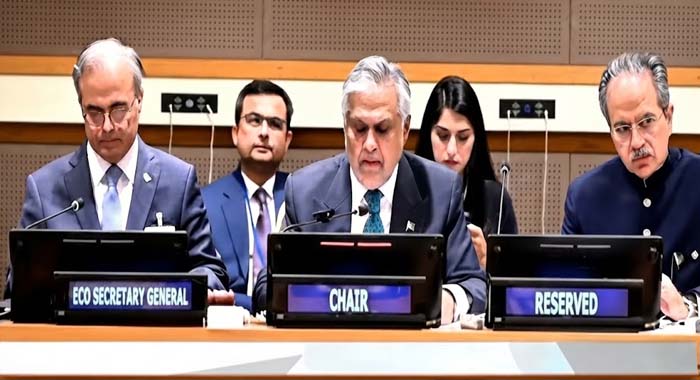
Deputy Prime Minister and Foreign Minister Senator Mohammad Ishaq Dar has warned that the threat of terrorism emanating from Afghanistan is undermining regional peace, stability, and economic development, calling on the Taliban government to take concrete and verifiable action against the Tehreek-e-Taliban Pakistan (TTP), Balochistan Liberation Army (BLA), and other affiliated groups.
Addressing the informal meeting of the Economic Cooperation Organization (ECO) Council, Senator Ishaq Dar said that lasting peace and meaningful economic progress in the region cannot be achieved unless the security challenges facing neighbouring countries are effectively addressed.
He stated that Pakistan wants to see a peaceful, prosperous, stable, and fully integrated Afghanistan that maintains peaceful relations with its neighbours. Pakistan, he noted, has pursued a policy of constructive engagement with Afghanistan and has provided various facilities to support bilateral trade, transit trade, and regional economic interaction.
However, the Deputy Prime Minister made clear that Pakistan’s expectation from the Taliban government is that it must address Islamabad’s legitimate security concerns and take practical, verifiable measures against groups that pose a threat to Pakistan’s sovereignty and the lives of its citizens.
Senator Dar specifically called for effective action against the TTP, BLA, and other associated groups, stressing that the continued presence and activities of such elements constitute a serious challenge to regional security. He emphasized that the elimination of the terrorism threat from Afghanistan is essential for creating the conditions necessary for sustained peace, stability, trade, and development across the region. Pakistan, he said, remains committed to constructive engagement but expects meaningful steps to address the security concerns that directly affect its people and national sovereignty.
Turning to the economic agenda, Senator Dar highlighted the enormous potential of the ECO region, which covers approximately 8 million square kilometres and is home to around 500 million people. Despite its vast geographical area, population, strategic location, and economic resources, the ECO region currently accounts for only around 2.2 percent of global trade, he noted.
The figures, according to the Deputy Prime Minister, demonstrate the considerable room for expansion in regional trade and economic cooperation. He emphasized that greater regional integration could unlock significant opportunities for investment, commerce, transportation, energy cooperation, and economic growth among ECO member states.
Senator Dar also highlighted the strategic importance of connectivity between Central and South Asia, saying that regional connectivity projects could open new avenues for economic cooperation and help countries realize their full commercial potential. He reaffirmed Pakistan’s readiness to play the role of a gateway for Central Asian states to the Arabian Sea, providing access to important maritime trade routes and international markets.
According to the Deputy Prime Minister, the development of efficient transport and trade corridors could strengthen commercial links between Central Asian economies and Pakistan’s seaports while creating new opportunities for regional businesses.
Senator Dar stressed that regional integration requires practical measures that make the movement of people and goods faster, easier, and more efficient. He identified improvements in visa regimes, cross-border movement, transit arrangements, digital integration, and regional transportation systems as important priorities for the ECO agenda. Enhanced connectivity, he said, would not only facilitate trade but could also promote greater people-to-people interaction and strengthen economic interdependence among member states.
The Deputy Prime Minister described the ECO Strategic Objectives for 2026–2035 as an important framework for strengthening regional cooperation during the coming decade. He emphasized the need to translate the organization’s shared objectives into practical initiatives capable of delivering tangible benefits to ECO member states.
Senator Dar also referred to preparations for the 30th ECO Council of Ministers meeting, scheduled to take place in Islamabad in November, and expressed Pakistan’s readiness to work closely with all ECO member states and the ECO Secretariat. He said Pakistan looks forward to working collectively with ECO partners to advance regional trade, connectivity, economic integration, and shared prosperity.
Senator Dar’s remarks underscored Pakistan’s position that regional economic ambitions cannot be separated from the prevailing security environment. For the ECO region to realize its considerable economic potential, he stressed, efforts toward connectivity, trade, investment, and development must be accompanied by effective measures to address terrorism and security threats.
Pakistan remains committed to strengthening regional cooperation and promoting a peaceful, stable, connected, and economically integrated ECO region



