
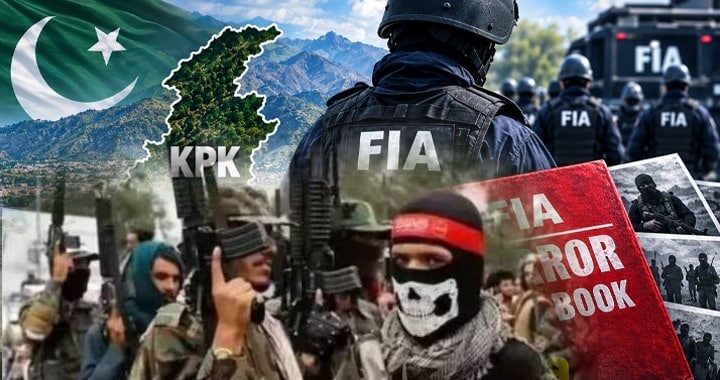
The numbers in the Federal Investigation Agency’s 2026 terror Red Book are difficult to overlook.
Of the 1,804 high-profile and most-wanted terrorists listed in the 1,878-page directory, 1,179 are from Khyber Pakhtunkhwa. That means roughly two out of every three names in Pakistan’s national terrorism wanted list are associated with the province.
The figure does not mean that 1,179 active terrorists are currently operating inside Khyber Pakhtunkhwa. A Red Book is a wanted-person directory, not a live battlefield map. The individuals listed may have different organizational affiliations, roles, locations and legal cases.
But the concentration is still significant.
It raises a larger question: why does Khyber Pakhtunkhwa account for such a large share of Pakistan’s most-wanted terrorism suspects?
The answer lies in a combination of geography, history, terrorist infrastructure, cross-border dynamics and the province’s continuing exposure to violence.
Geography Is Part of the Answer
Khyber Pakhtunkhwa occupies Pakistan’s most strategically sensitive frontier with Afghanistan.
The province includes a long international border, mountainous terrain, former tribal areas and routes that have historically connected population centers on both sides of the frontier. These characteristics have complicated the task of monitoring movement and dismantling clandestine networks.
For terrorist organizations, difficult terrain and established cross-border routes can provide opportunities for concealment, movement and logistical support.
For law-enforcement agencies, the same geography creates a very different problem.
A terrorist network does not need to control territory in the conventional sense to exploit the terrain. Small groups can move between remote locations, establish temporary hideouts, maintain local support structures and attempt to cross the border when under pressure.
That makes Khyber Pakhtunkhwa particularly vulnerable to a terrorism threat that is both local and transnational.
The Afghanistan Factor Cannot Be Ignored
The second major part of the explanation is Afghanistan.
Pakistan has repeatedly accused the Afghan Taliban authorities of allowing the banned TTP to maintain sanctuaries on Afghan territory. Kabul rejects the accusation and says it does not allow Afghan soil to be used against other countries.
But the security dimension remains central to Pakistan’s counterterrorism calculations.
Recent developments have continued to demonstrate the cross-border nature of the threat. In September, Pakistan’s military said its forces killed 15 TTP members attempting to cross from Afghanistan into North Waziristan after a prolonged engagement. The incident was another illustration of how violence involving Khyber Pakhtunkhwa can have a direct cross-border component.
At the United Nations in August, UNAMA also described the continued presence of terrorist groups on Afghan soil as part of the unresolved security issues between Afghanistan and Pakistan, while speakers identified groups including the TTP, Al-Qaeda and ISKP as matters of concern.
This does not mean every person listed in the Red Book is based in Afghanistan, nor does the Red Book itself establish the location of every wanted individual.
It does, however, help explain why Khyber Pakhtunkhwa remains at the center of Pakistan’s counterterrorism challenge.
KP’s Terrorism Problem Is Not One Organization
Another important feature of the Red Book is the range of organizations represented.
The list includes individuals associated with the banned TTP, Lashkar-e-Taiba, Jaish-e-Mohammed, Jamaat-ul-Ahrar, Lashkar-e-Islam, the Balochistan Liberation Army, Lashkar-e-Jhangvi, Islamic State Khorasan and Al-Qaeda in the Indian Subcontinent.
That diversity matters.
Khyber Pakhtunkhwa’s terrorism problem cannot simply be reduced to one organization operating in one part of the province.
Different groups have different histories, structures and operational priorities. Some have focused heavily on attacks against security forces. Others have been associated with sectarian violence, suicide attacks or transnational jihadist networks.
The province’s proximity to Afghanistan has also allowed different terrorist ecosystems to overlap, even when the organizations themselves remain distinct.
The result is a security environment in which dismantling one network does not automatically eliminate the wider threat.
From Tribal Areas to Settled Districts
The geography of the problem has changed as well.
The terrorism challenge is no longer confined to the former tribal districts or remote border areas.
Peshawar, Hangu, Kohat, Karak, Bannu, Dera Ismail Khan and other settled and semi-settled areas have repeatedly appeared in Pakistan’s security picture.
Recent operations in Khyber Pakhtunkhwa have involved intelligence-based raids against suspected terrorist hideouts, while attacks have targeted police, security forces and civilian locations.
This creates a difficult counterterrorism equation.
A terrorist network may have its leadership, facilitators or logistical infrastructure in one location while attempting attacks somewhere else. The person who carries out an attack may therefore represent only the most visible component of a much larger network.
That is precisely why the Red Book should not be read merely as a list of individuals.
It is also a window into the breadth of the counterterrorism challenge.
1,179 Names Are Not 1,179 Networks
There is another important caveat.
The 1,179 names from Khyber Pakhtunkhwa should not be interpreted as 1,179 separate terrorist organizations, cells or active combatants.
Some individuals may be associated with the same networks. Some may have different levels of operational importance. Some may be wanted in connection with specific cases rather than current battlefield activity.
The Red Book’s value therefore lies partly in what it represents as an investigative and law-enforcement tool.
The FIA’s Counter Terrorism Wing is specifically tasked with terrorism and terrorist-financing investigations, among other responsibilities.
The list can help consolidate information about wanted individuals, facilitate coordination between agencies and provide a reference for efforts to locate suspects.
But listing someone is not the same as removing the threat.
The Real Challenge Begins After the Name Is Printed
This may be the most important point raised by the Red Book.
A name on a wanted list represents unfinished counterterrorism work.
The ultimate objective is not to maintain an impressive directory of terrorists. It is to reduce the number of people capable of carrying out attacks and dismantle the networks that allow them to operate.
That means locating wanted individuals.
It means identifying their facilitators.
It means tracing their finances.
It means disrupting weapons and explosives supply chains.
It means identifying recruiters and communications networks.
And where evidence establishes criminal responsibility, it means bringing suspects before the courts.
Otherwise, a Red Book risks becoming a record of the problem rather than an instrument for reducing it.
Why KP Matters to the National Security Picture
The 1,179 figure therefore says something larger about Pakistan’s terrorism landscape.
Khyber Pakhtunkhwa is where geography, history and the contemporary regional security environment converge.
It sits next to Afghanistan.
It contains terrain that can complicate surveillance and movement control.
It has experienced decades of terrorist violence.
It contains communities that have repeatedly suffered attacks and displacement.
And it remains a principal theatre of the confrontation between Pakistani security forces and terrorist organizations operating along the Pakistan-Afghanistan frontier.
The province’s position in the Red Book is therefore not simply a matter of numbers.
It reflects the accumulated weight of a terrorism problem that has evolved over decades and continues to adapt.
The Question Behind the Numbers
The most revealing figure in the 2026 Red Book may not ultimately be 1,804.
It may be 1,179.
Not because every one of those names represents an immediate threat, but because the concentration shows where an extraordinary share of Pakistan’s counterterrorism burden remains concentrated.
The question now is what happens to those names.
If they lead investigators to facilitators, financiers, recruiters and operational commanders, the Red Book can become a tool for dismantling terrorist networks.
If they simply remain names in an expanding directory, the underlying problem remains.
For Khyber Pakhtunkhwa, the challenge is therefore larger than eliminating individual terrorists after an attack or adding new suspects to a wanted list.
The real test is whether the networks that produce those names can be systematically dismantled.
Until that happens, the Red Book’s overwhelming concentration of names from Khyber Pakhtunkhwa will remain not just a statistic, but a measure of how much of Pakistan’s terrorism challenge continues to run through the province.



