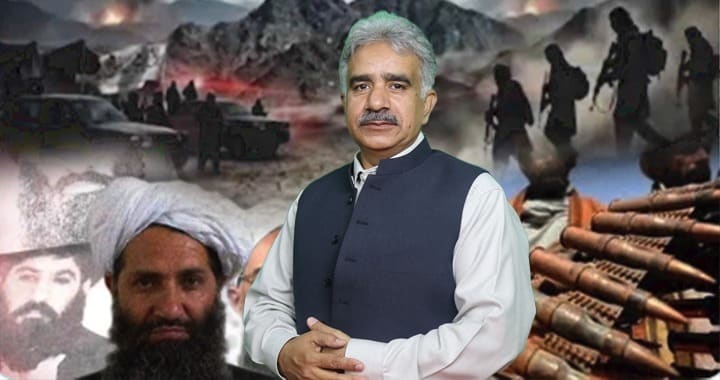
For years, the world has been told that Al-Qaeda was dismantled, weakened and pushed into the shadows. I do not believe that assessment reflects the reality we are witnessing today. Al-Qaeda may no longer operate exactly as it did two decades ago, but its network has not disappeared. It has changed its methods, expanded its relationships and increasingly worked through regional terrorist organizations.
The recent United Nations reporting on terrorist networks is important in this regard because it reflects what we have been observing for some time. Al-Qaeda is not simply surviving in isolation. It is patronizing, supporting, training and helping strengthen regional organizations, including the banned Tehreek-e-Taliban Pakistan (TTP) and the Balochistan Liberation Army (BLA).
This is no longer merely an ideological relationship. It is developing into an ecosystem.
Al-Qaeda’s Regional Network Is Becoming More Sophisticated
The most worrying aspect is the increasingly organized nature of these relationships. Al-Qaeda’s connections with the Afghan Taliban, the Haqqani Network and the Hafiz Gul Bahadur Group are particularly significant from Pakistan’s perspective.
The threat is also transnational. Al-Qaeda’s network extends beyond one organization or one geographical area, involving groups operating across Afghanistan, Pakistan, Central Asia and other parts of the region. Its links with the East Turkestan Islamic Movement, the Turkestan Islamic Party and Central Asian organizations show that the objective is broader than simply sustaining an insurgency inside Afghanistan.
The same pattern can be seen in the development of terrorist capabilities. Groups that previously relied primarily on conventional small arms are increasingly acquiring sophisticated weapons, surveillance equipment, night-vision devices, drones and other technologies. The training and organizational support available to them is allowing them to develop capabilities that were previously beyond their reach.
The emergence of drone and quadcopter capabilities among terrorist organizations is particularly concerning. The TTP has even spoken about developing a structure capable of operating drones, while BLA terrorists have displayed access to sophisticated equipment. These developments should not be viewed as isolated innovations. They indicate a broader transfer of knowledge and capabilities within the terrorist ecosystem.
Afghanistan Provides the Space These Networks Need
The fundamental question is not simply where Al-Qaeda operates. It is how it continues to obtain the space required to survive.
Al-Qaeda does not have the same territorial roots as some regional organizations. It needs shelter, recruitment, training facilities and an environment in which its leadership can operate. Afghanistan has historically provided such space, and evidence of the continued presence of Al-Qaeda leadership and associated foreign terrorist commanders remains deeply troubling.
The history of Al-Qaeda’s presence in Afghanistan cannot be separated from the Taliban’s political and security structure. The organization’s relationships with elements associated with the Afghan Taliban and other terrorist groups have created an environment in which transnational networks can maintain themselves.
This is why Pakistan’s security concerns cannot be treated as a bilateral disagreement with individual terrorist groups. When terrorists move from Afghanistan into Balochistan or Khyber Pakhtunkhwa, the consequences are felt inside Pakistan, but the network supporting them is much wider.
The TTP and BLA Are Part of a Wider Expansionist Pattern
We also need to stop looking at the TTP and BLA as completely separate phenomena.
Their objectives and operational environments are different, but the broader terrorist ecosystem allows knowledge, resources, training and propaganda methods to move between organizations. Al-Qaeda’s role is particularly important because it has decades of experience in building networks rather than depending entirely on a single organization.
The same pattern can be seen among terrorist organizations operating in Central Asia and elsewhere. Al-Qaeda’s strength lies partly in its ability to connect groups without necessarily forcing them into a single formal structure.
That is why I describe this as an ecosystem. These organizations can retain their individual identities while benefiting from shared expertise, resources and infrastructure.
The Threat Has Also Moved Into the Digital World
The transformation is not limited to weapons and training. Terrorist organizations have also transformed the way they recruit, raise funds and spread propaganda.
In the past, recruitment depended heavily on physical gatherings, mosque announcements, personal contacts and clandestine meetings. Today, a terrorist recruiter can sit in a room and reach thousands of people through social media and encrypted or concealed online channels.
This has made hybrid warfare considerably more dangerous.
Terrorist organizations do not merely publicize successful attacks. They create narratives around them. When an attack succeeds, they portray it as evidence of their strength. When their terrorists are eliminated, they attempt to generate sympathy and portray their losses as victories or sacrifices.
The objective is to create fear.
Fear itself becomes a weapon because frightened communities are less likely to provide information, cooperate with authorities or testify against terrorists. If people believe that terrorists are invincible, the terrorist organization has already achieved a psychological victory before carrying out its next attack.
That is why Pakistan’s response cannot be limited to kinetic operations. Security forces must disrupt terrorist networks, but the state and society must also challenge the propaganda and fear that protect those networks.
Why Does the Region Remain Volatile?
I also believe we need to examine the wider geopolitical environment.
There are undoubtedly failures within our own political and administrative systems. Our rulers and institutions have made mistakes, and we must acknowledge them. But I do not believe every development in this region can be explained by domestic failures alone.
The instability stretches far beyond the Pashtun belt. Baloch communities are suffering, Hazara communities have faced massacres, and Central Asian populations are also affected by terrorism. Therefore, reducing this entire conflict to ethnicity, language or geography is a mistake.
This is a much broader regional phenomenon.
The countries of this region possess enormous human and natural resources. Pakistan, Afghanistan, Iran, China, Russia and the Central Asian republics collectively represent an enormous economic and strategic space. If this region becomes peaceful and economically integrated, its resources, trade routes and technological potential could transform the wider balance of power.
China’s industrial and technological rise, its investment in regional connectivity and the potential value of rare-earth resources demonstrate what is at stake.
In my assessment, this is one reason we must examine very carefully who benefits when this region remains unstable.
Taliban Promises Must Be Measured Against Reality
The Afghan Taliban have repeatedly given assurances that Afghan soil will not be used against Pakistan. There have also been efforts to relocate or contain some terrorist families and groups.
But the fundamental question remains: are these measures sufficient?
If terrorist networks continue to train, recruit, reorganize and develop new capabilities on Afghan soil, then assurances alone cannot resolve Pakistan’s security concerns.
The regional countries are all feeling the consequences. Pakistan is facing terrorism in Khyber Pakhtunkhwa and Balochistan. Iran has its own security concerns. Central Asian states remain worried about extremist networks. China has concerns about terrorist organizations with regional and transnational ambitions.
This should therefore be treated as a collective regional security challenge.
Pakistan Must Fight the Terrorist Narrative Alongside the Terrorists
The terrorist threat today is more sophisticated than the one we confronted in the past. Al-Qaeda has not disappeared. It has adapted.
Its strength increasingly lies in the networks it supports, the capabilities it helps develop, the ideological narratives it promotes and the space in which affiliated organizations operate.
Pakistan must therefore continue its counterterrorism operations while simultaneously confronting the propaganda machinery behind terrorism. Communities must understand that reporting suspicious activity is not merely cooperation with the state. It is part of protecting their own families and communities.
The objective of terrorists is not only to kill. It is to intimidate, divide and create the perception that the state cannot protect its citizens.
We must deny them that psychological victory.
The real challenge before Pakistan and the wider region is therefore much larger than defeating one terrorist organization. It is dismantling the ecosystem that allows these organizations to survive, cooperate, recruit, acquire capabilities and project fear.
Al-Qaeda may have changed its face, but the threat has not gone away.