
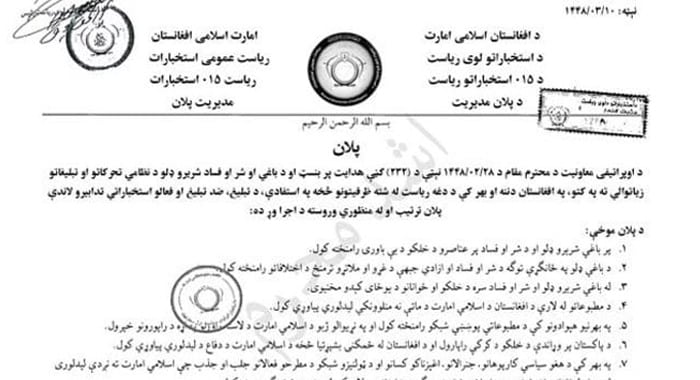
Leaked documents from the Taliban’s General Directorate of Intelligence (GDI) have exposed a 70.7 million Afghani plan focused on psychological warfare and propaganda rather than addressing the pressing needs of the Afghan people.
According to the documents, the funds have been allocated for a range of propaganda activities aimed at strengthening the Taliban’s narrative, discrediting its opponents and undermining anti-Taliban resistance leaders.
The plan reportedly includes efforts to create divisions among opposition groups, portray the activities of anti-Taliban forces as being linked to Pakistan, influence public opinion and weaken support for those challenging Taliban rule.
A significant portion of the proposed spending is also directed toward expanding and coordinating pro-Taliban messaging on social media. The documents include allocations for creating and managing multiple social media accounts and coordinating their activities to promote narratives favorable to the Taliban.
The budget contains separate allocations of 30 million and 20 million Afghani for various propaganda-related activities, forming a substantial part of the overall 70.7 million Afghani plan.
The disclosures raise questions about the Taliban’s priorities at a time when Afghanistan continues to face severe economic and humanitarian pressures. Millions of Afghans require access to employment, education, food and basic public services, yet the leaked plan indicates that a substantial amount of money is being directed toward information warfare and efforts to suppress or discredit political and armed opposition.
Rather than using such resources to improve living conditions or expand opportunities for ordinary Afghans, the plan focuses heavily on managing public perception and attacking those who oppose Taliban rule.
The effort to portray anti-Taliban resistance as a Pakistani project also reflects the Taliban’s broader approach of shifting attention toward external actors while facing growing domestic opposition. Anti-Taliban fronts have continued to carry out attacks against Taliban positions in several parts of Afghanistan, putting additional pressure on the group’s claim of comprehensive control.
The reported allocation for coordinated social media operations further indicates the importance the Taliban places on controlling the information environment. By establishing multiple accounts and coordinating their messaging, the group appears to be seeking to amplify pro-Taliban narratives while discrediting competing voices.
The documents therefore offer an indication of how the Taliban is attempting to fight its opponents beyond the battlefield, combining security measures with organized propaganda, psychological operations and information manipulation.
For ordinary Afghans, however, the central issue remains one of priorities. At a time when people need jobs, education, food and functioning basic services, the allocation of 70.7 million Afghani toward propaganda and psychological warfare raises serious questions about whether public resources are being used to serve the population or to protect and promote the Taliban’s hold on power.
The disclosures also underline the increasingly political nature of the Taliban’s information campaign, as the group seeks not only to confront armed opponents but also to shape how Afghans perceive resistance to its rule.



