
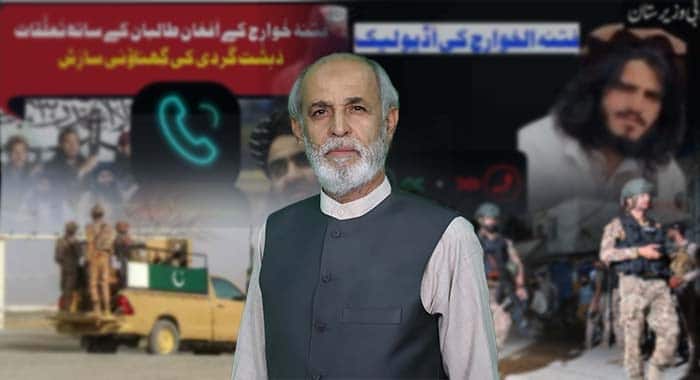
Shamim Shahid
The latest security developments emerging from South Waziristan and other troubled areas of Pakistan’s western frontier should not be viewed as isolated incidents. Taken together, reports of an alleged suicide-attack plot, clashes between local tribes and militants, continuing counterterrorism operations in Balochistan, and the prolonged deadlock between Islamabad and Kabul point toward a much larger and more complicated security challenge.
At the heart of this challenge lies a simple but uncomfortable reality: Pakistan’s battle against terrorism is not merely a contest between the state and armed groups. It is also a struggle over the future of communities that have spent years caught between militancy, counterterrorism operations, economic isolation and political uncertainty.
The reported audio from the South Waziristan border area is therefore significant not only because of the alleged attack plan it contains, but because it provides another glimpse into the environment in which militant networks attempt to operate.
According to the broadcast, the audio allegedly features a conversation between two individuals identified as Shirin and Fateh, who were described as having links to Afghan Taliban groups. The discussion reportedly concerned preparations for a suicide attack involving a vehicle. The plan was said to have been scheduled for September 2 and was subsequently described as having failed.
There remains uncertainty, however, about the fate of the two individuals. It has not been established from the information provided whether they were killed, arrested or escaped after the alleged plot was disrupted. That uncertainty is important. In matters of national security, preliminary claims must be distinguished from confirmed facts, particularly when they concern individuals, organizations and alleged terrorist operations.
Nevertheless, the alleged plan deserves serious attention.
The area identified in the discussion Angur Ada-Azam Warsak in South Waziristan is situated close to the Pakistan-Afghanistan border. The broadcast describes the corridor as currently closed, with economic and social activity severely restricted. Such circumstances create a particularly difficult environment for border communities. When normal commerce, mobility and social interaction disappear, security problems can become intertwined with economic hardship and social alienation.
The alleged target, according to the broadcast, was a security installation. Had such a plan succeeded, the consequences could have been severe. Suicide attacks and remotely detonated explosives are designed to create maximum casualties, fear and disruption. Their victims can include civilians, security personnel and other people who happen to be present at the location. A failed attack is therefore not merely a statistic; it potentially represents lives saved.
That is why the reported failure of the alleged operation should be viewed as a positive development while still prompting difficult questions. How was the plot detected? Were the planners operating independently or as part of a larger network? Were facilitators involved? Did the plan originate locally or involve cross-border connections? And, perhaps most importantly, what mechanisms can prevent similar plans from progressing from discussion to execution?
These are questions that require professional investigation rather than speculation. Perhaps the most significant aspect of the current situation is not the alleged attack plan itself, but the growing tension between militant groups and sections of the local population. The broadcast reports that clashes occurred in Zarmelan between local people and militants, with reports of casualties on both sides. The available account suggested that four people were killed, including individuals described as civilians as well as militants. Authorities, according to the broadcast, said that security had been tightened and further action was being taken.
If confirmed, such clashes reveal an important dimension of the conflict. Local communities are not necessarily passive observers of militancy. In many parts of the former tribal areas, ordinary residents have historically opposed militant groups when those groups threatened their homes, livelihoods, authority and traditional social structures. South Waziristan has experienced this dynamic before. The broadcast traces local resistance back to the years when militancy expanded dramatically in the region. It refers to incidents beginning in 2003 and subsequently to the 2004 Nek Muhammad episode, followed by developments in 2007 when local tribes, including members of the Zalikhel tribe, reportedly organized against Uzbek and other foreign militants.
The formation of peace committees was an important part of this local resistance. Such committees cooperated with the government and security forces in attempts to prevent militants from consolidating their influence. This history matters because it challenges the simplistic assumption that tribal communities and militants are naturally aligned. They are not. In many cases, local people have paid an enormous price for resisting militancy. Those who cooperate with the government, form peace committees or organize against armed groups can subsequently become targets themselves. Once militants identify a community leader, tribal elder or member of a peace committee as an opponent, that person may face threats, assassination or intimidation.
This creates a cruel paradox. The state needs local communities to resist militancy, but if those communities are left vulnerable, their willingness to resist can eventually disappear. That is why protecting local partners should be treated as a central component of counterterrorism policy. A tribal elder who speaks against militancy, a community member who provides information, or a local group that rejects armed extremism is not simply a civilian actor. In practical terms, such people can become an important part of the security architecture. The government therefore needs a comprehensive policy toward these communities one that goes beyond asking them to cooperate during crises. They need protection. They need political representation. They need economic opportunities. And they need confidence that standing against terrorism will not leave them exposed after the immediate security operation ends.
The security situation cannot be understood by focusing exclusively on South Waziristan. The broadcast also highlights continuing operations in Kharan, Masdum and other parts of Balochistan. It refers to claims that approximately 50 militants were killed in an operation in the days preceding the discussion. Such figures, like all battlefield casualty claims, should ideally be independently verified. But even without relying on any single number, the broader picture is clear: violence and counterterrorism operations remain serious problems in both Khyber Pakhtunkhwa and Balochistan.
The nature of militancy in the two provinces is not identical. Khyber Pakhtunkhwa has faced persistent attacks by militant organizations, including the Tehreek-e-Taliban Pakistan (TTP). Balochistan, meanwhile, faces both militant violence and separatist insurgency. The motivations, organizational structures and political narratives behind these movements differ, but their impact on citizens can converge: insecurity, deaths, displacement, disrupted commerce and declining confidence in the state.
This distinction is important because Pakistan needs policies tailored to different forms of violence rather than treating every security problem as if it has a single cause. Military and intelligence operations may be necessary against armed groups, but force alone cannot permanently eliminate the conditions that allow militancy to regenerate. A sustainable strategy must combine security with governance, justice, economic development, political inclusion and local participation.
There is another dimension to the South Waziristan story that deserves much greater attention the economic consequences of prolonged border closures and insecurity.
The Angur Ada-Azam Warsak corridor, as described in the broadcast, has been closed, eliminating normal economic and social activity. When a border crossing shuts down, the consequences are not limited to customs statistics. Truck drivers lose work. Traders lose markets. Transporters lose income. Shopkeepers lose customers. Families lose access to relatives across the border. Farmers and producers lose potential markets.
A security policy that closes economic routes indefinitely may sometimes be unavoidable, but it should never become a permanent substitute for a broader strategy. Security and economic activity are not necessarily competing objectives. In many frontier regions, legitimate trade can itself become a stabilizing force.
People who have dependable livelihoods have more to lose from instability. Communities with functioning markets, schools, health facilities and political institutions are generally better positioned to resist armed groups than communities where the state is visible primarily through checkpoints and military operations.
That is why border management must be accompanied by economic planning. Perhaps the most consequential issue raised in the broadcast is the relationship between Pakistan and Afghanistan. According to the discussion, there has been no significant improvement in relations between Kabul and Islamabad, despite statements by Afghanistan’s ambassador in Pakistan, Ahmad Shukib, that were reportedly welcomed because they included suggestions for resolving outstanding problems.
After those remarks, however, meaningful contact appears to have remained limited. The result is a dangerous diplomatic silence. Pakistan and Afghanistan cannot afford an indefinite absence of communication. Their geography guarantees that problems in one country will often have consequences for the other. Border security, terrorism, refugees, trade, transit and people-to-people relations are interconnected.
When official channels stop functioning, misunderstandings grow. When misunderstandings grow, suspicion grows with them. And when suspicion becomes entrenched, non-state actors can exploit the resulting vacuum. The broadcast also highlights the closure of bilateral trade and its economic consequences for Pakistan. A business meeting in Lahore was cited as an example of growing concern within the commercial sector, with demands for the reopening of trade and the border.
One estimate mentioned in the discussion suggested that Pakistan could earn around $2 billion in a few months if trade were restored. Whether that precise projection materializes is a separate question, but the broader economic argument is difficult to ignore. Pakistan’s industrial, agricultural and transport sectors are connected to regional trade. Prolonged disruption affects businesses and workers far beyond the immediate border areas.
Yet reopening trade cannot simply mean ignoring security concerns. The real challenge is to develop a system in which security and commerce reinforce each other. The most important lesson from the current situation may be this: Pakistan and Afghanistan need to talk precisely because they disagree. Dialogue is not a reward for good behavior. It is a mechanism for managing disagreement. If Islamabad and Kabul disagree over militant activity, border management or trade, those disputes need channels through which they can be discussed. If there are allegations that militants are using territory across the border, the answer cannot be permanent silence.
Diplomatic contact does not mean surrendering national interests. On the contrary, a country is often better able to defend its interests when it has functioning diplomatic channels. Trade negotiations, security talks, intelligence coordination, border mechanisms and political engagement can all coexist with firm national positions. The alternative is far more dangerous: a vacuum in which every incident becomes a crisis and every crisis further reduces the possibility of communication.
Pakistan now faces the need for a multidimensional response. First, security agencies must continue disrupting terrorist plots before they become attacks. Intelligence-led operations are particularly important because preventing an attack is far more valuable than responding after lives have been lost. Second, local communities must be treated as partners rather than merely as populations living in conflict zones. The history of peace committees and tribal resistance demonstrates that communities can play a powerful role in confronting militants but only if they are protected. Third, counterterrorism operations in Balochistan and Khyber Pakhtunkhwa should be accompanied by stronger civilian governance and economic development. Security cannot be separated from the everyday conditions in which people live.
Fourth, border management must balance security with legitimate trade and movement. Closed borders may reduce immediate risks, but indefinite closure can deepen economic frustration and create new vulnerabilities. Finally, Islamabad and Kabul need to restore meaningful communication. Neither country benefits from an atmosphere of permanent suspicion. The current situation in South Waziristan should therefore be seen as a warning rather than simply another security headline. The alleged suicide-attack plan, the clashes between militants and local residents, the operations in Balochistan, the vulnerability of tribal peace-builders, and the Pakistan-Afghanistan diplomatic deadlock are interconnected pieces of a much larger puzzle.
Pakistan cannot solve this puzzle through force alone. Nor can diplomacy alone resolve the threat posed by armed groups. The country needs both: effective security and sustained political engagement. Most importantly, it needs the people living on the frontline to be placed at the center of the strategy. They have already experienced years of terrorism, displacement, economic disruption and uncertainty. Many have demonstrated a willingness to stand against militants, sometimes at enormous personal cost. If Pakistan wants lasting peace in its western border regions, it must ensure that those who choose peace are not left unprotected.
The ultimate test of counterterrorism policy is not the number of operations conducted or the number of militants claimed killed. The real measure is whether ordinary citizens can eventually live without fear, whether businesses can function, whether borders can support legitimate commerce, and whether communities can trust both the state and their own future. South Waziristan has been at the center of Pakistan’s security story for far too long. The time has come to make it part of Pakistan’s peace story as well.



