
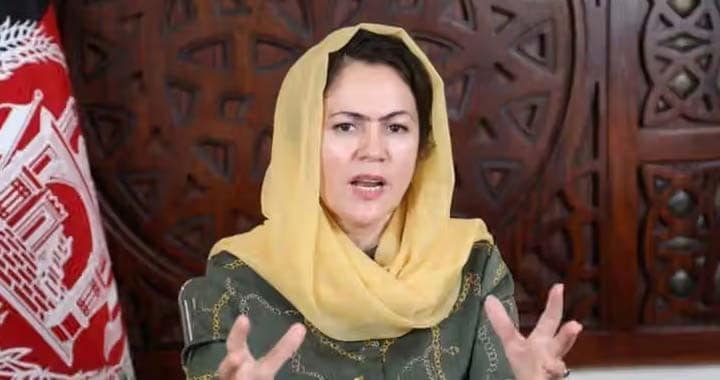

Former Afghan parliamentarian and women’s rights activist Fawzia Koofi has called for stronger and more coordinated international action against the Taliban, arguing that Afghanistan’s worsening crisis cannot be addressed without fundamental political change in the country.
In a recent interview with an Afghan media outlet, Koofi said the international community had so far failed to exert sufficient political pressure on the Taliban to alter the situation in Afghanistan.
She argued that the country’s crisis extends well beyond human rights violations, encompassing widespread poverty, a crisis of political legitimacy, repression of the population and the absence of a democratic political system.
Koofi said meaningful political change would require regional countries to adopt a coordinated approach towards the Taliban and work more closely with Afghan political forces.
She also called for greater pressure through international institutions, tougher sanctions targeting Taliban leaders and closer coordination between Afghan political groups and regional states.
Accountability Mechanisms
Koofi also raised concerns over the implementation of the Independent Investigative Mechanism for Afghanistan, approved by the UN Human Rights Council last year to investigate human rights violations in the country.
She said the mechanism had yet to become fully operational because of insufficient financial resources, adding that a European Union representative had pledged financial assistance for the mechanism during a recent meeting in Geneva.
According to Koofi, the investigative mechanism could play a significant role in collecting information, documents and evidence concerning human rights violations, particularly abuses against women and girls, and sharing that material with relevant international institutions.
She also criticized the international community’s response to the situation facing Afghan women, arguing that declining international attention to Afghanistan must not translate into declining responsibility towards its people.
Koofi said Afghanistan was no longer at the center of global attention, but that this should not lead the international community to overlook the country’s population, particularly women and girls.
She further accused the Taliban of using religious and cultural arguments to justify restrictions imposed on women and girls, arguing that such policies have no legitimate basis in Islam.
Koofi said Islam places clear emphasis on education and the equality of human beings, and accused the Taliban of misusing religion to justify its policies.
Calls for International Accountability
The former parliamentarian also called for those responsible for human rights violations in Afghanistan to be held accountable, describing accountability as a prerequisite for lasting peace.
She argued that timely accountability for perpetrators of serious crimes and rights violations committed over the past five decades could have served as a deterrent and a lesson for those continuing to violate human rights.
Koofi backed efforts to pursue Afghanistan-related cases through international judicial mechanisms, including the International Criminal Court and the International Court of Justice.
She also supported international efforts to have the systematic discrimination faced by Afghan women recognized as “gender apartheid” and advocated the use of universal jurisdiction to pursue those responsible for serious violations.
She urged the United Nations, UN Human Rights Council, International Criminal Court, European Union, Organization of Islamic Cooperation and other multilateral bodies to use their political and legal mechanisms to support Afghan women and pressure the Taliban to change its policies.
Koofi stressed that international action should go beyond resolutions and public statements, arguing that meaningful pressure requires political commitment, financial resources, practical solidarity and a coherent long-term strategy towards Afghanistan.



