
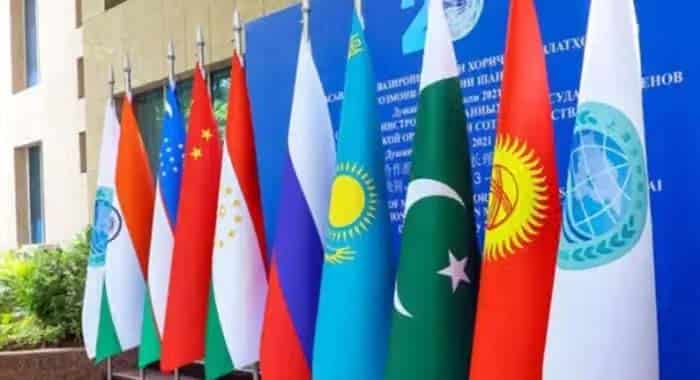
The Shanghai Cooperation Organisation (SCO) summit opened in Bishkek on Monday amid heightened regional attention to Afghanistan’s security situation, with concerns over terrorism, drug trafficking and cross-border security expected to feature prominently in discussions among member states.
The Taliban administration was once again not invited to participate in the SCO leaders’ summit, despite Afghanistan having held formal observer status in the organisation since 2012. Since returning to power, the Taliban has not attended any of the organisation’s annual leaders’ summits.
The opening day of the summit focused primarily on bilateral and multilateral engagements among participating leaders, while the main SCO leaders’ summit is scheduled to take place on Tuesday.
The summit has brought together an influential group of regional and global leaders, including Chinese President Xi Jinping, Russian President Vladimir Putin, Indian Prime Minister Narendra Modi, Iranian President Masoud Pezeshkian and Pakistani Prime Minister Shehbaz Sharif. Leaders from Kazakhstan, Kyrgyzstan, Tajikistan, Uzbekistan and Belarus are also participating in the gathering.
The summit is further being attended by United Nations Secretary-General António Guterres and Turkish President Recep Tayyip Erdoğan. Türkiye participates in the SCO as a dialogue partner rather than a full member. The gathering provides an important platform for discussions on regional security, economic cooperation and connectivity at a time of significant geopolitical and security developments across Eurasia.
Afghanistan’s security situation is expected to remain an important component of the summit’s security discussions. SCO member states, particularly Afghanistan’s immediate neighbours, have repeatedly expressed concern over the presence and activities of terrorist groups operating from Afghan territory. The threat posed by groups such as Islamic State has featured prominently in previous SCO discussions.
Concerns extend beyond terrorism to include drug trafficking and the potential for instability in Afghanistan to affect neighbouring states and the wider region. The issue was also raised during the SCO foreign ministers’ meeting held on July 24. Pakistan’s Foreign Minister Mohammad Ishaq Dar described terrorism originating from Afghanistan as one of Pakistan’s most serious security challenges, while Iran’s Foreign Minister Abbas Araghchi stressed the importance of a stable Afghanistan free from terrorism.
The Taliban administration was not represented at that ministerial meeting either. While regional security remains a major focus, the SCO summit is also expected to address a broad range of economic and strategic issues. Discussions are expected to cover economic and trade cooperation, energy, transportation and regional connectivity, reflecting the organisation’s growing role as a platform for cooperation across a large part of Eurasia.
The leaders are also expected to hold a number of bilateral meetings on the sidelines of the summit. President Vladimir Putin is scheduled to engage with the leaders of China, India, Iran and Türkiye, among other expected diplomatic interactions. These meetings provide opportunities for participating countries to discuss bilateral relations, trade, energy cooperation, strategic developments and regional security concerns.
At the conclusion of the summit, SCO leaders are expected to adopt the Bishkek Declaration, which will mark the 25th anniversary of the Shanghai Cooperation Organisation. The declaration is expected to reaffirm the organisation’s commitment to cooperation among member states and address key regional and international developments. Another significant development will be the transfer of the SCO’s rotating presidency from Kyrgyzstan to Pakistan, marking an important moment for Islamabad as it assumes responsibility for guiding the organisation’s agenda during the upcoming presidency.
Pakistan’s participation comes at a time when Islamabad continues to highlight terrorism emanating from Afghanistan as a major national and regional security concern. The SCO provides Pakistan with an important multilateral platform to engage directly with Afghanistan’s neighbours and other influential regional powers on issues including counterterrorism, border security, economic connectivity and regional stability. As Pakistan prepares to assume the organisation’s rotating presidency, Afghanistan-related security concerns are likely to remain an important element of its engagement with SCO partners.
Established in 2001, the Shanghai Cooperation Organisation has grown into a major regional grouping and now comprises 10 full members. China and Russia have increasingly used the organisation as a platform for promoting a broader vision of a multipolar international system. At the same time, the SCO officially maintains that it is not a military alliance directed against any particular country. Its expanding membership and geographical reach have nevertheless placed the organisation at the centre of discussions concerning the evolving balance of power across Eurasia.
With major powers gathered in Bishkek, the summit offers an opportunity to address interconnected challenges involving security, terrorism, energy, trade and regional connectivity.
The continued exclusion of the Taliban administration from the SCO leaders’ summit underscores the complex regional approach toward Afghanistan. While Afghanistan remains geographically and strategically central to the security concerns of many SCO members, questions surrounding terrorism, drug trafficking, political stability and regional security continue to shape the organisation’s engagement with the country.
The summit’s discussions could therefore provide further indications of how SCO members intend to address Afghanistan’s evolving security environment and its implications for neighbouring states. As leaders prepare for the main summit session on Tuesday, attention will remain focused on the Bishkek Declaration, Pakistan’s assumption of the SCO presidency, regional security priorities and the collective response to threats emanating from Afghanistan.
The Bishkek gathering thus comes at a pivotal moment for the SCO, as its members seek to strengthen regional cooperation while navigating an increasingly complex geopolitical and security landscape across Eurasia.



