
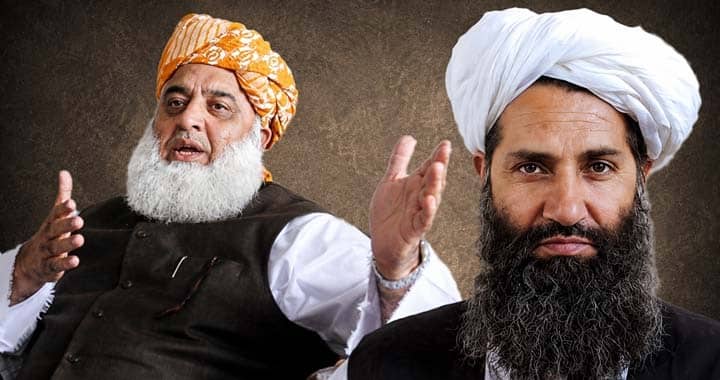
Jamiat Ulema-e-Islam-Fazl chief Maulana Fazlur Rehman is facing renewed criticism over remarks in which he reportedly told Afghan Taliban leader Sheikh Hibatullah Akhundzada that Afghanistan’s interests were more important to him than Pakistan’s.
The remarks have drawn strong criticism from political and security analysts, with senior journalist and Afghan affairs expert Aqeel Yousafzai questioning how a prominent Pakistani political leader could publicly place the interests of another country’s ruling regime above those of his own country.
Yousafzai said the reported remarks were particularly difficult to understand because they were made to the head of an Afghan Taliban regime that Pakistan has repeatedly accused of providing space and support to terrorist organizations operating against Pakistan.
He questioned whether such a statement was appropriate from the leader of a major Pakistani religious-political party and an important political stakeholder.
According to Yousafzai, the issue has attracted attention within relevant Pakistani circles, particularly because Islamabad’s security concerns regarding Afghanistan are not theoretical. Pakistan has repeatedly maintained that terrorist groups operating from Afghan soil pose a direct threat to Pakistani citizens and security forces.
Yousafzai argued that Fazlur Rehman’s position becomes even more controversial given the Taliban’s alleged links with terrorist organizations responsible for attacks in Pakistan.
He also pointed to the fact that three former leaders of the banned Tehreek-e-Taliban Pakistan, according to his account, had links to JUI-F at different points in their political or organizational lives.
The analyst said these circumstances make Fazlur Rehman’s reported remarks particularly difficult to separate from the wider debate over Pakistan’s security interests and its relationship with Afghanistan.
He further argued that Pakistan’s security establishment has made its position clear, namely that the country’s national interests and the protection of its citizens remain paramount.
The controversy comes at a time when Pakistan’s relations with the Afghan Taliban remain strained over cross-border terrorism and the alleged presence of terrorist networks in Afghanistan.
For critics of Fazlur Rehman, the central question is therefore straightforward: how can a Pakistani political leader claim to represent Pakistan’s interests while telling the leadership of a neighboring regime that Afghanistan’s interests are dearer to him?
The controversy is unlikely to disappear quickly, particularly as Islamabad continues to demand concrete action from Kabul against terrorist groups targeting Pakistan.



