
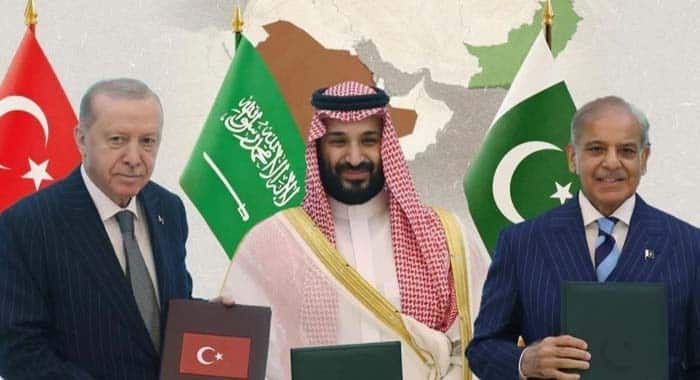
A recent analysis published by the Foreign Policy in Focus (FPIF) has described the Makkah Joint Defence Agreement between Pakistan, Saudi Arabia and Türkiye as an important development in the emergence of a regional security architecture less dependent on the traditional US-led framework.
The analysis comes after the three countries signed the agreement in Makkah, under which an armed attack against any one of the signatories is to be treated as an attack against all three.
According to FPIF, the significance of the agreement extends beyond the immediate defence commitments of Pakistan, Saudi Arabia and Türkiye, reflecting what it describes as a growing regional recognition that the existing security order needs to be redefined and complemented by stronger regional arrangements.
The analysis also points to US President Donald Trump’s public endorsement of the agreement as noteworthy. Trump welcomed the pact as a major step towards greater regional self-defence, a response that, according to the analysis, carries particular significance for Pakistan by demonstrating that Islamabad’s expanding defence cooperation with Riyadh and Ankara does not necessarily place it at odds with Washington.
A Defence Framework, Not an Anti-Iran Bloc
FPIF’s analysis cautions against interpreting the agreement simply as the creation of a Sunni military bloc against Iran.
The three signatories have maintained important channels with Tehran, while Pakistan in particular has sought to preserve relations with Iran alongside its partnerships with Saudi Arabia, Türkiye, China and the United States.
The analysis argues that the pact is therefore better understood as a deterrence and crisis-management framework, rather than an arrangement designed for confrontation with Iran.
This distinction could be particularly important for Islamabad, whose regional policy requires balancing security cooperation with diplomatic engagement across competing regional camps.
Pakistan’s Strategic Position
According to the FPIF analysis, each member brings a distinct capability to the arrangement.
Saudi Arabia contributes economic resources and political influence, Türkiye brings substantial military capabilities and a developed defence industry, while Pakistan offers extensive combat experience and strategic deterrence capabilities.
For Islamabad, the arrangement could consequently provide greater strategic depth beyond its already significant relationship with China.
The analysis also examines the implications of closer Israeli-Indian strategic cooperation, arguing that stronger defence ties between Pakistan, Saudi Arabia and Türkiye could complicate attempts to establish a regional alignment in which India and Israel play increasingly prominent roles.
At the same time, the analysis notes that Saudi Arabia’s extensive economic relationship with India makes the regional equation considerably more complicated and prevents the Makkah agreement from being reduced to a straightforward anti-India alignment.
Why the Agreement Matters Beyond the Three Signatories
FPIF further highlights that the agreement leaves the possibility of participation by other regional states, suggesting that its eventual importance could depend on whether it develops into a broader and flexible security framework.
The analysis, however, stops short of portraying the arrangement as a Middle Eastern equivalent of NATO, pointing to the absence of NATO-style institutional structures and automatic military mechanisms.
For Pakistan, the immediate significance lies in the formalization of defence cooperation with two strategically important partners while retaining diplomatic flexibility with other major regional powers.
The FPIF assessment ultimately raises a larger question about the future of regional security: whether countries in the Middle East and surrounding regions will continue relying primarily on external security guarantees or increasingly develop collective mechanisms of their own.
The Makkah agreement, the analysis suggests, may be an early indication that the latter model is gaining ground.



