
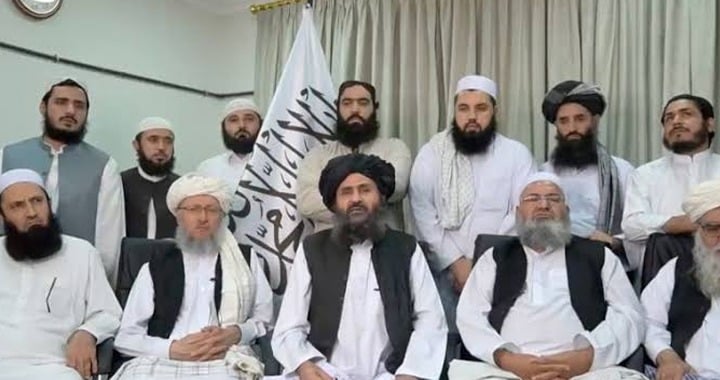
Five years after the Taliban returned to power in Kabul, the most revealing measure of their rule is no longer what they promised in 2021, but what Afghanistan has actually become.
The Taliban presented their return as the beginning of a new chapter. They promised security, stability, reconciliation and an Afghanistan that would no longer be a battlefield.
Yet five years on, the gap between those promises and reality has become increasingly difficult to ignore.
Afghanistan may no longer experience the same scale of conventional warfare that preceded the Taliban takeover, but the disappearance of one form of conflict has not produced genuine stability.
Instead, Afghanistan remains marked by political exclusion, restrictions on civil liberties, severe limitations on women and girls, economic weakness, internal security tensions and the continued presence of terrorist organizations whose activities have consequences far beyond Afghanistan’s borders.
For Pakistan, the most consequential contradiction is security.
The Taliban have repeatedly assured neighboring countries that Afghan territory will not be used against them. Yet Pakistan continues to face terrorist attacks linked to networks operating from or through Afghanistan.
That contradiction has transformed what might otherwise have been an Afghan domestic issue into a direct Pakistani national-security concern.
From Promises of Amnesty to Questions of Accountability
Perhaps nowhere is the gap between Taliban rhetoric and reality more visible than in their treatment of opponents and those who surrender.
The Taliban have repeatedly presented amnesty and forgiveness as instruments of reconciliation.
But amnesty only has meaning when those who surrender are genuinely protected from retaliation.
Recent developments in Badakhshan have raised precisely this question.
Following the surrender of Juma Khan Fateh and some of his men, reports emerged of arrests, house-to-house searches and pressure on local residents in areas associated with his forces. Local accounts have also described fear among people who had supported or been associated with the armed opposition.
These reports require careful verification, but the broader question they raise is unavoidable.
If surrender is followed by intimidation, arbitrary detention or reprisals, what confidence can future opponents have in promises of amnesty?
And if people surrender because they believe they will be forgiven, only to discover that the promise offers no meaningful protection, reconciliation itself becomes harder.
A government cannot build durable stability through assurances that citizens no longer trust.
The Taliban’s Version of Security
The Taliban’s strongest argument in favor of their rule remains that they ended the large-scale war that had consumed Afghanistan for two decades.
That achievement should not simply be dismissed.
But peace cannot be defined only by the absence of foreign troops or major conventional battles.
A country can be quieter and still remain deeply unstable.
If political opponents fear repression, if communities fear arbitrary action, if women are excluded from education and employment, if terrorist organizations continue to operate and if neighboring countries continue to face attacks originating from Afghan territory, then the meaning of “security” becomes considerably narrower than the word suggests.
The real test is whether ordinary Afghans can live without fear of both armed violence and arbitrary authority.
That is where the Taliban’s record remains deeply contested.
Five Years, Yet Terrorist Networks Remain
For Pakistan, the most serious concern is the continued existence of terrorist networks on Afghan soil.
The presence of Fitna al-Khwarij and other terrorist organizations in Afghanistan has become a central source of tension between Islamabad and Kabul.
Pakistan has repeatedly demanded that Afghan territory not be used to launch attacks against Pakistan.
The demand is neither unusual nor unreasonable.
No country can be expected to accept attacks planned, facilitated or launched from the territory of another state while being told that the problem is merely an internal Afghan matter.
The geography makes the issue even more serious.
Pakistan and Afghanistan share a long and difficult border. Communities on both sides have historical, familial and economic connections. Roads, mountain routes and informal crossings create opportunities that terrorist networks can exploit.
This means Afghanistan’s internal security environment inevitably affects Pakistan.
When a terrorist organization finds sanctuary across the border, the distance between an Afghan security problem and a Pakistani security threat can be measured in hours rather than years.
The Taliban’s Contradiction
This creates a fundamental contradiction in the Taliban’s position.
They insist that they control Afghanistan.
If they genuinely exercise effective control over the country’s territory and institutions, they must also accept responsibility for preventing that territory from being used against neighbors.
Control brings responsibility.
It cannot be claimed when convenient and rejected when accountability becomes uncomfortable.
Pakistan therefore has every reason to judge Afghan assurances by outcomes rather than statements.
Are terrorist leaders being restrained?
Are their networks being dismantled?
Are training and logistical facilities being shut down?
Are cross-border attacks being investigated?
Are facilitators being arrested?
Are weapons and equipment being prevented from reaching terrorist organizations?
These are the questions that matter.
Repression Cannot Produce Durable Stability
The Taliban’s domestic policies create another long-term problem.
Restrictions on women and girls have dramatically narrowed their participation in education and economic life. Recent labor-market assessments have highlighted the consequences, with women’s participation in Afghanistan’s labor force falling sharply compared with the period before the Taliban takeover.
That is not simply a social-policy issue.
It is an economic and national-development issue.
A country cannot strengthen its economy by excluding a huge portion of its population from productive activity.
Nor can it build resilient institutions while limiting the development of the human capital required to operate them.
The consequences may accumulate slowly, but they can become profound.
A generation deprived of education cannot simply be restored five years later with a policy announcement.
Afghanistan’s Instability Is Pakistan’s Concern
The situation in Badakhshan also demonstrates that the Taliban’s internal challenges cannot be separated entirely from regional security.
Local resistance, political grievances and armed confrontation may appear distant from Pakistan’s major population centers, but instability inside Afghanistan creates an environment in which armed groups can reorganize, alliances can shift and terrorist networks can exploit uncertainty.
Pakistan therefore has a direct interest in an Afghanistan that is genuinely stable.
But genuine stability cannot mean simply that one armed authority controls the state.
It must mean that Afghanistan has institutions capable of resolving political disagreements without violence, protecting civilians, preventing terrorist organizations from operating and maintaining workable relations with its neighbors.
Five Years Have Changed the Question
In 2021, the central question was whether the Taliban could take control of Afghanistan.
Five years later, the more important question is what they have done with that control.
Have their promises produced reconciliation?
Has their security model prevented terrorism?
Has their rule created economic opportunity?
Have Afghan women and girls been allowed to contribute fully to society?
Have political opponents been given meaningful protection?
Has Afghanistan become less of a security threat to its neighbors?
The answers remain deeply uncomfortable for the Taliban.
For Pakistan, however, one conclusion is particularly important.
Islamabad cannot build its security policy around assumptions about what the Taliban might do.
It must deal with what they actually do.
That means maintaining strong border management, intelligence-based operations and diplomatic pressure while keeping open channels for engagement where they serve Pakistan’s interests.
Pakistan Cannot Wait for Kabul’s Promises
Pakistan has already sacrificed enormously in the global War on Terror.
It therefore cannot be expected to absorb a renewed terrorist threat simply because the Taliban promise that Afghan territory will not be used against Pakistan.
Promises matter.
But verifiable action matters more.
The Taliban have had five years to demonstrate that their assurances about security, reconciliation and responsible governance have substance.
The record remains mixed at best and deeply troubling in areas that directly affect Pakistan.
The coming years will therefore be judged less by speeches from Kabul and more by measurable outcomes.
If Afghanistan genuinely wants peaceful relations with its neighbors, it must ensure that its territory is not converted into a sanctuary, training ground or launchpad for terrorism.
And if the Taliban genuinely want their claim of having brought peace to Afghanistan to be taken seriously, they must understand that peace cannot be exported as instability to the country next door.
Five years after their return to Kabul, the Taliban are no longer being judged by what they promised. They are being judged by what their rule has produced.



