
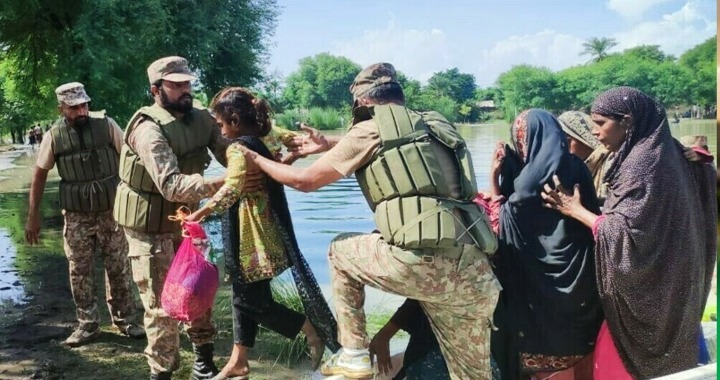
Pakistan’s security personnel do not sacrifice their lives only on battlefields while fighting terrorism or defending the country against hostile forces. They also put themselves in harm’s way when ordinary citizens need help, and the martyrdom of an SSG commando during a rescue search in the Indus River in Swabi is a powerful reminder of that wider duty.
SSG Commando Muhammad Tariq Dogar was taking part in a dangerous underwater search operation to locate the body of a citizen who had drowned in the Indus River when a technical malfunction caused his oxygen equipment to fail.
His oxygen supply was suddenly cut off while he was searching underwater. Muhammad Tariq could not return to the surface and was martyred in the river.
The commando, who belonged to the Pakistan Army’s SSG Musa Company, had entered the water as part of the effort to recover the drowned citizen. His mission was not a conventional combat operation. There was no terrorist target and no battlefield confrontation. He was there because a family was waiting for the recovery of a loved one’s body.
That distinction makes his sacrifice all the more significant.
For decades, Pakistan’s armed forces and law-enforcement personnel have confronted some of the country’s most serious security threats, from terrorist attacks to armed campaigns against the state. They have fought terrorists in Khyber Pakhtunkhwa and Balochistan, defended Pakistan’s borders and faced hostile actions linked to the country’s broader security environment, including threats emanating from across the western border and tensions with India.
Yet the duty of a Pakistani soldier does not end where the battlefield ends.
Floods, earthquakes, accidents, building collapses, drowning incidents and other natural or man-made emergencies repeatedly bring soldiers and specialized rescue personnel into situations where civilian lives are at immediate risk. In many such operations, the danger is no less real simply because there is no armed enemy in front of them.
The Swabi tragedy demonstrates that reality with painful clarity.
Muhammad Tariq Dogar knew that underwater search operations carried their own dangers, yet he entered the river to help recover a citizen. A technical failure turned that rescue mission into a fatal emergency, costing him his own life while he was trying to bring another person’s body back to the family waiting on shore.
Muhammad Tariq was the son of retired serviceman Sardar Ashiq Dogar and belonged to Gandhian Otar, Kot Dogran, in Sialkot district of Punjab. His family has now lost a son who died while performing a duty that had nothing to do with personal gain and everything to do with service.
A Soldier’s Duty Extends Beyond the Battlefield
This is what makes the sacrifices of Pakistan’s servicemen difficult to measure through the conventional language of war alone. A soldier may confront a terrorist one day, stand guard along a hostile frontier another day, and enter floodwaters or a raging river the next.
The uniform remains the same. So does the underlying responsibility, protecting human life and serving the nation.
The country’s fight against terrorism has already demanded enormous sacrifices from the armed forces and police. Personnel have fallen while confronting terrorist networks, protecting installations, securing communities and preventing attacks. Others have made the ultimate sacrifice during military operations and while defending Pakistan against external threats.
But Muhammad Tariq Dogar’s final mission illustrates another side of that service.
He did not give his life while eliminating a terrorist or exchanging fire with an enemy. He gave it while searching for a fellow citizen.
For the family whose loved one was being sought in the Indus, the rescue operation was an act of compassion. For Muhammad Tariq Dogar, it became his final act of duty.
His martyrdom therefore belongs to the same larger story of service that has seen Pakistan’s soldiers stand against terrorists, defend the motherland and rush toward civilians trapped by disasters. Sometimes the threat comes from an armed adversary. Sometimes it comes from nature itself.
And sometimes, as in the Indus River at Swabi, a soldier’s final battlefield is simply the place where another Pakistani needs help.



