
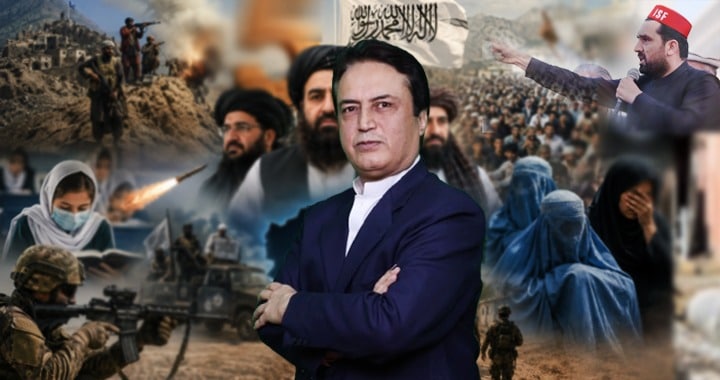
Five years after the Taliban returned to power in Kabul, Afghanistan appears to be entering another uncertain and potentially dangerous phase. The latest fighting in Badakhshan, particularly around the confrontation involving Juma Khan Fateh and Taliban forces, is important not merely because of the immediate clashes, but because it may signal the re-emergence of a broader armed challenge to Taliban control.
For months, resistance activity in Badakhshan had remained relatively fragmented. What has changed is the intensity and visibility of the confrontation. Fighting in remote areas, reported attacks on Taliban positions and the emergence of local commanders challenging Taliban authority indicate that the question of control in parts of northern Afghanistan is becoming more complicated.
The situation should not be exaggerated into an imminent collapse of the Taliban regime. The Taliban still retain considerable territorial control, military resources and administrative authority. But dismissing the resistance as insignificant would be equally misguided. Afghanistan has a long history of armed movements beginning locally and gradually acquiring wider political and military significance.
Badakhshan Is More Than a Local Battlefield
Badakhshan is strategically important. Its geography places it close to Afghanistan’s northern frontier and the wider Central Asian security environment. Any sustained deterioration there therefore has implications beyond a single province.
The reported confrontation involving Juma Khan Fateh is particularly significant because it reflects internal opposition rather than a conventional foreign military challenge. That distinction matters. The Taliban can portray foreign intervention as an attack on Afghan sovereignty, but an armed challenge emerging from within the country is much harder to explain away.
The Taliban’s response will consequently be closely watched. A purely military response could suppress the immediate challenge, but it may not address the grievances, political divisions and power struggles that produced it.
The danger is that fragmented resistance groups could gradually find common ground. They do not necessarily need to merge into a single organization to create pressure. Coordinated attacks, shared political objectives and growing local support could be enough to stretch Taliban security structures across multiple fronts.
Pakistan Must Not Be Made the Scapegoat
There is another important dimension to this development. Any attempt to automatically portray Afghanistan’s internal resistance as a Pakistani project risks obscuring the actual drivers of the conflict.
The resistance emerging in Afghanistan is fundamentally an Afghan phenomenon. Its political objectives, local grievances and struggles for power originate inside Afghanistan. Pakistan has its own security concerns, particularly the continuing threat posed by terrorist networks operating from Afghan soil, but that does not mean every anti-Taliban development should be reduced to a Pakistan-versus-Afghanistan narrative.
For Pakistan, the priority should remain clear: Afghan territory must not be used for terrorism against Pakistan, and relations between the two countries should be managed through diplomacy, border security and verifiable counterterrorism commitments.
Five Years, Five Unresolved Questions
The Taliban can point to some achievements after five years in power, particularly the consolidation of central authority and a degree of security compared with the years of full-scale war. But serious questions remain unresolved.
Girls and women continue to face sweeping restrictions. Afghanistan remains internationally isolated. Its economy remains fragile, unemployment remains widespread and humanitarian needs are immense. Most importantly from a regional security perspective, terrorist organizations continue to operate from Afghan territory.
The Taliban therefore face a difficult choice. They can continue relying primarily on coercive control, or they can address the political and security problems that continue to generate opposition.
The same lesson applies to Pakistan.
Khyber Pakhtunkhwa cannot afford to treat terrorism as a problem belonging exclusively to the security forces. Where terrorist networks operate, the provincial administration must provide governance, policing, development and political ownership. Holding rallies or issuing political statements cannot substitute for a functioning security and governance framework.
The merged districts require particular attention. Decades of underdevelopment have left communities vulnerable to both terrorism and political exploitation. Roads, schools, hospitals, clean water, employment and effective policing are not side issues in a counterterrorism strategy. They are part of it.
Security Cannot Be Left to Slogans
The greatest danger for Khyber Pakhtunkhwa is the creation of a vacuum in which security forces are expected to confront terrorism while political leadership remains focused on political confrontation.
A provincial government must be judged not only by what it says in Islamabad, Peshawar or on political platforms, but by what ordinary citizens experience in Bannu, Khyber, Waziristan, Tirah and other affected districts.
Pakistan’s Independence Day has once again demonstrated that the overwhelming public sentiment across the country is attachment to Pakistan and rejection of terrorism. The people of Khyber Pakhtunkhwa, including communities living closest to the violence, have repeatedly demonstrated resilience and patriotism.
That public commitment must now be matched by governance.
Afghanistan may be approaching another turning point, but Pakistan must ensure that instability across the border does not become instability within its own territory. The answer lies in vigilance at the frontier, decisive counterterrorism operations, stronger provincial policing, development in vulnerable districts and a political leadership willing to treat public security as its first responsibility.
The Taliban may still hold Kabul. But Badakhshan is a warning that holding power and securing lasting stability are two very different things. For Pakistan, the lesson is equally clear: terrorism cannot be defeated by security operations alone, and governance cannot be postponed until the guns fall silent.



