
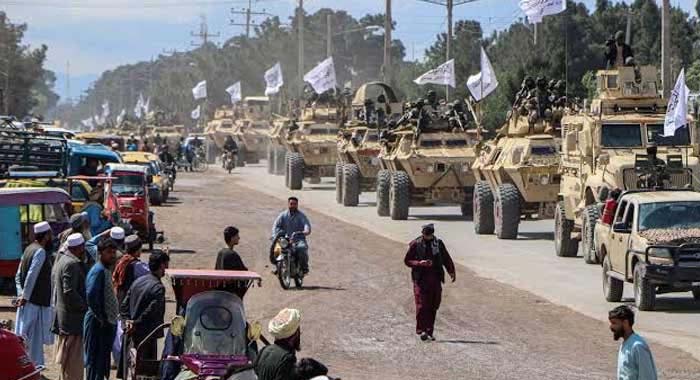
A United Nations monitoring report has warned that continued support provided by the Afghan Taliban to the Tehreek-e-Taliban Pakistan (TTP), a proscribed militant organization, has contributed to an increase in the frequency and lethality of terrorist attacks in Pakistan.
The findings are contained in the 38th report of the United Nations Analytical Support and Sanctions Monitoring Team, covering the period from 16 December 2025 to 9 June 2026. The report also highlights increasingly blurred operational and facilitation links among the TTP, Al-Qaeda, Islamic State Khorasan Province (ISIL-K), and the Balochistan Liberation Army (BLA).
According to the report, cross-border violence between Pakistan and Afghanistan increased during the reporting period, with a significant portion of the escalation attributed to a large number of attacks carried out by the TTP against Pakistan.
The UN monitoring assessment maintains that Afghanistan’s Taliban authorities have continued to support the TTP, despite repeated concerns raised over the group’s activities against Pakistan. The report states that the continued presence and support of the TTP contributed to an increase in attacks inside Pakistan and eventually to direct military confrontations along the Pakistan-Afghanistan frontier. Member states cited in the report expressed concern that the continuing confrontation could create additional opportunities for militant organizations to expand their activities, further complicating the regional security environment.
The assessment also describes what appears to be a dual approach by the Taliban authorities. On one hand, the TTP continues to benefit from ideological and logistical space inside Afghanistan; on the other, Taliban authorities have taken certain measures aimed at controlling or relocating TTP personnel. According to the report, Afghan authorities relocated approximately 2,000 TTP fighters and their families from areas close to the Pakistani border to locations deeper inside Afghanistan.
The measure was reportedly intended to bring the group under greater control and reduce tensions along the frontier. However, the UN assessment indicates that such relocation does not necessarily amount to dismantling the TTP’s command, training, logistical, or operational infrastructure. The report further states that Taliban supreme leader Hibatullah Akhundzada allegedly communicated with TTP leadership through back channels and warned the group to halt attacks against Pakistan or risk losing Taliban support.
The developments point to a delicate balancing act: Taliban authorities appear to be attempting to contain the TTP sufficiently to avoid a major confrontation with Islamabad and growing international pressure, while maintaining ties rooted in longstanding ideological and organizational connections.
The UN report also points to continued organizational development within the TTP. Following an annual leadership council meeting in December, the group reportedly announced structural changes, including the establishment of two new divisions. One was reportedly designated for Balochistan and the central region, while another was created for Kashmir and Gilgit. The group also announced a new formation referred to as the “TTP Air Force,” reflecting its reported efforts to broaden its organizational and operational capabilities. In March, the TTP announced a multilingual spring campaign referred to as “Operation Khyber,” calling for intensified attacks against Pakistani security forces and civilians.
Among the most lethal incidents cited during the reporting period was an attack in Bajaur on February 16, in which a vehicle-borne improvised explosive device reportedly killed 11 security personnel and one child, while injuring additional people. The TTP claimed responsibility for the attack, which, according to the report, was allegedly conducted from Afghanistan. The incident is cited as an example of the continuing threat posed by militant groups operating across the Pakistan-Afghanistan border and the difficulties faced by authorities in preventing cross-border attacks
The UN assessment also draws attention to the evolving relationship between Al-Qaeda and the TTP. According to the report, Al-Qaeda’s official media outlet, As-Sahab Media Foundation, issued a statement on April 28 supporting the Taliban and, notably, expressing support for the TTP’s activities against Pakistan. The development is significant because Al-Qaeda has historically provided the TTP with ideological guidance, training, and other forms of assistance. The reported statement represents a more direct expression of support for the TTP’s campaign. The report further states that one member state reported BLA militants receiving training in Afghanistan from Al-Qaeda instructors alongside TTP fighters.
It also describes Al-Qaeda in the Indian Subcontinent (AQIS) as an important component of the broader militant ecosystem, with its leadership reportedly maintaining a presence in Kabul. The report presents the threat to Pakistan not simply as an isolated TTP problem but as part of a broader and increasingly interconnected militant environment. According to the assessment, training, logistical assistance, facilitation networks, and operational capabilities are increasingly being shared or linked across different militant organizations. The reported interaction between the TTP, Al-Qaeda and BLA raises particular concerns because cooperation among groups with different operational priorities could expand the geographic reach and capabilities of militant networks.
The UN monitoring team also identifies Islamic State Khorasan Province (ISIL-K) as one of the most serious threats facing the Taliban authorities and the wider region. Although counterterrorism operations conducted by Pakistan and the Afghan Taliban have reportedly inflicted significant losses on ISIL-K, the organization has continued efforts to adapt and reorganize. According to the report, ISIL-K has shifted portions of its operational infrastructure toward northern Afghanistan while dispersing training networks along the Pakistan-Afghanistan border, including in Khyber Pakhtunkhwa. The group has also reportedly maintained a presence around Kabul.
The UN assessment suggests that ISIL-K is currently undergoing a period of reorganization. Rather than concentrating primarily on territorial control, the group has increasingly focused on fewer but highly visible attacks capable of producing significant casualties. This strategy, the report indicates, demonstrates the organization’s ability to adapt its methods in response to counterterrorism pressure.
Member states cited by the monitoring team reportedly assessed that ISIL-K possesses modern military equipment, including drones, night-vision devices and thermal imaging equipment. The group has also reportedly received training in urban combat and the use of drones, further complicating the security environment for both Afghanistan and neighboring countries. The report additionally cites information from a member state alleging that ISIL-K and the BLA have access to shared logistical and facilitation networks. While ISIL-K activity inside Afghanistan reportedly declined during the reporting period, its activities in Pakistan were assessed as having increased.
The UN report also refers to a deadly attack at Masjid Khadija al-Kubra in Islamabad on February 6, during Friday prayers. According to the information cited in the report, a suicide attacker carried out the bombing, killing 32 people and injuring more than 150 others. A group identifying itself as Islamic State in Pakistan claimed responsibility. However, the UN assessment reportedly considers it more likely that the attack was carried out by ISIL-K.
The group also reportedly claimed responsibility for the May 5 killing of Pakistani religious scholar Sheikh Muhammad Idrees in Khyber Pakhtunkhwa.
The findings of the UN monitoring team portray an increasingly complex militant landscape in and around Afghanistan, in which organizational boundaries are becoming less distinct and cooperation between extremist networks is reportedly expanding. The report’s assessment suggests that Pakistan faces a multifaceted threat: the TTP remains focused on attacks against Pakistan and reportedly benefits from networks inside Afghanistan; Al-Qaeda continues to provide ideological and training-related support; ISIL-K is adapting its operational strategy and maintaining the ability to conduct high-impact attacks; while links involving the BLA point toward an increasingly interconnected regional militant ecosystem.
The report further indicates that relocating TTP fighters away from the Pakistani border, without dismantling the group’s command structures, training facilities, recruitment networks and logistical infrastructure, may not be sufficient to eliminate the underlying threat.
The UN assessment underscores the growing security implications of militant activity originating from or facilitated through Afghanistan. For Pakistan, the continued presence of militant infrastructure across the border presents challenges that extend beyond individual attacks. The combination of cross-border operations, ideological cooperation, training networks, logistical links and evolving technological capabilities could create a more difficult and unpredictable security environment. The report also warns, in effect, that continued tensions between Pakistan and Afghanistan could provide militant organizations with additional opportunities to exploit regional instability.
The emerging picture is therefore one of a broader and increasingly interconnected militant threat, rather than a conflict confined to a single organization. The convergence of TTP, Al-Qaeda, ISIL-K and BLA-linked networks could have implications not only for Pakistan and Afghanistan but for the wider security environment across South and Central Asia. The findings and allegations cited above are attributed to the UN monitoring report and information provided by member states. Individual claims regarding specific organizations, attacks, training arrangements or operational links remain subject to the evidentiary assessments and qualifications contained in the original UN document.



