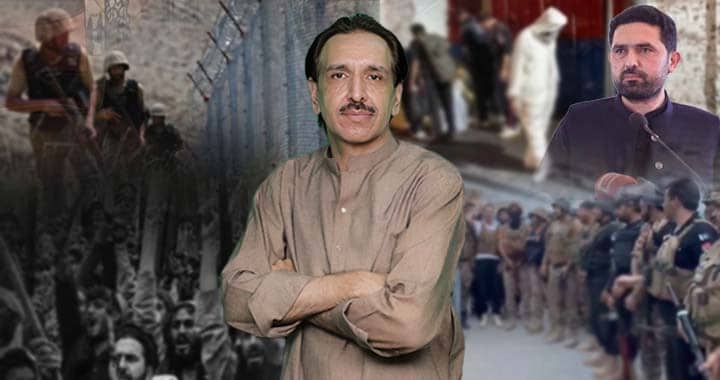
The suicide bombing at Swat’s Kabal Police Station was not an isolated act of terrorism. It was a carefully planned message from Fitna al-Khwarij to the Pakistani state. Their objective was not merely to inflict casualties, but to weaken the institutions responsible for maintaining civilian authority, law and order, and public confidence.
This is exactly why police have increasingly become one of the primary targets of terrorist organizations.
The police are the face of the state. From protecting ordinary citizens to securing government institutions and maintaining district administration, they represent the state’s everyday presence. Terrorists understand that weakening the police weakens governance itself. Every successful attack on a police station, patrol or checkpoint is intended to spread fear, undermine morale and create the impression that the state’s writ is diminishing.
Unfortunately, this attack did not occur in a vacuum. It came against the backdrop of growing political confrontation, weak institutional coordination and misplaced priorities in Khyber Pakhtunkhwa. Instead of concentrating national and provincial attention on an evolving security challenge, political battles continue to dominate public discourse. Terrorist groups have always exploited such distractions.
The provincial government carries the constitutional responsibility for maintaining internal security. Counterterrorism cannot succeed if governance, policing and intelligence coordination are not functioning with complete focus.
Swat’s Geography Never Changed, Only Our Attention Did
Many people are treating the Kabal attack as though terrorism has suddenly returned to Swat. That is an inaccurate reading of history.
Kabal, Kanju, Charbagh, Mata and the surrounding mountainous belt have repeatedly served as operational centers for terrorist networks. These areas witnessed some of the fiercest violence during the insurgency that engulfed Swat nearly two decades ago. The same terrain that once enabled militants to establish influence still exists today.
The mountain tracks linking Swat with neighboring districts remain difficult to monitor around the clock. While checkpoints and security deployments have improved significantly over the years, geography continues to favor those seeking covert movement unless surveillance, intelligence gathering and rapid response evolve continuously.
Swat also presents a striking contradiction.
Kabal is among the most educated areas of Malakand Division. The region has produced bureaucrats, professionals and educated youth in large numbers. Its people have repeatedly rejected extremist ideology and paid a heavy price in resisting terrorism. Yet education alone cannot compensate for security gaps when determined terrorist groups exploit difficult terrain and cross-border sanctuaries.
The Battlefield Has Shifted
Pakistan’s operations against terrorist hideouts across the border have changed the operational landscape.
Pressure on terrorist networks in eastern Afghanistan has forced many formations to relocate and adopt new infiltration routes. Rather than concentrating in one sector, these groups have dispersed across multiple corridors stretching from the southern districts of Khyber Pakhtunkhwa to the Malakand Division.
Even a relatively small number of well-trained terrorists equipped with sophisticated weapons can create significant instability if they find administrative weaknesses or delayed responses.
This changing reality demands a corresponding shift in strategy. Counterterrorism cannot remain reactive. Intelligence, surveillance, policing and military coordination must constantly adapt to evolving threats instead of responding only after attacks occur.
The Target Is Every Citizen Who Stands With the State
One aspect of the Kabal attack deserves particular attention.
Fitna al-Khwarij not only claimed responsibility for the suicide bombing but also openly declared that anyone supporting Pakistan’s security forces or police would be treated as a legitimate target. This is a dangerous escalation.
The message extends far beyond uniformed personnel. It is directed at tribal elders, religious scholars, political workers, peace committees, civil servants, journalists and ordinary citizens who refuse to surrender to extremist violence.
The attack also struck a gathering where a large number of young people had assembled. That is significant because terrorism seeks not only to kill individuals but to discourage public participation in activities promoting peace, national unity and confidence in state institutions.
When young Pakistanis become the targets of suicide bombers simply because they gather under the national flag, terrorism is attempting to shape society through fear rather than merely challenge the state through violence.
Politics Cannot Replace Security
There is another uncomfortable reality that policymakers must confront.
Routine statements issued after every terrorist attack no longer reassure the public. Announcing investigations, promising action and repeating familiar commitments are not substitutes for measurable improvements in security.
The fight against terrorism requires political consensus, institutional coordination and strategic clarity. Internal political rivalries should never become so consuming that they distract from the province’s foremost responsibility, protecting the lives of its citizens.
The tragedy in Kabal should serve as a reminder that terrorism does not distinguish between political affiliations, ethnic identities or social classes. Its objective is to dismantle the state’s authority and spread fear throughout society.
If Pakistan is to prevent another cycle of violence, every institution must recognize that restoring peace is not solely the responsibility of the security forces. It is equally a test of governance, political maturity and administrative competence. Terrorist organizations are constantly adapting their methods. The state’s response must evolve even faster, because complacency is precisely the opportunity they are waiting for.