
The war against terrorism has never been won by bullets alone. Military operations, intelligence-based raids and law enforcement actions can dismantle networks, eliminate commanders and recover weapons, but lasting success comes only when society itself refuses to provide terrorists the space to survive. That moment arrives when ordinary citizens begin identifying terrorism not as someone else’s problem, but as a direct threat to their homes, their livelihoods and the future of their children.
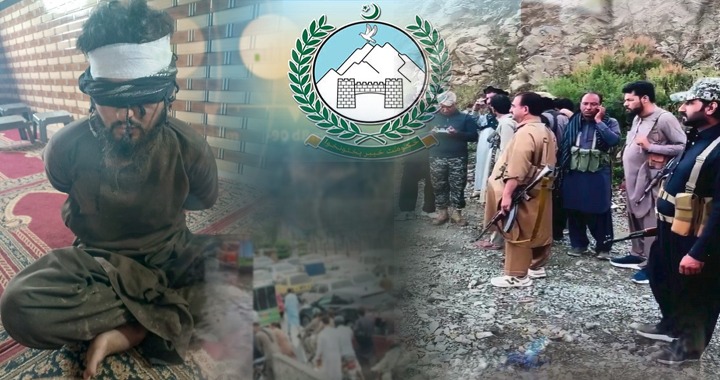
Two developments in Khyber Pakhtunkhwa over the past few days deserve to be viewed together rather than separately. On one hand, local residents in Central Kurram captured a suspected terrorist affiliated with the banned Fitna al-Khwarij and voluntarily handed him over to the authorities. On the other, the provincial government publicly declared its complete support for intelligence-based counterterrorism operations, promising zero tolerance for terrorists and asserting that Khyber Pakhtunkhwa’s soil would be made inhospitable for them.
Individually, both are important developments. Together, they carry a much larger message.
They suggest that the people and the provincial government are finally standing on the same side of a struggle that has defined Khyber Pakhtunkhwa’s recent history.
The government’s declaration deserves appreciation. Better late than never. A clear and unequivocal endorsement of intelligence-led counterterrorism operations is precisely the kind of political ownership that security campaigns require.
At the same time, honesty demands another observation.
This clarity has arrived almost thirteen years later than it should have.
For years, terrorism was too often discussed through political lenses rather than as a national security challenge demanding complete unity. Mixed messaging, competing narratives and unnecessary political disputes diluted what should always have remained a straightforward national consensus: terrorists are enemies of the state, enemies of society and enemies of every citizen regardless of political affiliation.
Yet while politics often remained divided, the people of Khyber Pakhtunkhwa had already made their decision.
They chose Pakistan.
They chose peace.
They chose resistance.
Long before official declarations, ordinary citizens had already declared that there would be no place for terrorists in their communities.
That reality has been written repeatedly in blood.
From Swat to Bajaur, from Mohmand to Dir, from Khyber to Kurram, from Bannu to Lakki Marwat, from Dera Ismail Khan to North and South Waziristan, the people have endured an extraordinary burden. Teachers, traders, laborers, tribal elders, religious scholars, journalists, policemen and ordinary civilians became targets simply because terrorists wanted to impose fear where normal life existed.
Entire communities refused to surrender.
Peace committees were formed.
Local elders stood beside state institutions despite receiving threats.
Families buried their martyrs and still refused to abandon their homeland.
Markets reopened after attacks.
Schools resumed classes.
Mosques continued congregational prayers despite repeated attempts by terrorists to silence society through violence.
These were not isolated acts of courage. They became the defining character of Khyber Pakhtunkhwa.
The recent incident in Central Kurram should therefore not be viewed merely as the arrest of one suspected terrorist. Its symbolic value is far greater.
Instead of offering shelter, remaining silent or looking the other way, local residents detained the suspect themselves before handing him over to law enforcement authorities.
This represents the very outcome every counterterrorism strategy seeks to achieve.
Terrorists survive only when they find safe houses, facilitators, logistical support or frightened populations unwilling to cooperate with the state.
When communities begin refusing all of these, terrorist organizations lose their most valuable asset.
No intelligence agency can replace the awareness of an alert population.
No surveillance system is more effective than citizens who refuse to let terrorists blend into their neighborhoods.
This is why counterterrorism experts across the world increasingly describe community cooperation as one of the strongest force multipliers available to any state.
Pakistan’s own experience confirms this reality.
The country’s security forces have repeatedly demonstrated remarkable operational capability through intelligence-based operations across Khyber Pakhtunkhwa and Balochistan. Numerous terrorist commanders have been eliminated, hideouts dismantled and large quantities of weapons recovered. These successes, however, become sustainable only when local populations deny terrorists the ability to regenerate.
Khyber Pakhtunkhwa has reached precisely such a moment.
The provincial government’s recent declaration therefore carries significance beyond political messaging.
It signals recognition that terrorism cannot be treated as a matter of administrative routine. It requires complete political ownership.
Equally important is the acknowledgement that intelligence-based operations represent the most effective model for the current security environment.
Unlike large-scale military campaigns of the past, today’s operations are increasingly intelligence-driven, highly targeted and designed to isolate terrorists while minimizing disruption to civilian life. The ongoing operations in Bannu illustrate this evolution. Authorities have repeatedly emphasized that these are precision operations against identified terrorist elements rather than population-wide campaigns requiring displacement.
That distinction matters.
It reflects lessons learned through two decades of counterterrorism.
But political ownership alone is insufficient.
The police must continue receiving modern equipment, surveillance technologies, protective gear, communication systems and specialized training. Intelligence coordination between civilian and military institutions must remain seamless. Development projects must accompany security gains so that terrorist organizations cannot exploit economic grievances or governance gaps.
Khyber Pakhtunkhwa’s police deserve particular recognition.
For years they have stood as the province’s first line of defence.
Unlike military formations operating in rotation, police officers serve permanently within the same communities where their families also live. Terrorists know where they reside, where their children attend school and where they pray.
Yet despite these vulnerabilities, the force has continued confronting terrorism with extraordinary resilience.
Its sacrifices deserve not only public praise but sustained institutional investment.
The same applies to intelligence agencies, Frontier Corps and other security institutions whose coordinated efforts have prevented countless terrorist plots before they could materialize.
Pakistan’s counterterrorism campaign has entered a phase where intelligence, technology and public cooperation matter as much as conventional force.
The enemy has evolved.
Fitna al-Khwarij increasingly relies on small mobile groups, cross-border facilitation, improvised explosive devices, encrypted communications and drone technology.
The state’s response must therefore continue evolving as well.
Fortunately, recent developments indicate movement in the right direction.
Public cooperation is strengthening.
Political ownership appears more explicit.
Operational coordination continues improving.
Together these developments create precisely the environment terrorist organizations fear most.
The greatest mistake would be treating this convergence as temporary.
Counterterrorism cannot fluctuate according to political seasons.
It requires continuity.
The people of Khyber Pakhtunkhwa have already demonstrated remarkable consistency.
Despite enduring perhaps the greatest burden of terrorism anywhere in Pakistan, they have repeatedly rejected extremist ideology, refused intimidation and continued supporting national institutions.
Their message has remained unchanged for years.
Now the provincial government’s message is finally matching that public sentiment.
That deserves recognition.
It also creates responsibility.
The declaration that there will be “no place for terrorists” must now translate into sustained policy, uninterrupted support for intelligence-based operations, stronger policing, faster intelligence sharing and continuous cooperation with federal security institutions.
The war against terrorism has never belonged to one institution.
It belongs equally to the soldier guarding the frontier, the police officer patrolling a village road, the intelligence operative tracking a network, the tribal elder refusing to bow before extremists, the shopkeeper reporting suspicious activity, the teacher educating children against radicalization and the ordinary citizen who chooses the law over fear.
The residents of Central Kurram demonstrated exactly what that partnership looks like.
They did not wait for someone else.
They became active participants in protecting their community.
That single act may prove more strategically important than many realize.
Terrorists can replace weapons.
They can recruit new members.
They can rebuild hideouts.
What they cannot easily recover is the trust of communities that have decisively turned against them.
That is why the real significance of these two developments lies not in one government statement or one arrest.
It lies in what both represent.
For perhaps the first time in many years, the provincial government and the people of Khyber Pakhtunkhwa are speaking exactly the same language on terrorism.
It is a language of zero tolerance.
A language of national unity.
A language that denies terrorists political ambiguity, operational space and social acceptance.
For Pakistan’s counterterrorism campaign, that may prove to be one of the most encouraging developments of all.



