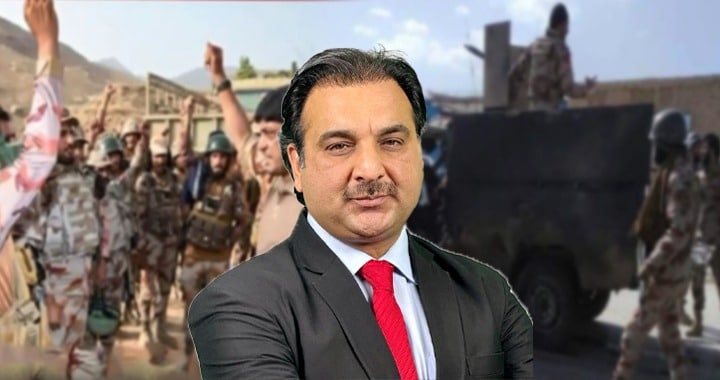
(Irfan Khan)
Pakistan is once again at a defining moment in its fight against terrorism. The security challenges emerging simultaneously in Khyber Pakhtunkhwa and Balochistan are not isolated incidents, nor are they simply a continuation of the militancy we have witnessed over the past two decades. They represent a new phase of warfare one in which terrorist organizations are adapting faster, collaborating more closely, exploiting technology, and attempting to destabilize Pakistan through multiple fronts at once.
In my assessment, the time has come for Pakistan to fundamentally rethink its national security strategy. We can no longer rely solely on reacting after an attack takes place. Our survival, stability, and future depend upon becoming proactive rather than reactive.
The recent security developments in Balochistan illustrate this reality. Security forces have intensified Operation Shaban, and according to reports emerging from the operation, nearly 95 terrorists have been eliminated. This demonstrates both the determination and operational capability of Pakistan’s security forces. However, while tactical successes deserve recognition, we must understand that military victories alone will not permanently eliminate terrorism unless we dismantle the ecosystem that sustains it.
The first question every Pakistani should ask is simple: where are these terrorist organizations obtaining their weapons, training, funding, intelligence, and logistical support? Terrorism is not self-sustaining. It requires money, planning, safe havens, communication networks, and external assistance. Militants do not manufacture sophisticated weapons in mountain caves, nor do they finance prolonged insurgencies without substantial backing. Every attack, every ambush, every suicide bombing, and every coordinated assault is part of a much larger network.
For years, Pakistan has maintained that terrorist elements continue to find sanctuary across the Afghan border. Unfortunately, our concerns have repeatedly been dismissed or denied. Yet infiltration continues, attacks continue, and evidence gathered during counterterrorism operations continues to point toward organized cross-border facilitation. Pakistan has repeatedly urged the authorities in Afghanistan to ensure that their soil is not used against neighboring countries. These concerns are neither political slogans nor diplomatic rhetoric. They arise directly from the sacrifices made by Pakistani soldiers, police officers, intelligence personnel, and innocent civilians who continue to pay the price for terrorism.
Equally alarming is the evolving nature of militant alliances. Historically, organizations such as the Balochistan Liberation Army (BLA) pursued separatist objectives, while Tehreek-e-Taliban Pakistan (TTP) promoted a radically different ideological agenda. Their narratives were distinct, and their declared goals differed significantly. Today, however, we are witnessing something far more dangerous.
Despite their ideological differences, these organizations increasingly appear to be moving toward operational cooperation. Whether under the banner of separatism or religious extremism, their immediate objective is the same to weaken Pakistan, attack security institutions, create instability, discourage investment, and undermine public confidence in the state’s ability to provide security. This convergence should concern every policymaker. When organizations with different ideologies begin coordinating attacks or benefiting from common sources of funding, logistics, or intelligence, they become far more dangerous than when they operate independently.
There have also been reports indicating the presence of Tajik militants alongside TTP elements in Balochistan. If these reports continue to be substantiated, they would suggest that Pakistan is facing an increasingly transnational security challenge rather than a purely domestic insurgency. In my view, these developments require an entirely new level of intelligence coordination. For many years, Pakistan demonstrated remarkable patience in dealing with regional complexities. Our leadership consistently emphasized dialogue, diplomacy, and cooperation. We repeatedly conveyed our concerns through diplomatic channels and encouraged regional stakeholders to prevent their territories from becoming launching pads for terrorism.
However, patience should never be mistaken for weakness. Every sovereign state has both the right and the responsibility to protect its citizens. If terrorism continues to originate from areas beyond our borders despite repeated diplomatic engagement, Pakistan will inevitably have to consider stronger measures within the framework of international law and its national security interests. Another issue that deserves honest reflection is Pakistan’s historical relationship with Afghanistan. For decades, Pakistan opened its borders, its schools, its hospitals, and its communities to millions of Afghan refugees. Entire generations grew up receiving shelter, education, healthcare, business opportunities, and humanitarian assistance inside Pakistan.
This humanitarian commitment came at enormous economic, social, and security costs. Pakistan never viewed this assistance merely as an obligation; it was rooted in shared history, geography, culture, and faith. Yet today, many Pakistanis understandably ask whether those sacrifices have been adequately acknowledged. While humanitarian generosity should never be conditional, no country can ignore security concerns indefinitely. Goodwill must ultimately be accompanied by mutual respect and reciprocal responsibility. Turning to Khyber Pakhtunkhwa, the security picture is equally significant.
Although Balochistan often dominates national headlines, Pakistan’s western frontier continues to witness persistent attempts by militant organizations to regroup and launch attacks. The encouraging development is that Pakistan’s security forces, intelligence agencies, and police are increasingly embracing modern technology. Today’s battlefield bears little resemblance to that of twenty years ago. There was a time when military success depended upon sending hundreds of soldiers into direct confrontation. Warfare today is intelligence-driven, technology-enabled, and precision-focused.
Advanced surveillance systems, aerial monitoring, digital intelligence, communication interception, artificial intelligence-assisted analysis, and precision targeting now determine operational success. A terrorist can coordinate attacks using encrypted communications from hundreds of kilometers away. Similarly, security forces can identify and neutralize threats without relying exclusively on conventional battlefield engagements. Technology has transformed warfare.
Consequently, Pakistan must continue investing not only in advanced equipment but also in highly trained personnel capable of utilizing these sophisticated systems effectively. Machines do not win wars. People trained to operate those machines do. I also believe that the Provincial Action Plan introduced in Khyber Pakhtunkhwa has considerable potential. Planning, however, is only the beginning. The real challenge lies in implementation. Do our police possess the necessary equipment? Have they received specialized training? Can intelligence information be shared rapidly across institutions?
Are provincial and federal agencies working seamlessly together? Do local law enforcement officers possess the technical expertise required to operate modern surveillance technologies? These questions determine success far more than policy documents. Pakistan’s counterterrorism strategy must increasingly emphasize prevention rather than reaction. Too often, governments celebrate successful responses after attacks have already occurred.
That is important. But genuine success is measured by attacks that never happen because intelligence agencies identified the threat beforehand. Reactive security means responding after tragedy. Proactive security means ensuring tragedy never occurs. This distinction will define the future of Pakistan’s internal security. The recent decision by Bannu Police and the Counter Terrorism Department to announce rewards for forty most-wanted militants demonstrates another important aspect of counterterrorism. Such profiling reflects systematic intelligence work.
Individuals placed on these lists are reportedly linked to attacks against security personnel and civilians and are wanted in multiple criminal cases. Many of these suspects are believed to have crossed into Afghanistan or sought refuge in remote mountainous terrain rather than remaining within their home communities. Public reward announcements therefore serve multiple purposes. They encourage citizen cooperation. They isolate militant networks. They increase psychological pressure. They signal that the state has identified key actors involved in terrorism.
Counterterrorism is not solely about eliminating militants. It is equally about disrupting their ability to recruit, finance operations, communicate, and move freely. Pakistan must also recognize that today’s war extends into cyberspace. Hostile propaganda spreads through digital platforms at extraordinary speed. False narratives, misinformation campaigns, recruitment videos, encrypted messaging applications, and coordinated online influence operations have become powerful weapons.
Our response must therefore be equally sophisticated. Military operations alone cannot defeat digital radicalization. Strategic communication, public awareness, cyber capabilities, and credible national narratives have become essential pillars of national security. At the same time, sustainable peace requires more than security operations. Development, education, employment, effective governance, and justice remain indispensable components of long-term stability. Communities that enjoy economic opportunity and public trust are significantly less vulnerable to extremist recruitment.
Finally, Pakistan’s greatest strength remains its people. Political differences should never weaken our collective resolve against terrorism. This is not a challenge confronting one institution, one province, or one political party. It is a national challenge demanding national unity. Pakistan’s armed forces, police, intelligence agencies, and law enforcement personnel continue to make extraordinary sacrifices every day. Their efforts deserve not only recognition but also unwavering national support. The road ahead will undoubtedly remain difficult.
Terrorist organizations continue adapting. Regional dynamics remain complicated. Hybrid warfare is becoming increasingly sophisticated. Yet Pakistan possesses the institutional experience, operational capability, and national resilience required to overcome these challenges. The lesson is clear. The era of waiting for terrorists to strike before responding must end. Pakistan’s future security depends upon identifying threats before they materialize, dismantling terrorist infrastructure before attacks are launched, strengthening intelligence before crises emerge, and investing in technology before adversaries gain the advantage.
The war has changed. Our strategy must change with it. Only then can Pakistan secure lasting peace for future generations.