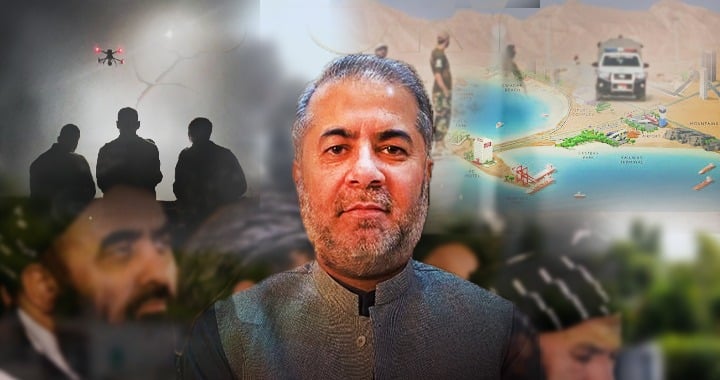
For the last several years, discussions about security in Pakistan have often focused on individual attacks, isolated incidents or temporary crises. However, what we are witnessing today in Balochistan and Khyber Pakhtunkhwa is part of a much larger and more complex picture. If we continue to view every attack as a standalone event, we will fail to understand the broader strategy being employed against Pakistan.
The recent operation in Nushki, where security forces foiled a plot linked to Fitna al-Hindustan, and the attempted quadcopter attack in Bannu linked to Fitna al-Khwarij, are reminders that the nature of conflict is changing. Terrorist organizations are adapting. Their sponsors are adapting. Their methods are adapting. Therefore, Pakistan must also adapt.
Balochistan remains one of the most strategically important regions not only in Pakistan but in the wider region. It is Pakistan’s largest province by area, yet its population is dispersed across vast distances. Securing such a large territory presents challenges that few countries face. Security forces cannot be present in every village, every valley or every mountain pass at all times.
At the same time, Balochistan possesses immense natural resources and enormous economic potential. The province is home to strategic projects, mineral wealth and critical infrastructure. Gwadar Port, in particular, has transformed Balochistan into a focal point of regional and international attention. Massive investments have flowed into the province, creating opportunities that were unimaginable a few decades ago.
This reality has also created incentives for hostile actors who do not want stability to prevail.
I have long believed that the violence in Balochistan cannot be understood without examining the external dimensions of the conflict. There is a reason why terrorist organizations operating in the province often possess sophisticated weapons, communication systems, vehicles and logistical capabilities that far exceed what local criminal groups could sustain on their own.
The question is simple: who pays for it?
Modern weapons are expensive. Night-vision equipment is expensive. Vehicles, fuel, communications networks and operational infrastructure all require significant financial resources. These are not capabilities that emerge in isolation. Reports and assessments over the years have repeatedly pointed toward foreign sponsorship, foreign facilitation and foreign interests seeking to destabilize Pakistan.
Many people already understand this reality. In fact, ordinary Pakistanis often understand it better than some analysts sitting in studios.
The challenge, however, extends beyond weapons and funding. The battlefield itself has changed.
When people think about war, they often imagine tanks, aircraft, artillery and soldiers confronting one another on traditional battlefields. Yet some of the most consequential conflicts of our time have been fought in a completely different arena.
The Arab Spring offers an important example. Between 2010 and 2012, entire states experienced profound instability. Governments were shaken, institutions weakened and societies polarized. In many cases, the decisive factor was not military invasion but information warfare. Narratives spread rapidly through social media. Public trust eroded. Internal divisions deepened.
This is why I repeatedly describe today’s environment as a form of fifth-generation warfare.
In this type of conflict, the objective is not necessarily to occupy territory. The objective is to influence minds.
The target is public confidence.
The target is national cohesion.
The target is the relationship between citizens and their institutions.
If people can be convinced that every institution is corrupt, every security operation is illegitimate and every national challenge is evidence of state failure, then adversaries achieve strategic gains without deploying conventional armies.
This is precisely why social media has become such an important battleground.
Unfortunately, many young people receive most of their information through short videos, viral posts and unverified content. When individuals lack access to credible information, they become vulnerable to manipulation. Narratives can spread faster than facts. Rumours can travel farther than reality.
That does not mean genuine problems do not exist. Every country faces challenges. Every society has grievances. Pakistan is no exception.
The question is how those issues are addressed.
One of Pakistan’s greatest strengths is often overlooked. We are a diverse country. We have different provinces, languages, ethnic identities and local cultures. We debate passionately. We disagree frequently. We criticize governments and institutions openly.
Yet despite all these differences, the overwhelming majority of Pakistanis remain committed to Pakistan.
From Karachi to Chitral, people may complain about governance, economic conditions or political disputes, but very few seek separation from the state itself.
This reality frustrates those who hope to weaken Pakistan.
I often hear claims from certain circles that Pashtuns in Khyber Pakhtunkhwa wish to join Afghanistan or that ethnic divisions will eventually break Pakistan apart. I have travelled extensively across the region, spoken with local communities and spent years reporting from conflict zones.
I simply do not see evidence supporting those claims.
Pashtuns in Pakistan are Pakistanis. They may share cultural, linguistic and historical ties across the border, but that does not translate into a desire to abandon Pakistan. These narratives frequently originate from outside the country and fail to reflect realities on the ground.
The recent attempted quadcopter attack in Bannu also demonstrates how terrorist organizations are incorporating technology into their operations.
Drones are no longer rare or inaccessible devices. They can be purchased in markets and used for legitimate purposes. However, terrorist groups have increasingly adapted commercial technologies for surveillance, reconnaissance and attacks.
This presents a policy challenge.
I believe Pakistan needs a clearer regulatory framework governing the purchase and use of drones. Just as weapons require licensing and oversight, authorities should consider mechanisms ensuring that advanced drone technologies do not fall into the wrong hands. The goal is not to prevent legitimate use but to reduce opportunities for abuse.
Another issue that deserves serious attention is the relationship between the state and its citizens, particularly in areas where protests and political movements emerge.
The Baloch Raji Muchi and other movements should not automatically be viewed through a simplistic lens. Genuine grievances exist in many regions of Pakistan. Citizens have the right to raise concerns and demand accountability.
The state’s response should focus on engagement, dialogue and problem-solving.
Ignoring legitimate complaints rarely makes them disappear. In many cases, unresolved issues become larger over time. They create opportunities for hostile actors seeking to exploit public frustration.
At the same time, we must recognize that foreign-sponsored networks often attempt to infiltrate or manipulate legitimate movements for their own purposes. This dual reality requires a balanced approach: addressing genuine concerns while preventing exploitation by hostile elements.
Governance also matters.
One of our longstanding challenges is that bureaucratic structures often appear disconnected from ordinary citizens. When people feel unheard, frustration grows. When institutions fail to communicate effectively, misinformation fills the vacuum.
This is particularly important given Pakistan’s demographics.
A significant majority of our population is young. This is one of Pakistan’s greatest assets, but it also creates responsibilities. Young people require education, opportunity and access to accurate information. If they are not engaged constructively, others will seek to shape their perceptions.
Parents today face challenges that previous generations did not. Teachers face challenges that previous generations did not. The influence of traditional institutions has weakened while the influence of digital platforms has expanded dramatically.
That reality cannot be ignored.
Pakistan’s security challenges are therefore not limited to military operations. They involve governance, education, information, technology and public trust.
The events in Nushki and Bannu are reminders that terrorist organizations continue to adapt. Yet they also demonstrate that Pakistan’s security institutions continue to disrupt plots, neutralize threats and protect communities.
The road ahead will not be easy. Balochistan and Khyber Pakhtunkhwa will continue to face challenges. External actors will continue attempting to exploit internal vulnerabilities.
However, despite every effort to divide, destabilize and weaken the country, one fact continues to stand out.
Pakistanis still believe in Pakistan.
And as long as that remains true, the objectives of those seeking to undermine the state will remain far more difficult to achieve.