
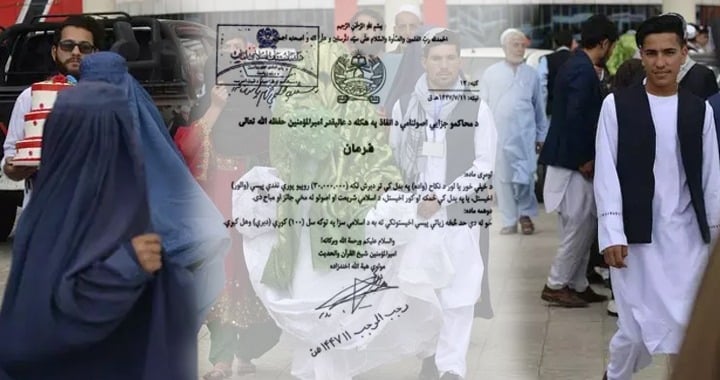
Afghanistan’s ruling Taliban have once again found themselves at the center of controversy after a decree attributed to supreme leader Sheikh Hibatullah Akhundzada reportedly set a maximum amount that families can demand in exchange for the marriage of a daughter.
Supporters may argue that the measure is intended to curb excessive financial demands and ease the burden on young men seeking marriage. Critics, however, see something far more troubling: the state effectively regulating the monetary value attached to women in marriage.
When Reform and Contradiction Meet
The Taliban’s reported decree comes at a time when Afghanistan is already under intense international scrutiny over restrictions on women’s education, employment, freedom of movement, and participation in public life.
Against that backdrop, any policy dealing with women inevitably attracts attention. Yet the deeper question is not whether the amount has been capped at three million Afghanis. The more important question is whether the concept itself aligns with the principles the Taliban claim to uphold.
Islamic teachings emphasize that marriage is a sacred contract based on consent, dignity, and mutual rights. A woman is neither property nor a commodity to be purchased and transferred between families. Classical Islamic jurisprudence places great emphasis on the woman’s consent and her financial rights within marriage.
The concept of mahr is often misunderstood. In Islamic tradition, it is not a payment made to parents in exchange for a bride. Rather, it is a financial right belonging to the woman herself.
The Difference Between Mahr and Market Value
The controversy surrounding the Taliban decree stems largely from perception.
If a government announces a ceiling on the amount that can be demanded for marriage, critics argue that it risks reinforcing the idea that marriage is fundamentally a financial transaction. The debate then shifts from human dignity to price regulation.
Questions naturally arise.
If women are not commodities, why should a state be involved in setting limits on what can be demanded in exchange for marriage?
If the purpose is social welfare, why focus on regulating payments instead of strengthening economic opportunities for families?
And if Islamic principles are being invoked, where is the distinction between protecting women and treating marriage as a market activity?
A Wider Debate
The controversy reflects a larger struggle taking place across Afghanistan.
For many families facing economic hardship, marriage arrangements have become increasingly tied to financial survival. For critics, however, the answer lies not in government-imposed ceilings but in addressing the poverty, unemployment, and social pressures that drive such practices in the first place.
Whether viewed as reform or regulation, the decree has reignited debate over women’s status in Afghanistan and the extent to which state policies are shaping their lives.
As questions continue to mount, one issue remains central: does placing a limit on what can be demanded in marriage protect women, or does it inadvertently reduce them to figures in a financial calculation?
The Real Question Is Not the Amount, but the Principle
The controversy surrounding the Taliban decree ultimately extends beyond economics. It touches on fundamental questions of dignity, agency, and the interpretation of Islamic principles in modern governance.
For many observers, the issue is not whether the ceiling is three million Afghanis or three hundred thousand. The issue is whether any system that assigns monetary parameters to marriage negotiations can truly claim to uphold the spirit of equality and human dignity that Islam seeks to protect.



