
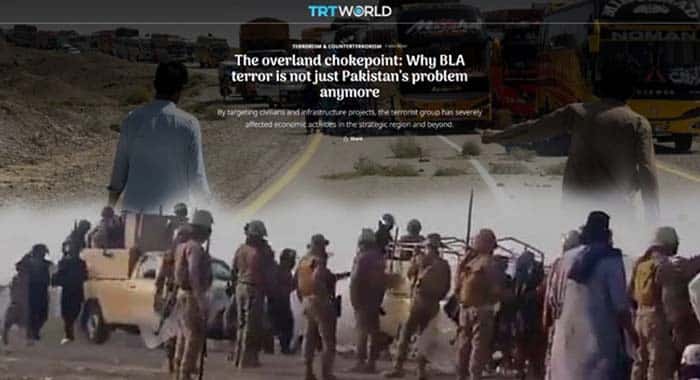
Terrorist activities carried out by the banned Balochistan Liberation Army (BLA) have evolved from a domestic security challenge into a growing threat to regional connectivity, international commerce, and critical infrastructure, according to a recent report published by Turkish media outlet TRT World.
The report highlights the escalating security situation in Pakistan’s southwestern province of Balochistan, where key highways, transportation routes, and trade corridors are increasingly coming under attack from BLA militants. Analysts warn that the group’s campaign extends far beyond local insurgency and is now directly impacting regional economic integration and global supply chains.
According to the report, the BLA’s primary objective is to undermine Pakistan’s economic stability by targeting strategic infrastructure, transportation networks, and development projects. Attacks on railway lines, highways, freight vehicles, and commercial routes are described as deliberate efforts to disrupt economic activity, hinder investment, and isolate Balochistan from regional growth initiatives.
Security experts cited in the report argue that these attacks do not serve the interests of the people of Balochistan but instead threaten employment opportunities, development projects, and economic progress across the province. The continued targeting of public infrastructure has raised concerns among investors, businesses, and regional stakeholders regarding the long-term stability of one of South Asia’s most strategically significant regions.
The report further notes that the United States, Australia, and the United Kingdom have designated the BLA as a terrorist organization, while growing international concern is increasing pressure on other countries to adopt similar measures. Observers warn that the group’s operational methods are becoming increasingly similar to those employed by internationally recognized terrorist organizations, including attacks on civilian infrastructure and efforts to create widespread disruption and fear.
Particular attention is drawn to the strategic importance of Balochistan and the deep-sea port of Gwadar, both of which serve as critical gateways for international trade, energy transit, and regional connectivity. As a vital component of emerging trade corridors linking South Asia, Central Asia, the Middle East, and global markets, instability in the region carries consequences far beyond Pakistan’s borders.
The report emphasizes that repeated attacks on transportation infrastructure have already affected roads, railways, and major development initiatives, creating challenges for logistics networks and undermining investor confidence. Such disruptions not only impact domestic economic growth but also have implications for international supply chains and global commercial interests.
Among the incidents highlighted is the attack on the Jaffar Express and a series of assaults targeting Pakistan’s railway network. These attacks have repeatedly forced the suspension of train services in parts of Balochistan, disrupting passenger movement, commercial transport, and regional trade activities.
According to the Global Terrorism Index 2026, approximately three-quarters of all terrorism-related incidents reported in Pakistan during the previous year occurred in Balochistan, underscoring the province’s central role in the country’s evolving security landscape.
The report also points to growing threats against the China-Pakistan Economic Corridor (CPEC), energy infrastructure projects, and strategic trade routes. Such attacks are increasing security costs, delaying development initiatives, and creating additional challenges for governments and investors seeking to enhance regional economic integration.
Analysts stress that peace and stability in Balochistan are not solely matters of national importance for Pakistan but are equally significant for China, Gulf nations, Central Asian states, and European markets that stand to benefit from secure and efficient trade corridors.
Beyond the economic impact, the report underscores the human cost of terrorism. It argues that militant violence is depriving ordinary citizens of Balochistan of employment opportunities, infrastructure development, education initiatives, and broader economic participation. By targeting projects designed to improve connectivity and investment, extremist elements are effectively obstructing the province’s long-term development and prosperity.
The findings suggest that the BLA’s broader strategy seeks to render Balochistan less attractive for investment, governance reforms, and economic integration. Such actions, the report concludes, risk isolating the province from regional development opportunities while simultaneously creating challenges for international commerce.
As governments, businesses, and international stakeholders continue to monitor developments, the report calls for enhanced regional cooperation, stronger counterterrorism efforts, and sustained investment in stability and development. It warns that the cost of instability in Balochistan is being borne not only by the people of Pakistan but also by global supply chains, international investors, and consumers worldwide.



