
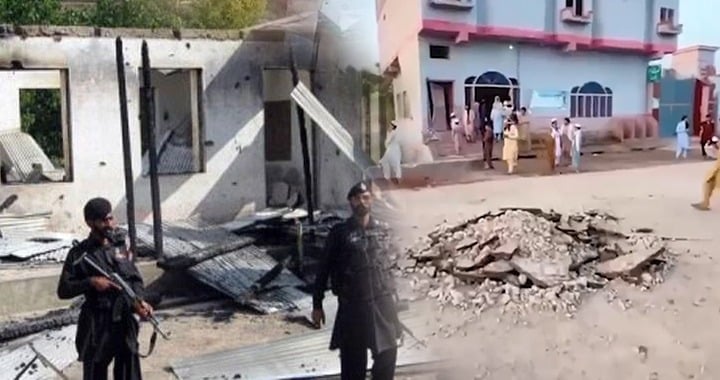
Operation Iron Fist-3 stands among the most significant counterterrorism operations conducted in recent months.
According to operational details, security forces carried out extensive sanitization operations across Palangzai, Khuzai, and Nadeem Kot in the Miranshah area between June 1 and June 12. The operation reportedly resulted in the elimination of 62 terrorists, including four high-value targets. Multiple hideouts, command centers, tunnels, weapons caches, and ammunition storage facilities were destroyed.
From a military perspective, the operation represents a substantial achievement.
Yet even as security forces recorded these gains, terrorist incidents continued to emerge elsewhere.
In Bajaur, a bomb blast near a madrassa martyred a civilian.
In Lakki Marwat’s Khairo Khel Pakka area, local residents reportedly intervened to foil a suicide attack targeting Friday prayers. The attack resulted in the martyrdom of a minor girl and injuries to five civilians, including children.
In another incident in Lakki Marwat’s Ghazni Khel area, a police armored personnel carrier was targeted in a bomb attack. Fortunately, no police personnel were harmed.
Meanwhile, terrorists destroyed a government middle school in Sheri Khel.
At first glance, these incidents appear disconnected.
In reality, they may reveal an important feature of Pakistan’s current security environment.
Terrorist Groups May Be Losing Territory, But They Are Seeking Visibility
Large-scale counterterrorism operations have significantly degraded the capabilities of many terrorist organizations. Safe havens are increasingly contested. Command structures face constant disruption. Senior figures are being eliminated at a faster pace.
Under such conditions, terrorist groups often adapt.
Instead of attempting to hold territory, they seek visibility.
Soft civilian targets, educational institutions, places of worship, and symbolic attacks become attractive because they generate attention disproportionate to the resources required.
The incidents in Bajaur and Lakki Marwat illustrate this phenomenon. None of the attacks altered the security balance. None threatened state control. Yet each succeeded in generating fear, uncertainty, and public concern.
This distinction is important.
The continuation of attacks does not necessarily indicate terrorist strength. In some cases, it may reflect weakness.
Organizations facing sustained military pressure often resort to opportunistic violence precisely because they can no longer achieve larger strategic objectives.
At the same time, dismissing such attacks as insignificant would be a mistake.
For local communities, the consequences remain devastating regardless of the broader strategic picture.
The destruction of a school affects education. Attacks on worshippers undermine social cohesion. Bombings targeting civilians spread fear far beyond the immediate blast site.
The challenge facing Pakistan today is therefore twofold.
First, security forces must continue dismantling terrorist infrastructure through operations such as Iron Fist-3.
Second, authorities must prevent terrorist groups from compensating for battlefield losses through attacks designed to maximize psychological impact.
The recent incidents across Khyber Pakhtunkhwa and Balochistan suggest that Pakistan’s security forces are increasingly succeeding in disrupting organized terrorist networks. The remaining question is whether terrorist groups, unable to reverse those losses militarily, will continue shifting toward attacks intended primarily to create fear rather than achieve strategic gains.
That question may define the next phase of Pakistan’s counterterrorism landscape.



