
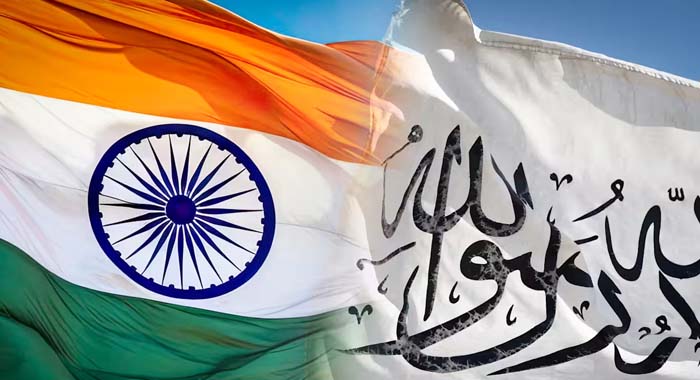
Pakistan has formally raised the alarm over what its security and foreign policy establishment describes as a systematic and deliberate Indian strategy to cultivate, finance, and militarily empower the Taliban administration in Afghanistan a government not recognised by the United Nations for the singular purpose of sustaining and intensifying terrorist violence against the Pakistani state. The latest manifestation of this strategy is the India-brokered defence pact between Russia and the Taliban, which threatens to grant the militant-run government capabilities that could neutralise Pakistan’s right to self-defence against cross-border terrorism.
“India once called the Taliban terrorists. Today it funds them, arms them through proxies, and shields them diplomatically because they are killing Pakistanis.”
For decades, India positioned itself as an implacable opponent of the Taliban and Afghan-based extremism. New Delhi funded the Northern Alliance, maintained close ties with anti-Taliban factions, and invested heavily in the reconstruction of Afghanistan under the post-2001 democratic framework. Indian officials routinely and publicly labelled the Taliban a terrorist organisation. This was not merely rhetorical it reflected a genuine strategic alignment with the international community’s counter-terrorism consensus.
The Taliban’s seizure of Kabul in August 2021 initially appeared to deal India a strategic blow: its considerable investment in Afghan infrastructure, diplomatic networks, and political relationships was suddenly rendered precarious. Yet within months, a dramatic reversal began to take shape behind the scenes. Indian intelligence operatives, with Ajit Doval reportedly at the centre of the effort, initiated back-channel contacts with Taliban leadership in Doha and Kabul.
The explanation for this reversal is straightforward: the Taliban, now in control of the Afghan state apparatus, had proven to be the single most effective instrument available to India for prosecuting its proxy war against Pakistan. Groups including the Tehrik-i-Taliban Pakistan (TTP), the Baloch Liberation Army (BLA), and the Islamic State-Khorasan Province (ISKP) all operating from Afghan soil under Taliban protection were actively killing Pakistani civilians and security personnel. For India, the Taliban’s continued rule was not a problem to be solved it was an opportunity to be exploited.
Pakistan’s assessment is that Indian engagement with the Taliban has evolved across several distinct but interlinked tracks diplomatic, financial, and now military. Together, these tracks constitute what Pakistani officials describe as a structured and sustained proxy arrangement.
India has progressively rehabilitated its diplomatic presence in Kabul, initially under the cover of humanitarian and consular operations. This presence has served as a platform for intelligence-gathering and for maintaining direct lines of communication with Taliban leadership. India has also worked to facilitate the Taliban’s engagement with Central Asian states, helping to break the regime’s international isolation a legitimacy dividend that India has extended in exchange for continued Taliban cooperation in sustaining pressure on Pakistan.
Financial flows from Indian-linked entities to Taliban-administered structures have been documented by regional intelligence agencies. These flows, routed through intermediaries and front organisations, are assessed to serve a dual purpose: sustaining the Taliban’s administrative capacity (ensuring their continued grip on power) and providing direct financial incentives for the facilitation of cross-border terrorist operations into Pakistani territory. Reports confirm that Indian intelligence has offered monetary inducements to Afghan militant operatives in Balochistan and Khyber Pakhtunkhwa to carry out attacks against Pakistani civilian and military targets.
The most consequential and most recent dimension of India-Taliban engagement is the military track, culminating in the defence pact brokered between Russia and the Taliban administration. Afghanistan’s Foreign Minister Amir Khan Muttaqi announced the agreement publicly, stating that the pact would furnish the Taliban with air defence systems and advanced missile capabilities assets that Muttaqi himself declared would prevent Pakistan from conducting airstrikes against terrorist sanctuaries on Afghan soil.
India’s National Security Advisor is assessed by Pakistani and regional intelligence to have been the principal architect of this agreement, leveraging India’s longstanding relationship with Moscow and deploying diplomatic capital specifically to advance a military arrangement designed to constrain Pakistan’s counter-terrorism options.
“The Russia-Afghanistan defence pact is not about Afghan sovereignty. It is about ensuring Pakistan cannot defend itself against the terrorists India is sponsoring across the border.”
III. THE ESCALATING TIMELINE: INDIA–TALIBAN RELATIONS AT A GLANCE
| PERIOD | DEVELOPMENT |
| Pre-2021 | India officially labels Taliban a terrorist organisation; funds Northern Alliance opposition. |
| Aug 2021 | Taliban seize Kabul. India evacuates embassy staff. Initial silence from New Delhi. |
| Late 2021 | Back-channel talks begin. Indian intelligence operatives hold secret meetings with Taliban officials in Doha. |
| 2022 | India resumes partial diplomatic presence in Kabul under cover of ‘humanitarian’ mission. |
| 2023 | Financial flows from Indian-linked entities to Taliban-affiliated administrators documented by regional intelligence agencies. |
| 2024 | India facilitates Taliban’s outreach to Central Asian states; provides logistical and infrastructural support. |
| Early 2026 | Ajit Doval brokers Russia–Afghanistan defence pact. Taliban announces air defence systems and missile transfers from Russia. |
| June 2026 | Taliban FM Muttaqi publicly warns Pakistan: Russian-supplied defences will neutralise Pakistani airstrikes against TTP. |
India’s National Security Advisor has emerged as the central figure in India’s covert regional strategy. Operating beyond conventional diplomatic channels, he has cultivated contacts across the spectrum of militant and extremist organisations operating in South and Central Asia. His methodology — offering financial inducements, strategic assurances, and access to Indian diplomatic networks in exchange for operational cooperation against Pakistan — represents a systematic instrumentalisation of terrorism as an instrument of statecraft.
Pakistan’s security establishment notes that his fingerprints are discernible across a range of destabilising developments: the arming and financing of militant networks in Balochistan, the facilitation of ISKP’s expansion as a tool of pressure against both Pakistan and Iran, and now the brokering of the Russia-Afghanistan defence agreement. The international community, which has long been aware of India’s intelligence footprint in Afghanistan, has until now refrained from a direct public accounting of this conduct. Pakistan urges a change in that posture.
► He is assessed to have maintained direct and indirect contacts with TTP, BLA, ISKP, and other proscribed organisations.
► Financial disbursements linked to Indian intelligence networks have been traced to militant operatives responsible for attacks in Peshawar, Quetta, and other Pakistani cities.
► His role in the Russia-Afghanistan defence pact represents an escalation from financing terrorism to providing its perpetrators with state-level military protection.
► The global counter-terrorism community must examine whether India’s NSA meets the threshold for designation under international terrorist-financing frameworks.
India faces a paradox it has thus far been unable to credibly explain to the international community. On the one hand, New Delhi presents itself as a victim of cross-border terrorism, a responsible democratic partner in global security, and a champion of a rules-based international order. On the other hand, it maintains deepening and increasingly overt ties with a regime that: (a) is not recognised by the United Nations as a legitimate government; (b) has been repeatedly identified as providing sanctuary to internationally designated terrorist organisations; and (c) is waging, through its proxies, an active campaign of violence against a neighbouring UN member state.
The United States, India’s strategic partner has itself maintained the Taliban’s designation as a terrorist-affiliated entity and has expressed concern about the regime’s human rights record and terrorist harbourage. Yet India continues to deepen its engagement, apparently calculating that its relationship with Washington is sufficiently insulated from scrutiny on this specific issue.
Pakistan submits that this calculation is incorrect and that the international community including the United States, the European Union, and the Gulf states — must confront the evidence of India’s role in sustaining terrorist violence in South Asia.
“Every nation that has fought terrorism must now ask: is India a partner in that fight, or is it selectively deploying terror as a foreign policy tool when it serves New Delhi’s interests?”
The Government of Pakistan does not seek confrontation. It seeks accountability, transparency, and a return to the foundational norms of international conduct that prohibit the sponsorship of terrorism against sovereign states. Pakistan’s position is clear and consistent:
► The Taliban’s growing ties with India must be viewed in their proper context: as a quid pro quo arrangement in which the Taliban provide operational cover to anti-Pakistan terror groups in exchange for Indian financial, diplomatic, and now military support.
► The Russia-Afghanistan defence pact, as brokered by Indian intelligence, must be scrutinised by the UN Security Council and should not be treated as a bilateral matter between Moscow and Kabul.
► Pakistan calls on the Russian Federation to engage directly with Islamabad, to hear Pakistan’s documented evidence of Taliban-sponsored terrorism, and to reconsider any arrangement — however characterised — that enhances the Taliban’s military capability.
► Pakistan will engage the People’s Republic of China as a strategic partner to collectively impress upon Moscow the destabilising consequences of the pact.
► Pakistan calls on all states that have designated TTP, BLA, and ISKP as terrorist organisations to formally examine the documented evidence of Indian support to these groups and their Taliban hosts, and to take appropriate diplomatic and sanctions-related measures.
► Pakistan calls on the international media and civil society to investigate and report on the expanding architecture of India-Taliban cooperation without the filter of strategic bias.



