
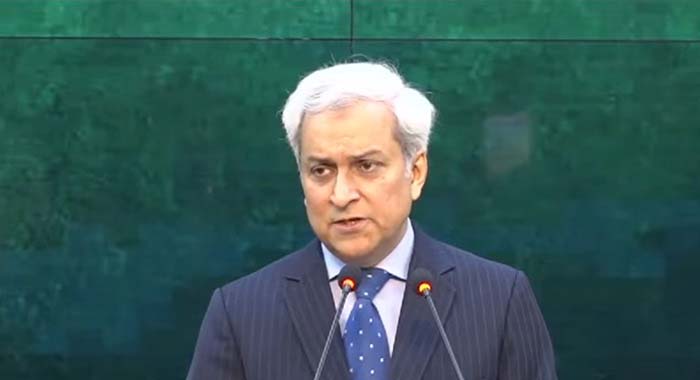
Pakistan has reiterated its unwavering commitment to promoting peace, stability, and constructive diplomacy across the region while firmly safeguarding its national interests, including its rights under the Indus Waters Treaty. These remarks were made by Foreign Office Spokesperson Tahir Hussain Andrabi during the Ministry of Foreign Affairs’ weekly press briefing.
Addressing security concerns, the spokesperson stated that the continued terrorist attacks originating from Afghan territory have severely tested Pakistan’s patience and resolve. He emphasized that attacks against Pakistani citizens and law enforcement personnel can no longer be tolerated.
“Pakistan remains one of the world’s foremost victims of terrorism,” he said, noting that thousands of Pakistani citizens have lost their lives as a result of terrorist violence. He further highlighted that Pakistan’s security forces continue to face terrorism that is planned, financed, and supported from across the border.
The spokesperson stressed that no responsible state can remain silent when its sovereignty, territorial integrity, and the safety of its citizens are threatened. Pakistan will continue to take all necessary measures to protect its people and uphold national security.
The Foreign Office underscored Pakistan’s extensive diplomatic engagements over the past two weeks, describing them as a reflection of the country’s growing role in fostering regional and international cooperation.
Prime Minister’s recent official visit to China was described as highly successful, resulting in the signing of multiple Memorandums of Understanding aimed at strengthening bilateral cooperation in various sectors. The visit reaffirmed the longstanding strategic partnership between Pakistan and China and included detailed discussions on regional developments and future collaboration.
Following his visit to China, Deputy Prime Minister and Foreign Minister Senator Ishaq Dar traveled to the United States, where he held meetings with senior American leadership. Discussions focused on regional peace, conflict prevention, and Pakistan’s diplomatic efforts to promote stability. According to the spokesperson, U.S. Secretary of State Marco Rubio appreciated Pakistan’s constructive role in mediation and conflict resolution efforts.
The spokesperson also highlighted Pakistan’s active participation in international forums, including high-level engagements at the United Nations, where Pakistani representatives discussed reforms in global governance and cooperation on pressing international challenges. Meetings were held with representatives from Portugal, Colombia, Costa Rica, Cuba, Indonesia, and several other countries.
In addition, Pakistan maintained high-level diplomatic contacts with Egypt, Vietnam, Iran, the European Union, and other international partners through telephone discussions focused on bilateral relations and regional developments.
Pakistan strongly condemned ongoing Israeli aggression against the Palestinian people and reaffirmed its unwavering support for the legitimate rights of Palestinians. The spokesperson noted that foreign ministers from eight countries jointly condemned Israeli actions at Al-Aqsa Mosque and rejected attempts to alter the historical and legal status of East Jerusalem. They called on Israel to immediately cease all illegal and provocative measures.
Pakistan reiterated that it remains firmly committed to supporting the Palestinian cause and advocating for a just, lasting, and peaceful resolution based on internationally recognized principles and relevant United Nations resolutions.
“Pakistan’s position remains clear and consistent: we stand for peace, stability, and the legitimate rights of the Palestinian people,” the spokesperson stated.
The Foreign Office expressed serious concern over reports that India is attempting to divert water from the River Chenab towards the River Beas and over developments related to desilting activities at the Salal Dam in Indian Illegally Occupied Jammu and Kashmir.
The spokesperson emphasized that Pakistan will protect its rights over the waters of the River Chenab under the Indus Waters Treaty and expects India to fulfill its treaty obligations in both letter and spirit.
He pointed out that under the 1978 Salal Agreement, desilting of the dam is not permitted in the manner currently being pursued and noted that India failed to provide prior notification to Pakistan regarding the activity, constituting a violation of treaty provisions.
The Foreign Office further stressed that using water as a political or strategic tool runs contrary to international law and undermines the spirit of the Indus Waters Treaty. Any attempt to threaten Pakistan’s food security through disruption of water flows could contribute to increased instability in South Asia.
Pakistan reiterated that, under the treaty framework, it possesses the right to unrestricted use of waters allocated from the western rivers and will continue to defend those rights through all available legal and diplomatic channels. The spokesperson reaffirmed Pakistan’s longstanding position that Jammu and Kashmir remains an internationally recognized disputed territory.
He stated that visits by foreign individuals or dignitaries to Indian Illegally Occupied Jammu and Kashmir cannot alter the legal and political status of the dispute. Referring to the recent visit of the Swiss Ambassador to the region, the spokesperson confirmed that Pakistan is in contact with Swiss authorities and has formally conveyed its concerns regarding the matter.
Addressing broader regional developments, the Foreign Office reiterated Pakistan’s commitment to reducing tensions between the United States and Iran through sincere diplomatic engagement. The spokesperson emphasized that Pakistan has consistently maintained that dialogue, diplomacy, and peaceful negotiations—not conflict or military confrontation—are the only viable means of resolving international disputes.
Pakistan has been engaging with friendly countries and international partners to encourage diplomatic solutions and promote regional stability. The country believes that maintaining peace in the region is a shared responsibility requiring restraint, wisdom, and constructive engagement from all stakeholders.
The Foreign Office also announced the successful convening of the Eighth Round of the Pakistan-European Union Strategic Dialogue. The dialogue reviewed progress across various areas of cooperation and concluded with the issuance of a joint communiqué reflecting the shared commitment to strengthening bilateral relations.
Pakistan reaffirmed its determination to work closely with the international community to address common challenges, advance economic development, support multilateral cooperation, and contribute to regional and global peace.
Concluding the briefing, the Foreign Office emphasized that Pakistan will continue to pursue an active and principled foreign policy rooted in peace, diplomacy, mutual respect, and international cooperation.
Pakistan remains committed to fostering constructive partnerships, defending its national interests, supporting oppressed peoples, combating terrorism, and promoting a secure, stable, and prosperous regional environment for all.



