
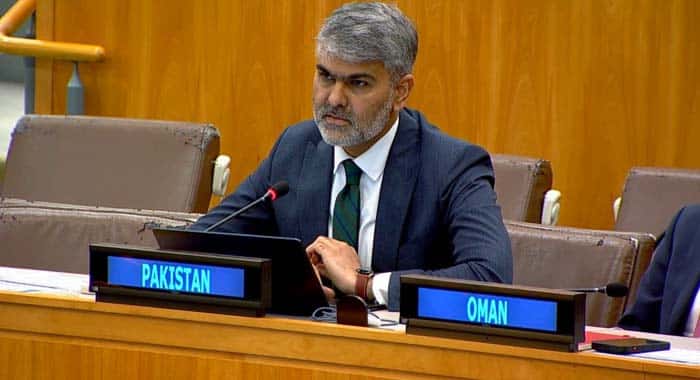
Pakistan has expressed serious concern over the presence of large quantities of advanced weapons and ammunition in Afghanistan, warning that the proliferation of such arms poses a growing threat to regional security and neighboring countries.
The concerns were raised during the Ninth Biennial Meeting of States on the United Nations Programme of Action on Small Arms and Light Weapons, where Pakistan highlighted the risks associated with the illicit circulation of military-grade weapons and their potential access by non-state armed groups.
Speaking on behalf of Pakistan, Syed Atif Raza, Counsellor at Pakistan’s Permanent Mission to the United Nations, emphasized that the unchecked spread of small arms and light weapons continues to fuel conflicts, prolong instability, and strengthen the operational capabilities of armed groups operating across borders.
According to the Pakistani representative, the increasing sophistication, availability, and accessibility of illicit weapons have emerged as a significant challenge for regional and international security. He warned that such weapons not only intensify existing conflicts but also undermine efforts aimed at peacebuilding, civilian protection, and sustainable development.
Addressing the situation in Afghanistan, Pakistan voiced particular concern over what it described as substantial stockpiles of advanced weaponry and ammunition remaining in the country. Islamabad argued that the continued presence of these arms represents a serious security risk for neighboring states and could contribute to the further destabilization of the wider region.
Pakistan cautioned that weapons falling into the hands of terrorist organizations and other non-state actors could significantly enhance their operational capabilities, enabling them to conduct more sophisticated attacks and expand their activities beyond national borders.
The statement underscored that the threat posed by illicit arms trafficking is no longer confined to a single country. Instead, officials noted, it has evolved into a transnational challenge with direct implications for regional stability, border security, and international counterterrorism efforts.
The Pakistani delegation further stressed the importance of strengthening global mechanisms for tracing, monitoring, and controlling the movement of small arms and light weapons. It called for enhanced international cooperation to prevent the diversion of military equipment into illicit networks and to ensure greater accountability in arms management practices.
Security experts have long warned that the proliferation of unregulated weapons can serve as a force multiplier for extremist groups, insurgent organizations, and criminal networks. The availability of advanced arms, analysts note, can increase the lethality of attacks, complicate law-enforcement responses, and prolong cycles of violence in already fragile regions.
Pakistan reiterated its commitment to international efforts aimed at combating the illicit trade in small arms and light weapons and urged the global community to address emerging threats stemming from unsecured weapons stockpiles in conflict-affected areas.
The remarks come amid ongoing regional concerns over cross-border militancy, terrorism, and the movement of armed groups operating in South and Central Asia. Pakistani officials maintain that preventing the diversion of advanced weaponry to terrorist organizations remains a critical component of ensuring long-term peace and stability in the region.
As discussions continue at the United Nations, Pakistan has called for collective action to address the growing security implications associated with the spread of illicit weapons and to strengthen international frameworks designed to curb their proliferation.



