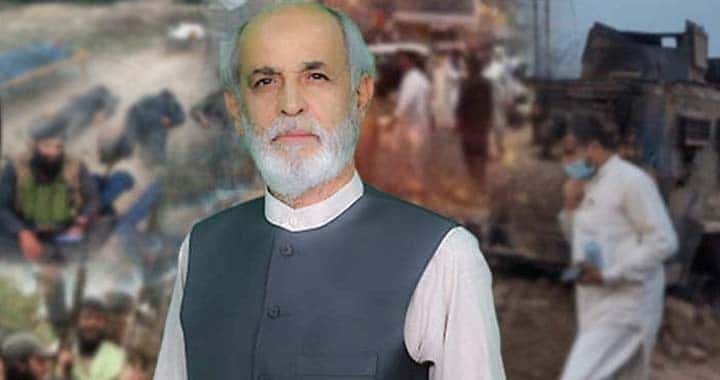
(Shamim Shahid)
Once again, Kurram has returned to the national headlines. But unlike previous episodes, this latest tragedy is not the direct result of a military operation, drone strike, or cross-border infiltration. This time, the violence emerged from within the militant landscape itself: two rival factions of banned extremist networks locked in a deadly confrontation in the central Kurram region, leaving at least eighteen militants dead.
For many observers, the incident may appear to be just another chapter in Pakistan’s endless conflict with militancy. Yet the bloody clash in the Manatoo-Kamran Khel area of central Kurram reveals something much deeper and more dangerous. It exposes the internal fragmentation of militant groups, the persistence of extremist sanctuaries, the weakening writ of the state in sensitive tribal districts, and the continued absence of a coherent national counterterrorism strategy.
The tragedy also raises an uncomfortable but unavoidable question: if heavily armed militants can fight pitched battles against each other in territories where police, administration, and security institutions are supposedly present, then who truly controls these regions?
The clash reportedly involved two rival commanders associated with factions of the outlawed Tehreek-e-Taliban Pakistan (TTP). One group was linked to a commander identified as Kazim, while the rival faction was led by a commander known locally as Imti. The fighting was intense enough to leave nearly eighteen militants dead from both sides.
However, the significance of this event lies not merely in the death toll but in what it tells us about the militant ecosystem that continues to thrive in Pakistan’s northwestern belt.
For years, militant organizations in the tribal districts have projected themselves as ideologically united entities fighting under the banner of religion or resistance. The reality, however, has often been very different. Beneath the rhetoric lies a ruthless competition for territory, influence, weapons, extortion networks, smuggling routes, and financial resources.
The current conflict in Kurram appears to be another manifestation of this old pattern.
History shows that these factions have repeatedly fought among themselves. Splinter groups emerge, commanders defect, loyalties shift, and alliances collapse. Some militants accuse rival commanders of betrayal, while others claim that senior TTP leadership selectively eliminates competitors to maintain centralized authority.
In this latest episode, Jamaat-ul-Ahrar itself historically linked with the TTP network reportedly issued statements accusing TTP chief Mufti Noor Wali Mehsud of orchestrating targeted killings against rival commanders. Such accusations are not new. Similar allegations surfaced during the eras of Hakimullah Mehsud and earlier militant leadership structures.
This pattern demonstrates a critical reality often ignored in public discourse: militant violence is not driven solely by ideology. More often than not, it is shaped by power struggles, economic competition, criminal interests, and personal rivalries.
In the tribal belt, militancy has long operated as both an ideological movement and an underground economy.
Weapons trafficking, kidnapping, taxation, extortion, and control over smuggling corridors generate enormous profits. Whoever controls the routes controls the money. Whoever controls the money controls recruitment, influence, and territorial authority. In that sense, these violent confrontations resemble organized criminal warfare as much as ideological conflict.
Yet perhaps the most disturbing aspect of the Kurram incident is not the militant infighting itself but the apparent paralysis of the state during the confrontation.
The Manatoo-Kamran Khel region is not an ungoverned wilderness entirely beyond state reach. Administrative institutions exist there. Police structures are present. Security agencies maintain operations in and around the region. If militants fought openly for hours, where was the state?
Why was the opportunity not utilized to encircle the combatants, arrest surviving militants, gather intelligence, and dismantle the wider network operating in the area?
These are not rhetorical questions. They strike at the heart of Pakistan’s counterterrorism dilemma.
For decades, Pakistan’s security framework has often remained reactive rather than proactive. Authorities move forcefully after major attacks but frequently fail to exploit moments when militant organizations become vulnerable due to internal fragmentation. Militant infighting provides rare intelligence and operational opportunities. Rival factions expose each other’s hideouts, logistics, and command structures. In many countries confronting insurgencies, such moments are strategically exploited to weaken extremist infrastructure permanently.
Unfortunately, Pakistan has repeatedly failed to capitalize on these openings.
Reports suggest that a few arrests may have occurred after the Kurram clashes, though no official confirmation has emerged. If true, such limited action would still fall far short of what was possible under the circumstances.
The larger concern is that the very geography of Kurram makes the situation extraordinarily dangerous.
Kurram sits at a strategic intersection bordering Orakzai, North Waziristan, and routes connected to Afghanistan. Historically, these mountainous corridors have served as transit zones for militants, smugglers, and armed networks. Any resurgence of organized militant presence in such areas threatens not only local peace but the broader regional security architecture.
What is happening in Kurram cannot be viewed in isolation. It forms part of a wider deterioration in security conditions across Khyber Pakhtunkhwa.
From Bannu to Lakki Marwat, from North Waziristan to South Waziristan, incidents of targeted killings, attacks on tribal elders, ambushes against security personnel, kidnappings, and intimidation campaigns have intensified.
The assassination of respected tribal figures in recent months has created widespread fear among local populations. In many districts, people reportedly avoid venturing outside after sunset. Retired security officials and anti-militancy tribal elders are particularly vulnerable. Mosques have allegedly been used to issue warnings against individuals perceived as cooperating with the state.
This atmosphere reflects a dangerous erosion of public confidence.
Once fear replaces trust, governance begins to collapse from within.
It is against this backdrop that discussions of a possible military operation in Bannu and surrounding districts have intensified. According to reports, authorities are preparing for large-scale action against militant hideouts following a series of deadly incidents in the region.
But military operations alone do not guarantee success.
Pakistan’s history offers painful lessons in this regard. Some operations achieved temporary tactical victories but failed to establish lasting peace because they lacked political ownership, civilian rehabilitation planning, and local trust-building mechanisms.
The example most frequently cited as comparatively successful remains the 2009 Swat operation. That campaign succeeded not merely because of military force but because the population was taken into confidence. Civil administration was empowered. Rehabilitation and return mechanisms for displaced families were relatively organized. Political consensus existed. Most importantly, local people believed the state intended to restore normal life rather than simply conduct another security exercise.
That distinction matters enormously.
Today, residents in areas likely to witness fresh operations are deeply anxious. Their fears are not abstract. They remember displacement, destroyed livelihoods, prolonged camp life, economic collapse, and delayed rehabilitation from previous operations. In the scorching summer heat, families facing the possibility of displacement naturally ask: where will we go? Who will support us? Will the government ensure our safe return? Will compensation arrive? Will schools reopen? Will businesses recover?
These are legitimate concerns.
No counterterrorism operation can succeed sustainably if local populations feel abandoned or punished alongside militants. Therefore, if the government intends to launch new operations in Bannu or adjoining districts, several principles are essential. First, local communities must be consulted and taken into confidence. Public trust is not a secondary matter; it is the foundation of operational success. Second, provincial and federal authorities must coordinate closely rather than operate through mutual suspicion and political rivalry. Third, rehabilitation plans for internally displaced persons must be prepared in advance, not after displacement occurs.
Fourth, local civilian administration must be empowered with resources, authority, and logistical capacity. And fifth, there must be a clear long-term governance strategy after military operations conclude. Clearing territory means little if governance vacuums later allow militants to return. Unfortunately, political polarization continues to undermine collective action against militancy.
The ongoing tensions between the federal government and the provincial administration in Khyber Pakhtunkhwa have created serious coordination gaps. Distrust between institutions weakens intelligence sharing, policy implementation, and operational clarity. At the same time, allegations regarding political engagement or informal communication with militant elements continue to generate controversy. Audio leaks and accusations involving political actors have fueled heated debate. However, focusing solely on partisan blame risks missing the larger reality.
Terrorism today is not targeting one political party, one ideology, or one ethnic group. It is targeting the entire state and society. Religious scholars, tribal elders, nationalist leaders, democratic activists, security personnel, and ordinary civilians have all become victims. Militants have attacked mosques, schools, markets, funerals, political gatherings, and security installations alike.
The threat is universal.
That is why all political parties, regardless of ideological differences, must adopt a unified and unequivocal stance against militancy. Ambiguity, selective condemnation, or tactical silence only emboldens extremist networks. Similarly, state institutions must also recognize that military responses alone cannot eliminate militancy permanently. Extremism survives where governance fails, justice weakens, economic despair deepens, and public trust disappears. Kurram’s latest bloodshed should therefore serve as a warning.
When militant groups begin fighting each other openly, it may appear superficially beneficial because extremists are killing extremists. But such thinking is dangerously simplistic. Internal militant warfare often signals competition for expanding influence, not organizational collapse. If left unchecked, surviving factions frequently become more violent, more criminalized, and more desperate to establish dominance.
Moreover, every clash further destabilizes already fragile regions and normalizes armed non-state power. Pakistan cannot afford that normalization. The people of Kurram, Bannu, Waziristan, Lakki Marwat, and other conflict-affected districts deserve more than endless cycles of violence followed by temporary security responses. They deserve functioning governance, accountable institutions, economic opportunity, and durable peace.
The state must move beyond crisis management toward a coherent national security vision rooted in public confidence and institutional coordination. The lesson from Kurram is painfully clear: where the state hesitates, militants evolve. Where governance weakens, fear expands. And where political divisions overshadow national priorities, extremism finds space to survive. Pakistan has already paid an unbearable price for these lessons.
It cannot afford to learn them again through another generation of bloodshed.