
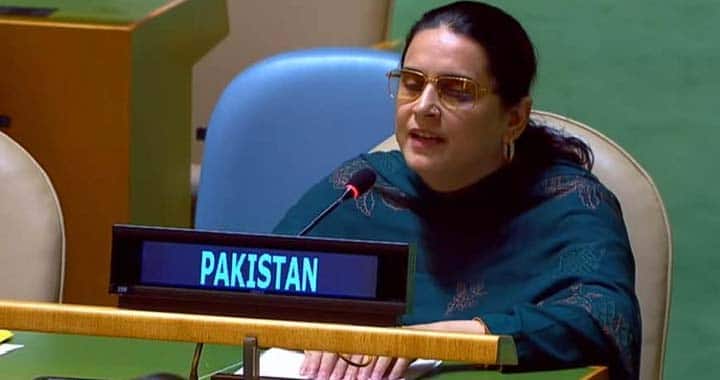
Pakistan has strongly raised concerns at the United Nations Security Council (UNSC) over what it described as India’s continued support for proxy militant organizations operating against Pakistan, while reaffirming Islamabad’s commitment to regional peace, dialogue, and international law.
Speaking during a session of the United Nations Security Council, Pakistan’s Counsellor Saima Saleem stated that banned militant outfits including Tehreek-e-Taliban Pakistan (TTP), the Baloch Liberation Army (BLA), and the Majeed Brigade were functioning as proxy groups allegedly backed by India to destabilize Pakistan and undermine regional security.
In her remarks before the international forum, Saima Saleem accused India of “exporting terrorism” and facilitating cross-border militant activities targeting Pakistan. She said that several attacks against Pakistani interests had been planned and coordinated from Afghan territory, adding that Pakistan had carried out “precise and targeted operations” against terrorist hideouts in response to emerging security threats.
The Pakistani diplomat rejected allegations made by the Taliban administration regarding Pakistan’s counterterrorism operations, describing them as part of a “misleading propaganda campaign” intended to divert international attention from the actual sources of regional instability.
She emphasized that Pakistan’s security actions were conducted in accordance with its sovereign right to self-defense and aimed solely at eliminating terrorist infrastructure threatening Pakistani citizens and national security.
“Pakistan remains committed to combating terrorism in all its forms and manifestations while adhering to international law and principles of responsible state conduct,” she stated.
During her address, Saima Saleem also highlighted the situation in Indian Illegally Occupied Jammu and Kashmir (IIOJK), asserting that India could not conceal what she described as ongoing human rights violations in the disputed territory.
She alleged that civilians in occupied Kashmir continued to face killings, arbitrary detentions, demographic changes, restrictions on freedoms, and forced displacement.
The Pakistani representative reiterated Islamabad’s longstanding position that the Kashmir dispute remains an internationally recognized issue requiring resolution in accordance with United Nations Security Council resolutions and the aspirations of the Kashmiri people.
The Pakistani envoy further raised concerns regarding the treatment of minorities in India, stating that discrimination and violence against Muslims and other minority communities had become increasingly widespread.
She called upon the international community and global human rights organizations to closely monitor developments related to religious freedoms, minority protections, and civil liberties in India.
Saima Saleem additionally referred to the status of the Indus Waters Treaty, expressing concern over what Pakistan described as India’s continued suspension and non-compliance with the historic water-sharing agreement.
She stressed that adherence to international agreements and treaty obligations was essential for maintaining regional stability and preventing further tensions between neighboring states.
Concluding her statement, the Pakistani diplomat emphasized that Pakistan firmly believes in peaceful coexistence, dialogue, diplomacy, and respect for international law as the only sustainable path toward regional peace and security.
“Pakistan remains committed to peace, constructive engagement, and the resolution of disputes through dialogue and lawful international mechanisms,” she stated.
Pakistan’s remarks at the UNSC come amid heightened regional security concerns, renewed debates over counterterrorism cooperation, and growing international attention on South Asian geopolitical tensions.



