
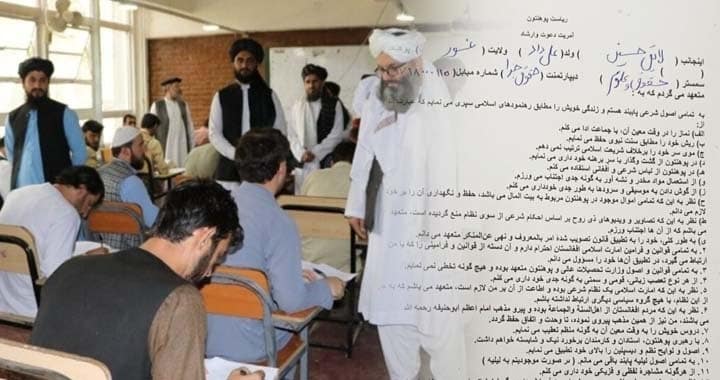
According to reports and documents shown by Amu TV suggest that Taliban authorities have been pressuring more than 10,000 university students in western Afghanistan to sign mandatory religious pledge at gunpoint forms as part of tightened ideological and behavioral controls within higher education institutions.
According to the documents and multiple student accounts, the pledge is being presented as a compulsory requirement at universities including Ghor University, raising concerns over coercion and increasing ideological enforcement on campuses.
The reported 14-point pledge requires students to commit to a set of strict behavioral, social, and religious rules. These include maintaining prescribed grooming standards such as keeping beards, wearing traditional attire including the perahan tunban, and using head coverings in public.
The document further restricts students from listening to music or viewing images of living beings and calls for full compliance with the Taliban’s Law on the Promotion of Virtue and Prevention of Vice, which governs public and private conduct.
Students are also reportedly required to affirm adherence to the Sunni Hanafi school of Islamic jurisprudence and to refrain from association with political groups opposed to the current authorities.
Students interviewed by Amu TV say that pressure to sign the pledge has intensified in recent weeks, with repeated summons and directives issued across university campuses.
One student, speaking anonymously for fear of repercussions, said:
“For more than two years we have been told to follow certain rules, but now we are being called almost every day and told to sign the pledge.”
Another student described the academic environment as increasingly restrictive:
“We no longer feel like university students. Everything is controlled.”
Sources also report that students are being required to attend bi-monthly ideological sessions in which regular academic classes are suspended and replaced with religious instruction aligned with official directives.
According to available information, Dawat wa Irshad departments operate within universities across Afghanistan, overseeing student conduct, organizing ideological programs, and monitoring compliance with prescribed regulations.
Education observers say these structures have significantly expanded their role in campus governance since 2021.
Former academics and education experts have expressed concern that growing ideological enforcement and reported coercion may undermine academic independence and weaken Afghanistan’s higher education system.
Basir Ahmad Daneshyar, a former professor at Herat University, said such measures could have long-term consequences for students.
“Universities should be spaces for learning and intellectual development,” he said. “When compliance and ideology become central, academic freedom is significantly reduced.”
Since 2021, Afghanistan’s education sector has seen major restrictions, including bans on female secondary and higher education in many areas, alongside increased oversight of curricula, faculty, and student life.
Human rights organizations and education analysts have repeatedly warned that expanding ideological controls could contribute to declining academic standards and increased migration of students and professionals.
Afghanistan currently has approximately 40 public universities and more than 100 private institutions, serving over 200,000 students nationwide, according to available data.
The reported requirement for students to sign mandatory pledge forms, combined with allegations of increasing pressure and expanded ideological supervision, has raised serious questions among students and education observers about academic freedom and institutional autonomy in Afghanistan’s higher education system.
Authorities have not yet issued a detailed public response addressing these specific allegations.



