
QUETTA: The arrest of two young girls linked to the banned terrorist organization Balochistan Liberation Army’s suicide network has exposed a disturbing pattern of coercion, blackmail and psychological manipulation being used to recruit vulnerable female students for terrorist attacks.
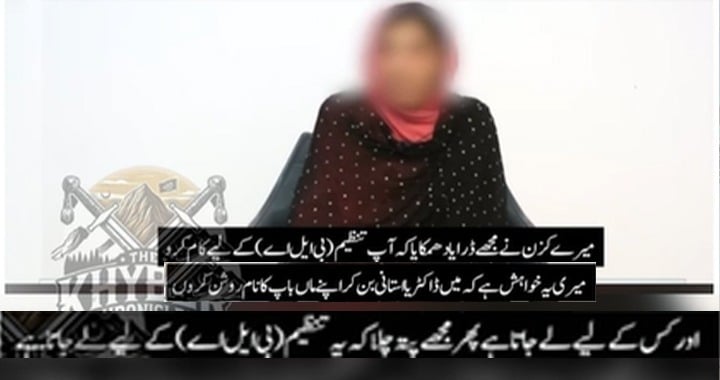
One of the detained women, an F.Sc second-year student from Turbat, revealed during her recorded confession that she had been pressured into joining the BLA’s suicide squad after repeated threats against her family, particularly her elderly father.
According to her statement, her parents were impoverished and elderly, while her younger siblings were still dependent on the family. She said a cousin associated with the terrorist organization repeatedly threatened to kill her father if she refused to cooperate with BLA operatives.
The student stated that she initially complied out of fear, helping by preparing bread and purchasing mobile phone cards for her cousin, without fully knowing where the supplies were being delivered or for whom they were intended. She later discovered that the network was linked to the banned BLA terrorist organization.
She further disclosed that her cousin took her twice to mountainous hideouts where her eyes were blindfolded before meetings with BLA terrorist commanders. There, she said, she was subjected to repeated indoctrination sessions in which stories of previous female suicide bombers were glorified and exaggerated in an attempt to psychologically condition her for a “fidayee” mission.
According to her confession, commanders repeatedly cited women such as Shari Baloch and Samia Baloch, portraying them as heroic figures in order to convince her to follow the same path.
The student said her fiancé attempted to stop her after learning about the matter and warned her to stay away from the cousin involved in the network. Her parents also advised her against maintaining contact with him, fearing additional hardship for the already struggling family.
“My father is a poor driver. He never knew that I remained silent only because I feared for his life,” she stated in her confession, adding that she was slowly dragged onto what she described as a dark path.
She later travelled to Hub for medical treatment related to an ear condition, during which she received further instructions from the network. According to her account, she was told to complete her treatment, spend some time with her parents and then prepare for a suicide mission.
However, she said panic spread through the network after her cousin was arrested. Fearing imminent detention, she destroyed her mobile phone but was later taken into custody by police and shifted to a secure location where, according to her statement, she was treated respectfully.
The student told investigators she subsequently provided information regarding other individuals linked to the network because she never truly wanted to become a suicide bomber.
“I did not want to carry out a ‘fidayee’ attack on my own army or security personnel,” she said. “I was brainwashed, blackmailed and threatened. I never wanted to do this willingly.”
She also appealed to other young people not to become tools of terrorist organizations, warning that terrorism only destroys lives and families.
The student said she loved studying and painting, adding that she dreamed of becoming either a doctor or a teacher in order to serve society and make her parents proud.
“I wanted to study further and become a good human being,” she said. “What I was about to do was wrong. Terrorism is not something good. People should stay away from terrorists.”
Women Turned into Weapons
The case emerged shortly after Balochistan Chief Minister Mir Sarfraz Bugti announced that intelligence agencies had foiled a major terrorist plot by arresting another female suicide bomber tasked with carrying out an attack in Islamabad.
Speaking at a press conference in Quetta alongside the detained woman, the Chief Minister said intelligence agencies acted in time to prevent what could have become a devastating terrorist attack in the federal capital. He stated that the woman had allegedly been prepared and directed for a suicide mission before security agencies neutralized the plot.
Mir Sarfraz Bugti strongly condemned the use of women and young girls by terrorist organizations, stating that such actions were entirely alien to Baloch traditions and values. He said the people of Balochistan believed in education and dignity for women, while terrorist networks sought to exploit vulnerable girls through fear, coercion and intimidation.
Officials further stated that the detained woman would be returned to her family in a lawful and dignified manner, underscoring the state’s position that victims of coercion must be treated with sensitivity.
Security analysts say the two cases reflect an evolving strategy by terrorist organizations attempting to weaponize women for psychological impact, operational concealment and propaganda purposes. They warn that such recruitment patterns indicate a deeper effort by terrorist networks to prey upon vulnerable individuals through emotional pressure, threats and manipulation.
Authorities have reiterated that intelligence-based operations against terrorist networks will continue across the country in order to dismantle extremist infrastructure and prevent attacks targeting civilians and security personnel.



