
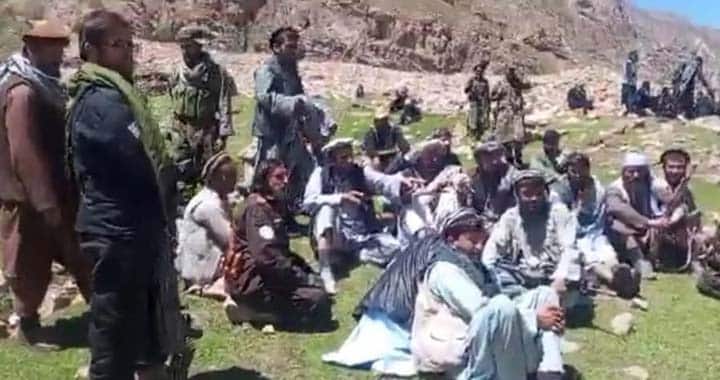
Informed sources report a renewed escalation in Badakhshan’s Jurm district, where Taliban forces have been redeployed from Faizabad, Baharak, and Ashkasham to suppress growing armed opposition in mountainous terrain.
According to local sources, Taliban deputy governor for Badakhshan, Jamaluddin Haqjo, has personally moved into the village of Khostak in Jurm district, particularly the Dara Kalan valley area, to oversee containment operations against what is described as an emerging insurgent presence.
A video reportedly shows Jamaluddin Haqjo accompanied by armed personnel moving through valley routes in Khostak. Sources say he was assigned due to his familiarity with the district’s tribal and geographic complexity.
Local accounts indicate that at least 30-armed opponents have taken positions in elevated terrain over recent days. These groups are said to have declared open opposition to Taliban control, with additional individuals reportedly joining them in recent days.
The current mobilization reflects a broader pattern of unrest in Badakhshan that has developed over the past year. In May 2025, violent confrontations were reported in Shahran, Khash district, when farmers resisted a Taliban anti-narcotics campaign targeting poppy fields. Protesters set fire to at least three government tractors, triggering armed clashes and prompting Taliban helicopter deployments over Khash and nearby Jurm.
By June 2025, the situation escalated further when protests over poppy eradication in Khash turned deadly. At least eight civilians, including a woman and a young girl, were killed and 27 others injured following clashes with Taliban forces. Dozens of individuals, including local elders and protest organizers, were arrested and transferred to the provincial capital.
In July 2025, according to documented reporting and local accounts, Taliban counternarcotics operations across Argo, Jurm, and Khash districts triggered widespread resistance. Protesters reportedly set fire to government equipment and blocked roads, prompting a temporary suspension of eradication efforts and communications restrictions in affected areas. At least twelve civilians were killed during these incidents, with multiple others wounded.
In November of the previous year, Badakhshan had already witnessed violent confrontations linked to poppy eradication drives and local resistance movements. These incidents included fatalities, arrests, and repeated clashes between rural communities and Taliban enforcement units, highlighting long-standing tensions over economic survival and governance practices. During this period, the Taliban also urged the United Nations not to comment on or monitor public protests in Badakhshan related to poppy eradication campaigns, reflecting heightened sensitivity over international scrutiny of local unrest.
Across all phases, the underlying drivers remain consistent: destruction of poppy crops without alternative livelihoods, removal of local power structures, expansion of enforcement campaigns, and allegations of coercive behavior by Taliban units. These factors have repeatedly triggered cycles of protest and armed resistance across multiple districts, particularly Khash and Jurm.
Badakhshan has therefore remained one of the most persistent centers of anti-Taliban unrest since 2021, with overlapping layers of economic grievance, local armed mobilization, and shifting control dynamics between rural communities and central authority.
Despite repeated Taliban operations to reassert control, the province continues to experience intermittent clashes, shifting alliances, and renewed mobilization in mountainous districts.
As of the latest developments in Jurm, armed positioning in high-altitude terrain and continued Taliban reinforcement suggest that the current phase of confrontation remains active and unresolved.



