
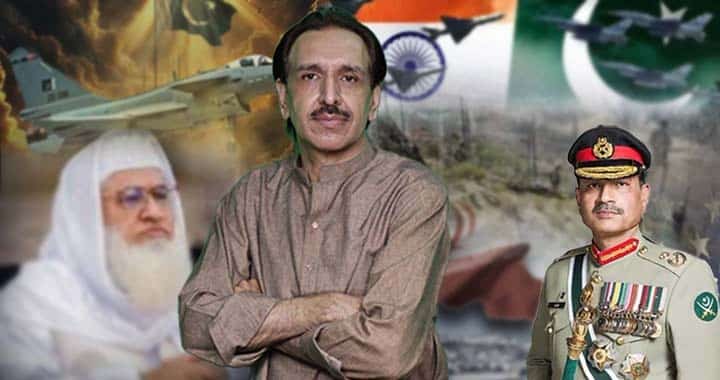
As far as I see it, Pakistan gained from Marka-e-Haq and lost nothing. There is an old doctrine in strategic thinking that wars, despite destruction, also create opportunities. Everything depends on whether a nation’s leadership possesses the vision and courage to convert conflict into strategic advantage.
In my opinion, Pakistan’s military and political leadership succeeded in doing exactly that.
Before May 2025, very few people could have imagined where Pakistan would stand one year later. But today, after Marka-e-Haq and Operation Bunyan al-Marsoos, Pakistan is being discussed differently across the world, militarily, diplomatically, and psychologically.
The first and most visible impact emerged in the defence sphere. Pakistan demonstrated that numerical superiority alone does not guarantee dominance. India possessed larger numbers in multiple domains, larger armed formations, bigger economic capacity, and broader international lobbying networks. Yet Pakistan’s response in a multi-domain environment altered the regional perception of power.
The professionalism shown by Pakistan’s armed forces, particularly the Pakistan Air Force, became a major discussion internationally. The briefings shared with international media, the operational details released afterward, and the broader acknowledgment of Pakistan’s aerial capabilities all contributed toward strengthening Pakistan’s strategic image globally.
At the same time, Pakistan’s military leadership projected confidence, discipline, and clarity during the conflict. This matters because wars are not fought through weapons alone. They are also fought through command structures, morale, communication, and psychological positioning.
I believe another major outcome of Marka-e-Haq was regional realignment.
Soon after the India-Pakistan confrontation, the Middle East entered another dangerous phase because of escalating tensions involving Iran, Israel, and the United States. There were fears that the region could slide toward a much wider conflict. In that situation, Pakistan’s diplomatic role became extremely important.
President Trump himself acknowledged that requests from Pakistan and several other countries contributed toward restraining further escalation. China, Pakistan, and Russia all appeared engaged in efforts aimed at stabilizing the regional environment. This was not a minor diplomatic development.
For years, Pakistan was often discussed internationally only through the lens of instability or security concerns. But after these developments, Pakistan increasingly began appearing as a stabilizing actor capable of military deterrence and diplomatic engagement simultaneously.
I personally observed another important change during interactions abroad.
Whether in Europe, North America, or elsewhere, overseas Pakistanis increasingly spoke about receiving greater respect after Marka-e-Haq. People often underestimate how important national perception becomes for citizens living outside their homeland. Inside Pakistan, we criticize our governments, politicians, and institutions regularly, and that is natural. But abroad, the respect attached to your country directly affects how you are perceived.
This psychological shift matters.
Pakistan’s success, however, was not accidental. It came from difficult decision-making.
When military planners evaluate conflict, they compare numbers relentlessly, aircraft strength, troop formations, economic endurance, technological depth, and strategic vulnerabilities. India possessed advantages in several conventional areas. Yet Pakistan’s leadership under Field Marshal Syed Asim Munir displayed confidence in its preparation, doctrine, and operational capability.
That confidence translated into action.
Pakistan defended itself, responded forcefully, and demonstrated that it possessed escalation capability beyond what many expected. Statements from officials, including Mohsin Naqvi and DG ISPR Lieutenant General Ahmed Sharif Chaudhry, reinforced that message repeatedly.
According to the details shared publicly, Pakistan not only intercepted and countered hostile actions but also demonstrated the ability to penetrate sensitive Indian zones through missile and drone capabilities. Discussions around operations targeting strategic military sites, drone reach near sensitive Indian locations, and aerial engagements collectively reinforced Pakistan’s deterrence posture.
The broader message was unmistakable: Pakistan understands the changing nature of warfare.
Modern conflict is no longer limited to tanks and conventional battlefield formations. Today’s wars involve cyber capability, drones, intelligence coordination, missile systems, narrative warfare, and technological integration across land, air, sea, and information spaces simultaneously.
That is why Pakistan’s strategic posture after Marka-e-Haq appears far more confident today.
At the same time, however, another dangerous arc has continued developing alongside these successes, the internal and regional security challenge linked to Afghanistan and ISKP.
This became painfully visible after the assassination of Sheikh Idrees in Charsadda.
In my view, whenever such incidents occur, the objective is rarely limited to killing one individual. The purpose is to spread fear, create instability, and disrupt fragile balances inside society.
ISKP fits exactly within that pattern.
Unlike some other organizations, Daesh Khurasan does not necessarily operate through overwhelming numbers. Instead, it focuses on symbolic, high-impact attacks designed to generate maximum political and psychological consequences.
The attack on Sheikh Idrees was one such operation.
Initially, many actors came under suspicion because Sheikh Idrees reportedly played a role in efforts aimed at reducing tensions between Pakistan and Afghanistan. But later, ISKP claimed responsibility, consistent with its long-standing pattern of targeting influential religious personalities and symbolic gatherings.
We have seen this before.
The Bajaur JUI-F workers’ convention bombing, attacks on religious scholars, sectarian violence, and assaults on symbolic targets all reflect a broader extremist strategy. ISKP wants instability. It wants polarization. It wants the collapse of any middle ground capable of producing dialogue.
Sheikh Idrees was precisely the kind of personality who represented that middle ground.
He was not merely a religious scholar. He was an influential political and social figure, respected even by ideological opponents. In Charsadda, personalities linked to entirely different political traditions acknowledged his stature.
He maintained relationships across divides and carried himself with unusual humility.
Honestly, people who met him often described him as an angel-like person.
His conduct, his tone, his ability to engage others without hostility, these qualities made him influential beyond ordinary politics. That is why his elimination carries implications extending far beyond one assassination.
At the time of his killing, limited but meaningful efforts toward Pakistan-Afghanistan de-escalation were also underway.
There had been local understandings involving tribal elders in border regions such as Bajaur, Mohmand, and Kunar. Religious delegations and informal channels were trying to reduce tensions. In environments where formal diplomacy often struggles, religious scholars sometimes succeed because they possess credibility inside communities.
Sheikh Idrees reportedly played a role within this broader atmosphere.
That is why his assassination should not be viewed separately from the wider regional picture.
I also believe Pakistan has suffered heavily from ISKP violence, despite repeated propaganda attempting to portray the issue differently. Pakistan has targeted Daesh extensively, and Pakistan itself has remained among the biggest victims of ISKP-linked terrorism.
The organization has repeatedly targeted scholars, religious gatherings, and sectarian communities.
At the same time, concerns regarding extremist safe havens and transnational networks inside Afghanistan continue complicating the situation further. Pakistan’s position, reiterated repeatedly through military forums such as the Corps Commanders’ Conference, remains that Pakistan’s conflict is not with the Afghan people but with terrorist groups using Afghan territory against Pakistan.
This distinction is extremely important.
However, alongside the regional dimension, the assassination also exposed serious governance failures inside Khyber Pakhtunkhwa.
If a personality already facing threats can move without meaningful protection, then questions naturally arise regarding the priorities of the provincial administration.
I say this very clearly: when ordinary social media influencers and politically connected personalities receive elaborate protocol, while genuinely threatened religious leaders remain exposed, public frustration becomes inevitable.
In my opinion, administrative negligence also became part of this tragedy.
If authorities already knew Sheikh Idrees faced threats, why was proper security not provided? These are legitimate questions.
The reaction after his assassination showed how deeply respected he was.
The President, Prime Minister Shehbaz Sharif, Field Marshal Asim Munir, governors, chief ministers, and senior religious and political figures, including Maulana Fazl-ur-Rehman, all strongly condemned the attack. Messages of solidarity emerged from across the Muslim world as well.
But beyond condolences lies another reality many people fail to understand.
Across Pakistan, especially in Khyber Pakhtunkhwa and Balochistan, massive madrasa networks remain connected with JUI-F. Every year, millions of students graduate from seminaries across the country, and a substantial number belong to institutions ideologically aligned with the party.
Despite repeated provocations, attacks on scholars, political grievances, and growing frustration, Maulana Fazl-ur-Rehman has continued showing restraint.
And frankly speaking, Pakistan should recognize the importance of that restraint.
Because if such networks are ever mobilized emotionally and politically after incidents like Sheikh Idrees’ assassination, the consequences would extend far beyond ordinary political agitation. The state machinery, policing structures, and provincial administration would come under extraordinary pressure.
This is why protecting influential, moderating, and bridge-building personalities is not merely a security matter. It is directly linked to national stability.
Ultimately, the situation Pakistan faces today is layered and interconnected.
On one side, Marka-e-Haq strengthened Pakistan’s strategic confidence, military credibility, and diplomatic standing. On the other, forces of destabilization continue attempting to sabotage internal cohesion, regional peace efforts, and social balance through terrorism and targeted violence.
That is why Sheikh Idrees’ assassination should not be treated as an isolated incident.
iWhen influential voices capable of reducing tensions are systematically removed from the scene, and when extremist groups deliberately target personalities who can bridge divides, then the pattern becomes impossible to ignore.



