
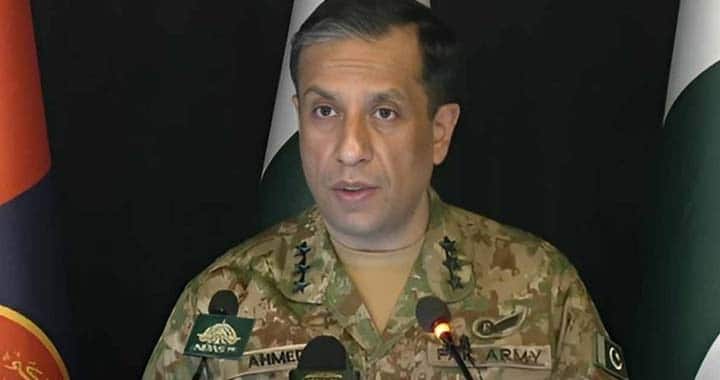
On the first anniversary of Marka-e-Haq, the role of Director General Inter-Services Public Relations (DG ISPR) Lieutenant General Ahmed Sharif Chaudhry in articulating Pakistan’s national position during the crisis has been widely acknowledged as a defining example of strategic communication under conflict conditions.
Throughout the escalation triggered by what Pakistan described as unprovoked Indian aggression during the night of 6/7 May 2025, the DG ISPR consistently conveyed the national stance with clarity, confidence, and resolve, ensuring that both the Pakistani public and the international community remained informed on developments as they unfolded.
Observers note that during Marka-e-Haq, Pakistan effectively demonstrated that national resolve was not limited to rhetoric alone. Through calibrated strategic communication and decisive operational actions, the country reinforced the message that its commitments were backed by capability, preparedness, and action.
In his initial response to the Indian strikes, Lieutenant General Ahmed Sharif Chaudhry stated that India had launched a “cowardly and shameful attack” from within its own territory against Pakistan and warned that a timely, effective, and forceful response would follow.
He emphasized at the time that Pakistan’s response would be so decisive that the adversary’s “temporary celebration would turn into lasting regret.” The statement quickly gained widespread national and international attention and came to symbolize Pakistan’s determination during the conflict.
The DG ISPR further stated that Indian actions had deliberately targeted civilian populations without provocation or justification and reiterated that Pakistan reserved the right to respond at a time, place, and manner of its own choosing.
Addressing the nation during the crisis, Lieutenant General Ahmed Sharif Chaudhry remarked that the adversary had chosen to target innocent civilians under the cover of darkness instead of confronting military forces directly. He assured the nation that every drop of innocent blood would be accounted for and reaffirmed Pakistan’s commitment to safeguarding its sovereignty and territorial integrity at all costs.
In one of the most widely cited moments during the conflict, the DG ISPR declared that when Pakistan responded, there would be no need for media speculation or explanation because “the entire world would witness it.” He further stated that Pakistan was not a nation that could be intimidated by aggression, military pressure, or strategic coercion.
Analysts describe these statements as historically significant in shaping public confidence, maintaining national unity, and projecting strategic clarity during a period of heightened regional tension. The messaging was viewed as a critical component of Pakistan’s broader response framework during Marka-e-Haq, complementing operational preparedness with information dominance and psychological resilience.
Security observers note that the communication strategy adopted during the conflict reflected a deliberate effort to maintain transparency, manage escalation responsibly, and reinforce deterrence without compromising operational credibility.
The statements issued by the DG ISPR during the conflict have since become associated with Pakistan’s broader narrative of national unity, resilience, and strategic confidence in the face of external aggression.
As the nation marks one year of Marka-e-Haq, the role of strategic communication in shaping both domestic morale and international perception remains widely recognized as a significant element of Pakistan’s response during one of the most consequential military episodes in recent regional history.



