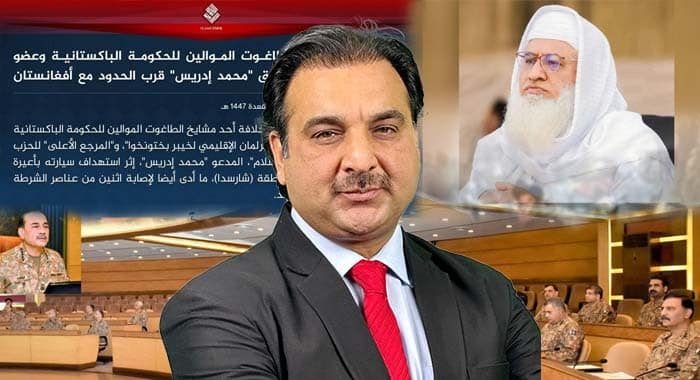
(Irfan Khan)
In South Asia’s already complex security landscape, moments of official high-level deliberation often become more than routine bureaucratic exercises they become signals, interpretations, and sometimes, battlegrounds of perception. The recent Corps Commander Conference in Pakistan, coupled with the ongoing investigation into the assassination of a religious scholar, Maulana Muhammad Idrees, has triggered exactly such a moment. What is unfolding is not only a story of security policy and counterterrorism, but also a deeper struggle over narratives, accountability, and regional trust particularly between Pakistan and Afghanistan.
At the center of this evolving situation are two parallel developments: first, a high-level military deliberation reportedly focused on Pakistan’s internal security challenges and its tense relationship with Afghanistan; and second, the early-stage investigation into the targeted killing of Maulana Muhammad Idrees, which has already become entangled in competing claims, social media speculation, and geopolitical insinuations.
Together, these developments reveal a country navigating a volatile intersection of militancy, political polarization, and regional mistrust—where facts, interpretations, and political messaging are often indistinguishable in the public domain. The Corps Commander Conference, described in official framing as routine, is widely understood as one of the most significant military deliberation forums in Pakistan’s security architecture. According to accounts circulating in public discourse, the latest session reportedly addressed two major themes: the evolving security situation following recent militant incidents, and Pakistan’s strained relationship with Afghanistan amid ongoing cross-border tensions.
While the internal details of such conferences are not publicly disclosed in full, the messaging attributed to it reflects a familiar strategic posture: that Pakistan’s security forces remain committed to countering militancy and that any threats emanating from across the border will be met with decisive responses. Afghanistan, in particular, appears to have been a focal point. The discussion, as reported in public commentary, emphasized concerns over militant sanctuaries allegedly operating within Afghan territory. The broader assertion is that Pakistan’s counterterrorism operations have contributed to a decline in militancy domestically, but that residual threats persist due to cross-border safe havens and transnational militant mobility.
The tone attributed to this discourse reflects a hardened strategic stance one that signals continuity in counterterrorism operations and a willingness to escalate responses if attacks continue. It also underscores an increasingly familiar theme in Pakistan’s security narrative: that internal peace is inseparable from regional stability, especially in Afghanistan. However, such positions also carry diplomatic weight. Statements or perceptions of cross-border blame often complicate already fragile relations with Kabul, where the Afghan Taliban-led administration rejects allegations of allowing its territory to be used by militant groups targeting Pakistan. This divergence of narratives remains one of the most persistent obstacles to regional de-escalation.
Parallel to the strategic discourse, Pakistan is grappling with the aftermath of a high-profile killing the assassination of Maulana Muhammad Idrees, a religious scholar whose death has drawn widespread attention and strong reactions. According to early-stage police investigation reports referenced in media discourse, the attack appears to have been carried out by armed individuals on motorcycles. The method described suggests a coordinated target killing operation, with CCTV footage reportedly playing a crucial role in reconstructing the sequence of events. Initial accounts indicate that the attackers followed the victim’s movements for a period of time before executing the attack. Surveillance evidence is said to have captured aspects of their movement and possibly their identities, though authorities have not publicly confirmed full details at this stage.
What has intensified public debate, however, is the proliferation of competing narratives around the incident. Some unverified claims circulating online suggest involvement of organized militant networks, while others introduce geopolitical speculation involving foreign intelligence agencies or cross-border facilitation. These claims remain part of the informational fog that often surrounds politically sensitive killings in the region. At this early stage, law enforcement agencies have reportedly expanded their investigation to trace communication networks, logistical support structures, and possible facilitators. Yet, as is often the case in such high-profile cases, the gap between investigation and public expectation is already being filled by speculation.
One of the most striking dimensions of both developments the military conference and the assassination is not confined to institutions but plays out aggressively in the digital sphere. Social media platforms have become arenas where interpretations of the killing and the security response are rapidly constructed, contested, and weaponized. Competing political narratives have emerged, with different groups attributing responsibility or ideological motivation based on pre-existing political alignments rather than verified evidence. This environment has created a feedback loop: unverified claims gain traction, prompting counter-claims, which in turn deepen polarization. In such a climate, even official investigative ambiguity becomes politically charged.
Reports circulating in public commentary suggest that online accounts affiliated with various political and ideological groups have reacted sharply to the assassination some condemning it, others allegedly justifying or contextualizing it within broader political grievances. These reactions further complicate the already sensitive investigative environment. The danger in such scenarios is not merely misinformation, but the erosion of trust in institutional processes. When every incident becomes a proxy for political conflict, the space for neutral investigation shrinks significantly.
Afghanistan’s role in Pakistan’s security discourse remains one of the most sensitive geopolitical fault lines in the region. The allegations repeated in various official and semi-official narratives that militant groups operate from Afghan soil continue to be strongly denied by Kabul. The Afghan Taliban administration maintains that it does not permit its territory to be used against any country. Pakistan, however, continues to express concerns over cross-border attacks and militant regrouping. This divergence has led to a cycle of mistrust, where security incidents inside Pakistan are often interpreted through a cross-border lens, and diplomatic engagement struggles to overcome the weight of security grievances.
The reported discussions at the Corps Commander Conference reflect this enduring tension: a belief that militancy cannot be fully addressed without addressing external sanctuaries, and a counter-position that such claims risk oversimplifying a deeply fragmented regional security environment. The result is a strategic stalemate—where both sides articulate security concerns, but mutual trust remains limited. The convergence of a high-profile assassination, heightened military messaging, and intense social media speculation creates a volatile environment. In such contexts, three risks become particularly pronounced.
First, investigative processes risk being overshadowed by narrative competition. When conclusions are drawn prematurely in public discourse, the integrity of legal processes can be compromised. Second, regional tensions may escalate if attribution of responsibility becomes politicized before evidence is fully established. In South Asia, historical experience shows that perception often moves faster than verification. Third, internal political polarization may deepen if competing groups use the incident to advance broader political arguments, further complicating consensus on national security priorities.
What emerges from this moment is not a single story, but multiple overlapping realities: a military establishment signaling strategic resolve; law enforcement agencies pursuing a complex investigation; political and ideological actors interpreting events through competing frameworks; and a region struggling to stabilize long-standing fault lines. The assassination of Maulana Muhammad Idrees remains under investigation, and definitive conclusions must rest with credible judicial and forensic processes. Similarly, the strategic messaging attributed to the Corps Commander Conference reflects a broader security doctrine shaped by years of counterterrorism challenges, regional instability, and evolving threats. Yet beyond the specifics, the deeper issue is structural: a region where security, politics, and information are tightly interwoven, often to the point where separating fact from interpretation becomes increasingly difficult.
If there is a lesson in this unfolding situation, it is that stability depends not only on operational responses to security threats, but also on restraint in narrative construction, transparency in investigation, and diplomacy grounded in verification rather than assumption. Without these, every incident risks becoming not just a tragedy or a policy discussion—but another accelerant in an already volatile regional equation.