
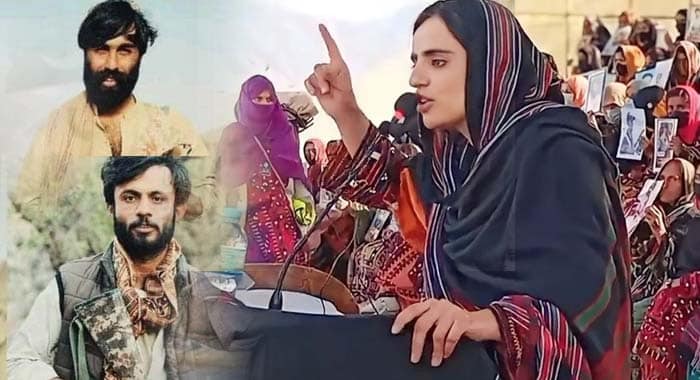
The latest exposure of two so-called “missing persons”, mourned by so-called human rights activists, as active commanders of the banned Balochistan Liberation Army (BLA) is not an isolated contradiction; it is part of a well-documented and recurring pattern that has unfolded over the past year.
The crux lies in how the “missing persons” narrative has repeatedly intersected with militancy, often collapsing under the weight of subsequent evidence.
Last year, one of the earliest major cracks appeared in a case widely amplified by the Baloch Yakjehti Committee (BYC), where Abdul Wadood Satakzai was projected as a victim of enforced disappearance for years. That narrative unraveled when the BLA itself declared him a key commander of its Majeed Brigade, directly involved in deadly attacks and suicide missions. What was presented as a human rights case was ultimately exposed as a cover for active participation in terrorism.
The same pattern deepened further in subsequent months. Investigations revealed that individuals like Asif Baloch, long cited as “missing,” were in fact present inside militant camps of the Baloch Liberation Front, operating freely and even appearing alongside senior terrorist leadership. Visual evidence directly contradicted years of advocacy claims.
Other cases followed in quick succession. Names such as Suhaib Langov, Raziq Nechari, Qadir Bakhsh Kurd, and Shabbir Baloch surfaced from so-called missing lists only to be confirmed as active militants, many of them eliminated in counterterror operations. In several instances, the militant organizations themselves acknowledged their roles, leaving little room for ambiguity.
Even more striking is the scale suggested by security assessments, which indicate that a significant proportion of BLA operatives killed in recent years had previously been listed as “missing persons.” This raises serious concerns about whether these narratives stem from misinformation, lack of verification, or deliberate obfuscation.
A Pattern Too Consistent to Ignore
When viewed collectively, these cases reveal a consistent structure.
First, an individual is declared “missing,” often amplified through advocacy platforms and social media. Public sympathy builds, and allegations against state institutions gain traction. Then, over time, the same individual reappears, not in detention, but in militant ranks, sometimes armed, sometimes leading, and often ultimately eliminated in combat.
This cycle does more than distort facts, it reshapes the information environment.
For terrorist groups like the BLA, such narratives serve as a strategic asset. They provide moral cover, aid recruitment, and complicate counterterrorism messaging. For advocacy fronts, whether knowingly or otherwise, the repetition of unverified claims risks eroding credibility with each exposure.
Another dimension is the exploitation of vulnerability. Several documented cases show how young individuals, including minors, were recruited, indoctrinated, and transformed into operational assets. Yet, when these same individuals are later presented as victims, the reality of their radicalization is obscured.
The consequences extend beyond narrative battles. Genuine cases of enforced disappearance risk being overshadowed by disputed or false claims, making it harder for real victims to receive attention and justice.
The latest case of the two students follows this exact trajectory. Once listed as missing, later found in militant strongholds, and finally confirmed as armed commanders.
The pattern is no longer anecdotal, it is cumulative.
And with each new exposure, the central question grows sharper, whether the “missing persons” narrative is being systematically manipulated to shield terrorism, or whether it has become an instrument where truth is the first casualty.



