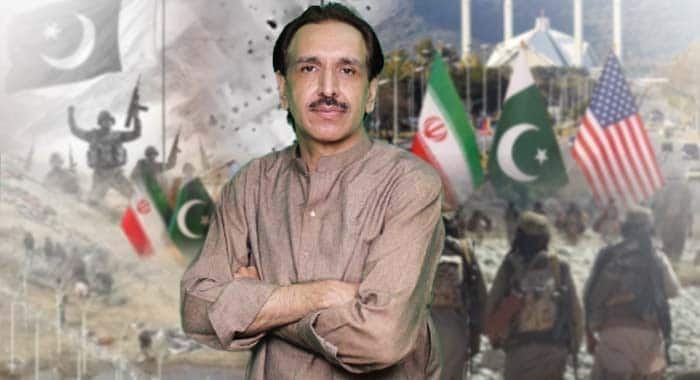
Well, one or two days ago, you must have noted that in South Waziristan, in two or three locations, especially in Angoor Adda and nearby areas, there was mortar shelling from across the border. A drone attack was also carried out. Not only were security forces targeted, which was foiled by the forces, but a house was also hit, where five people, including three children, were injured. One of them remains in critical condition and was shifted to Peshawar.
In response, strong actions emerged from the Pakistani military establishment. The basic reason lies in what preceded this. From the Afghan media and its aligned voices, particularly regarding an earlier incident in Kunar, a large propaganda campaign was launched, claiming that Pakistan had targeted a university, resulting in casualties. Yet, no evidence, not even a single image of an injured person, was presented. Claims of deaths were made, but without proof.
When such narratives are constructed for political point scoring, they become events in themselves. In contrast, Pakistan’s response was grounded in what it viewed as credible threats. Following the shelling and cross-border aggression, Pakistan targeted specific locations across the border in Nangarhar and Paktika.
In Nangarhar, whose capital is Jalalabad and which lies opposite Torkham, there were clear reports of casualties, supported by available footage. These were not populated civilian zones but mountainous areas where certain camps existed. Afghan media itself had earlier shared videos of these locations, and those same camps were later targeted.
Similarly, in Kunar, further strikes were carried out, while in Paktika, particularly across from South Waziristan, additional targets were engaged. Over the span of roughly 24 hours, Pakistan carried out operations against militants across three districts.
Now, regarding the so-called talks in Istanbul, there is significant confusion. What is being described as negotiations is, in reality, a routine seminar. Istanbul hosts numerous such events focused on South Asia, Central Asia, and Europe. This particular gathering includes participants from multiple countries, including Pakistan, Afghanistan, and China.
The presence of individuals such as journalists or senators does not transform a seminar into formal negotiations. Yet, segments of Afghan media have portrayed it as a Pakistan–Afghanistan dialogue process. This is misleading. It is not a structured negotiation, nor does it carry the framework of diplomatic engagement.
Such misrepresentation feeds into a broader pattern of disinformation. Similar claims were made about past meetings in Urumqi, Kabul, and elsewhere, often accompanied by exaggerated or entirely fabricated outcomes. The reality is that no such formal talks are currently underway.
The same pattern appears in claims about a Kandahar meeting allegedly led by the Afghan Taliban leadership, where action against TTP was supposedly decided. There was no such meeting, and no such decision. These reports fall into the category of fabricated narratives.
From what is understood, any meeting in Kandahar was related to internal organizational matters. Discussions were limited to administrative changes, including renaming institutions or restructuring departments. There was no operational decision regarding action against terrorist groups.
On the question of Al-Qaeda, however, the situation is different. This information holds credibility. Current estimates suggest that between 2,600 to 3,500 Al-Qaeda members are present in Afghanistan. International reports, including those referenced by global intelligence assessments, place the figure around 3,000.
Al-Qaeda’s historical and operational linkages with the Afghan Taliban are well established. This is not a new alliance. Whenever required, Al-Qaeda has functioned as a supporting structure within broader militant frameworks.
Recent movements of key figures, including Saif ul Adl, further indicate regrouping and renewed operational positioning. His reported presence across Iran, Kandahar, Kabul, and possibly Nangarhar reflects a fluid but active network.
Al-Qaeda’s stance toward Pakistan has long been hostile. Its post-9/11 narratives explicitly framed Pakistan as a target. Given its financial strength and transnational reach, any renewed activity along the Pakistan border raises serious concerns.
Recent statements and alignments reinforce fears that Afghanistan could once again become a hub for international terrorist groups. Even global voices have begun acknowledging this trend, adding to the gravity of the situation.
Turning to Khyber Pakhtunkhwa, the internal security environment remains deeply concerning. Official reports indicate significant casualties, including civilians and security personnel, over recent months. The scale of losses underscores the seriousness of the threat.
Despite this, political distractions continue to dominate. Jirgas and protests, often driven by political motives, fail to address the structural issues at hand. Instead of actionable governance, there is a tendency toward symbolic gestures.
The lack of alignment between provincial and federal priorities further complicates the response. Counterterrorism requires coherence, clarity, and commitment, not fragmentation.
At the same time, regional dynamics are shifting. Developments involving Iran, the United States, and broader diplomatic engagements may influence the trajectory of events. There are also emerging indications of possible actions against TTP, though their credibility remains to be seen.
If all this is happening, then what is Pakistan going to do, this is something people will know in the next few days.